JEE PYQ: Motion in a Plane - Question ID fb36b1e0847a (JEE Main 2021)
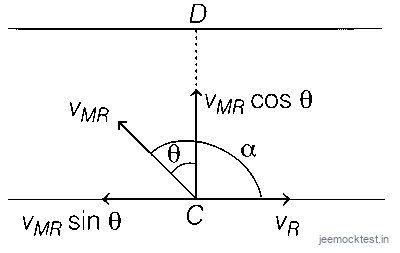
Your Answer
Step-by-step Explanation
In problems involving relative motion in a plane, we decompose velocities into components parallel and perpendicular to a reference direction (here, the river flow). The key idea is:
- The swimmer’s resultant velocity is the vector sum of his velocity relative to the water and the water’s velocity .
- To reach the point directly opposite the starting point, the net displacement perpendicular to the river flow must equal the river’s width, while the net displacement parallel to the flow must be zero.
- Mathematically, if the swimmer swims at an angle upstream (measured from the direction of river flow), his velocity components are: where is along the river flow and is perpendicular to it.
- The river’s velocity is purely along :
- The resultant velocity is:
- For zero net displacement along the river (i.e., reaching the point directly opposite), the -component of must be zero:
Step 1: Convert velocities to consistent units (km/h is acceptable here).
Given:
Step 2: Set up the condition for zero net displacement along the river.
For the swimmer to reach the point directly opposite, the resultant velocity along the river (-direction) must be zero:
Substitute the given values:
Step 3: Solve for .
Step 4: Find the angle .
The angle whose cosine is is:
This is the angle measured from the direction of river flow (i.e., the swimmer must swim upstream relative to the river’s flow).
Step 5: Verify the perpendicular component.
The -component of the swimmer’s velocity is:
This ensures the swimmer crosses the river perpendicularly while compensating for the river’s flow.
Step 6: Round to the nearest integer.
The angle is already an integer: .
- Misinterpreting the angle’s reference: Students often measure the angle from the perpendicular to the riverbank instead of the river’s flow direction. The question specifies "with respect to the direction of flow," so the angle must be measured from the river’s velocity vector.
- Sign errors in velocity components: Forgetting that the swimmer must swim upstream (negative -component) leads to incorrect angles like . Always ensure the resultant -component is zero or opposite to the river’s flow.
- Unit consistency: While km/h is acceptable here, ensure all velocities are in the same units if conversions are needed (e.g., m/s).
- Inverse cosine range: has two solutions in : and . Only is physically meaningful (swimming upstream).
Related Questions from Motion in a Plane
Two identical bodies, projected with the same speed at two different angles cover the same horizontal range . If the time of flight of these bodies are 5 s and 10 s , respectively, then the value of is
m. (Take )
At , a body of mass 100 g starts moving under the influence of a force After 2 s its position is . The ratio is .
If and coordinates of a projectile as a function of time are given as and , respectively, then the angle (in degrees) made by the projectile with horizontal when is .
The two projectiles are projected with the same initial velocities at the and with respect to the horizontal. The ratio of their ranges is . The value of is