JEE PYQ: Motion in a Plane - Question ID d0148f71eabb (JEE Main 2026)
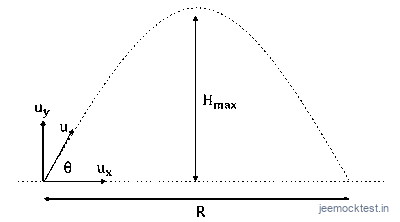
The two projectiles are projected with the same initial velocities at the and with respect to the horizontal. The ratio of their ranges is . The value of is
Select Option
Step-by-step Explanation
This problem deals with the fundamental concept of projectile motion. When a projectile is launched with an initial velocity at an angle with respect to the horizontal, its trajectory is parabolic under the influence of gravity, assuming air resistance is negligible. One of the key parameters describing this motion is the horizontal range, which is the total horizontal distance covered by the projectile before it returns to the same horizontal level from which it was launched. The formula for the horizontal range () of a projectile is given by: where:
- is the initial speed of projection.
- is the angle of projection with the horizontal.
- is the acceleration due to gravity.
Step-by-Step Derivation:
Let the initial velocity for both projectiles be . The acceleration due to gravity is . For the first projectile: The angle of projection is . Using the range formula, its range will be: For the second projectile: The angle of projection is . Using the range formula, its range will be: Now, we need to find the ratio of their ranges, . Notice that the term is common in both the numerator and the denominator, so it cancels out. We know the standard trigonometric values: Substitute these values into the ratio: The problem states that the ratio of their ranges is . So, we have: Comparing this with our calculated ratio: Therefore, the value of is: This matches option B.
Common Traps & Exam Tip:
1. Missing the in the formula: A very common mistake is to directly use instead of in the range formula. If one were to use and directly, the result would be incorrect. Always remember that the range formula involves the sine of *twice* the projection angle. 2. Incorrect Trigonometric Values: Errors in recalling or calculating the values of or can lead to the wrong answer. It's crucial to be proficient with these standard angles. 3. Assumptions about and : While the problem explicitly states "same initial velocities," sometimes students might accidentally consider them different. Always carefully read the problem statement to identify constants and variables. is always constant for a given location. 4. Complementary Angles: Remember that the range is the same for projection angles and (e.g., and , or and ). While this concept is not directly applied here (as and are not complementary, nor are and ), it's a related property of projectile motion that can sometimes lead to confusion if misapplied. Here, and *are* complementary angles, which means , and this is why their sines are directly related (). To avoid these traps, always write down the correct formula, substitute values carefully, and double-check your trigonometric calculations.
Related Questions from Motion in a Plane
Two identical bodies, projected with the same speed at two different angles cover the same horizontal range . If the time of flight of these bodies are 5 s and 10 s , respectively, then the value of is
m. (Take )
At , a body of mass 100 g starts moving under the influence of a force After 2 s its position is . The ratio is .
If and coordinates of a projectile as a function of time are given as and , respectively, then the angle (in degrees) made by the projectile with horizontal when is .
A boy throws a ball into air at from the horizontal to land it on a roof of a building of height . If the ball attains maximum height in 2 s and lands on the building in 3 s after launch, then value of is m.