JEE PYQ: Motion in a Plane - Question ID f5d339fc0d21 (JEE Main 2026)
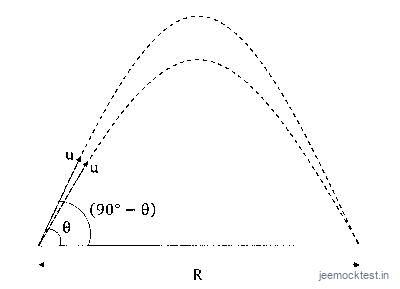
Two identical bodies, projected with the same speed at two different angles cover the same horizontal range . If the time of flight of these bodies are 5 s and 10 s , respectively, then the value of is
m. (Take )
Select Option
Step-by-step Explanation
Greetings, future engineers! This problem tests your fundamental understanding of projectile motion, specifically the relationship between time of flight and horizontal range for different projection angles.
Core Formula & Concept:
In projectile motion, when a body is launched with an initial speed at an angle with the horizontal, the key kinematic equations for its motion are:
- Time of Flight (T): The total time the projectile remains in the air.
- Horizontal Range (R): The total horizontal distance covered by the projectile.
A critical concept to remember here is that for a given initial speed , the horizontal range remains the same for two complementary projection angles. That is, if a projectile is launched at an angle , it will have the same range as a projectile launched at an angle , provided the initial speed is the same for both.
Let the two different angles of projection be and . Since the problem states that the bodies are projected with the same speed and cover the same horizontal range , it implies that these angles must be complementary. Therefore, we can write:
Step-by-Step Derivation:
Let the initial speed be . The two angles of projection are and . Since they yield the same range for the same speed , we infer that .
1. Write down the expressions for the time of flight for each body:
For the first body, with time of flight s and projection angle :
For the second body, with time of flight s and projection angle . Since , we can write:
Using the trigonometric identity :
2. Now, consider the expression for the horizontal range :
The range for either projectile (since it's the same for both) is given by:
3. Multiply Equation 1 and Equation 2:
Multiplying the left-hand sides and right-hand sides of Equation 1 and Equation 2 gives us a direct relationship to :
4. Relate the product to the range :
Notice that the expression for is . We can rewrite the product obtained in the previous step to isolate :
Substituting into this equation:
5. Solve for :
Rearranging the equation to solve for :
6. Substitute the given value of :
Given :
Thus, the value of the horizontal range is 250 m.
The correct option is A.
Common Traps & Exam Tip:
- Forgetting Complementary Angles: A frequent mistake is to overlook the property that two different angles giving the same range implies they are complementary. If this property is not recognized, students might attempt to solve for and separately, which is possible but significantly more complex and time-consuming, increasing the chances of errors.
- Trigonometric Identity Errors: Confusion between and or mishandling of can lead to incorrect derivations. Always be precise with your trigonometric identities.
- Directly Calculating and : While one could solve for and individually from the two time of flight equations (by squaring and adding or dividing), this is an indirect path. The elegant solution lies in recognizing the relationship , which is directly derived by multiplying the time of flight expressions, as shown in the steps above.
- Units and Calculation Errors: Always double-check your arithmetic and ensure that all units are consistent throughout the problem. A simple miscalculation can lead to selecting the wrong option.
Exam Tip: Whenever you encounter problems involving two projectiles with the same range and initial speed but different times of flight, immediately recall the complementary angle property and the direct relationship . This formula is a very powerful shortcut, saving valuable time during the exam, and is derived directly from the fundamental principles as demonstrated.
Related Questions from Motion in a Plane
At , a body of mass 100 g starts moving under the influence of a force After 2 s its position is . The ratio is .
If and coordinates of a projectile as a function of time are given as and , respectively, then the angle (in degrees) made by the projectile with horizontal when is .
The two projectiles are projected with the same initial velocities at the and with respect to the horizontal. The ratio of their ranges is . The value of is
A boy throws a ball into air at from the horizontal to land it on a roof of a building of height . If the ball attains maximum height in 2 s and lands on the building in 3 s after launch, then value of is m.