JEE PYQ: Motion in a Plane - Question ID c7c4d2940329 (JEE Main 2026)
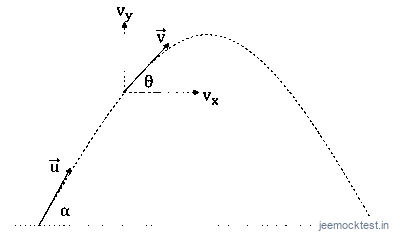
If and coordinates of a projectile as a function of time are given as and , respectively, then the angle (in degrees) made by the projectile with horizontal when is .
Select Option
Step-by-step Explanation
A warm welcome, aspiring engineers!
Let's dissect this problem from the Motion in a Plane chapter, a perennial favorite in the JEE Advanced examination. Understanding the dynamics of projectile motion is crucial, and this question tests your fundamental grasp of position, velocity, and their interplay with time.
Core Formula & Concept:The motion of a projectile can be decomposed into two independent components: horizontal and vertical. The horizontal motion is typically uniform (constant velocity, neglecting air resistance), while the vertical motion is uniformly accelerated due to gravity.
The position coordinates of a projectile as a function of time are given by and .
To find the velocity components, we differentiate the position functions with respect to time:
- Horizontal velocity:
- Vertical velocity:
At any instant , the velocity vector of the projectile makes an angle with the horizontal. This angle is determined by the ratio of the vertical and horizontal components of the velocity at that instant:
From this, the angle can be found using the inverse tangent function:
Step-by-Step Derivation:We are given the and coordinates of the projectile as a function of time :
1. Horizontal position:
2. Vertical position:
Step 1: Determine the velocity components.
We differentiate and with respect to time to obtain the horizontal () and vertical () components of the velocity, respectively.
- Differentiating with respect to :
As expected in projectile motion (ignoring air resistance), the horizontal velocity is constant.
- Differentiating with respect to :
This expression correctly shows the vertical velocity changing linearly with time due to the acceleration of gravity, (since the coefficient of is , implying ).
Step 2: Calculate the velocity components at the specified time .
- At , the horizontal velocity remains:
- At , the vertical velocity is:
Step 3: Calculate the angle made by the projectile with the horizontal.
The angle with the horizontal is given by:
Substitute the values of and at :
Therefore, the angle is:
Comparing this result with the given options, we find that our calculated angle matches option B.
Common Traps & Exam Tip:- Common Trap 1: Confusing Position with Velocity. A frequent mistake is to incorrectly assume that the angle can be found directly from the and coordinates, or their ratio. Remember, the angle of the *path* (tangent to the trajectory) is defined by the direction of the *velocity* vector, not the position vector. Always differentiate position to get velocity.
- Common Trap 2: Calculation Errors. Simple arithmetic errors, especially when multiplying by (for ) or substituting the time value, can lead to incorrect answers. Double-check your calculations.
- Common Trap 3: Misinterpreting . The coefficient of in the equation () directly gives away the value of . If the problem had used a different value like , this term would have been . Always be mindful of the value of implied or explicitly stated.
- Exam Tip: Visualize and Understand. For projectile motion problems, it's often helpful to quickly sketch the trajectory. While not strictly necessary for this problem, visualizing the motion helps in conceptual understanding and can sometimes reveal errors if the calculated angle seems physically unreasonable (e.g., negative angle when the projectile is clearly moving upwards). Also, pay attention to the exact question being asked - "angle with horizontal *at *" is different from "initial launch angle."
Related Questions from Motion in a Plane
Two identical bodies, projected with the same speed at two different angles cover the same horizontal range . If the time of flight of these bodies are 5 s and 10 s , respectively, then the value of is
m. (Take )
At , a body of mass 100 g starts moving under the influence of a force After 2 s its position is . The ratio is .
The two projectiles are projected with the same initial velocities at the and with respect to the horizontal. The ratio of their ranges is . The value of is
A boy throws a ball into air at from the horizontal to land it on a roof of a building of height . If the ball attains maximum height in 2 s and lands on the building in 3 s after launch, then value of is m.