JEE PYQ: Motion in a Plane - Question ID f5d69e69ed4e (JEE Main 2025)
The position vector of a moving body at any instant of time is given as . The magnitude and direction of velocity at is,
Select Option
Step-by-step Explanation
In two-dimensional motion, the position vector describes the location of a particle at any time . The velocity vector is the time derivative of the position vector: Its magnitude gives the speed, and its direction is tangent to the path at that instant.
If , then The magnitude of is and its direction is specified by the angle it makes with one of the coordinate axes, where
Step-by-Step Derivation:1. Identify the position components
Given
Thus
2. Compute the velocity components
Differentiate each component with respect to :
So the velocity vector at any time is
3. Evaluate at s
Substitute :
Hence
4. Find the magnitude of velocity
5. Determine the direction
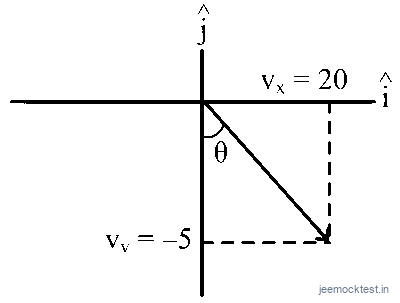
We compute the angle that makes with the negative –axis. Since points along and points along , the vector lies in the fourth quadrant. The angle between and the downward (negative ) direction satisfies
Therefore
measured from the negative –axis toward the positive –axis.
6. Match with the given options
Our result is
This exactly matches option A.
1. Sign errors in differentiation: Students sometimes forget the negative sign when differentiating , leading to instead of . 2. Angle reference: One must be careful whether the angle is measured from the –axis or the –axis. Here the question specifies “with –ve axis,” so the tangent ratio uses . 3. Magnitude simplification: must be simplified to ; failing to do so can cause confusion when matching options.
Exam Tip: Always write down the velocity components explicitly, compute the magnitude, and then draw a small sketch of the vector to identify the correct reference axis for the angle.
Related Questions from Motion in a Plane
Two identical bodies, projected with the same speed at two different angles cover the same horizontal range . If the time of flight of these bodies are 5 s and 10 s , respectively, then the value of is
m. (Take )
At , a body of mass 100 g starts moving under the influence of a force After 2 s its position is . The ratio is .
If and coordinates of a projectile as a function of time are given as and , respectively, then the angle (in degrees) made by the projectile with horizontal when is .
The two projectiles are projected with the same initial velocities at the and with respect to the horizontal. The ratio of their ranges is . The value of is