JEE PYQ: Motion in a Plane - Question ID 9883a2c51350 (JEE Main 2026)
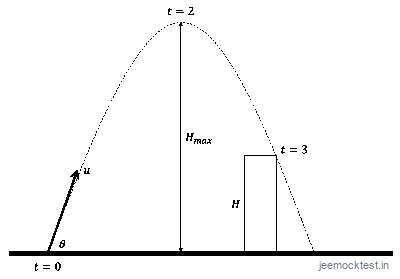
A boy throws a ball into air at from the horizontal to land it on a roof of a building of height . If the ball attains maximum height in 2 s and lands on the building in 3 s after launch, then value of is m.
Select Option
Step-by-step Explanation
1. Horizontal Motion: Assuming negligible air resistance, there is no acceleration in the horizontal direction. Thus, the horizontal component of velocity () remains constant throughout the motion.
2. Vertical Motion: In the vertical direction, the particle experiences a constant downward acceleration due to gravity, . We typically choose an upward direction as positive and downward as negative. The equations of motion for constant acceleration apply:
3. Components of Initial Velocity: If a particle is projected with an initial speed at an angle from the horizontal, its initial velocity components are:
4. Time to Attain Maximum Height: At the maximum height of its trajectory, the vertical component of the velocity () becomes momentarily zero. Using the first equation of motion for vertical direction: Step-by-Step Derivation: We are given the initial projection angle, the time to reach maximum height, and the time to land on the building. We need to find the height of the building.
Step 1: Determine the initial vertical component of velocity (). The problem states that the ball attains maximum height in s. At maximum height, the vertical component of its velocity, , is zero. We can use the first equation of motion for vertical displacement: Given and s:
Step 2: Utilize the projection angle (optional but good for complete understanding). The ball is thrown at from the horizontal. We know . So, . The initial horizontal component of velocity . For this problem, is not directly required to find , but it's consistent with since .
Step 3: Calculate the height of the building. The ball lands on the building in s after launch. The height is the vertical displacement at this time . We use the second equation of motion for vertical displacement: Substitute the values we have: , s, and .
The height of the building is 15 m. The final answer is . Common Traps & Exam Tip:
1. Misinterpreting Time of Flight: A common mistake is to confuse the time to land on the building (3 s) with the total time of flight to return to the initial launch height (which would be s if it landed at the same level). Since the ball lands on a roof of height , the motion is not symmetric, and the total time of flight to the ground could be even longer. Always use the given time for the specific event described.
2. Incorrect Sign Conventions: Ensure consistent sign conventions for vertical motion. If upward is taken as positive, then initial vertical velocity is positive, and acceleration due to gravity must be taken as negative (). If downward is positive, would be negative, and would be positive. I've used , where is taken as the magnitude of acceleration, and the minus sign accounts for its downward direction when is upward positive.
3. Assuming Landing at Max Height: Some students might erroneously assume that the ball lands on the building at its maximum height. The problem states it attains maximum height in 2 s and lands in 3 s, clearly indicating these are different points in time and thus different positions.
4. Unnecessary Calculations: While determining the initial speed and horizontal velocity can be done, they are not strictly necessary to find . Focus on isolating the relevant information for the specific unknown variable. In this case, and time are sufficient for .
Related Questions from Motion in a Plane
Two identical bodies, projected with the same speed at two different angles cover the same horizontal range . If the time of flight of these bodies are 5 s and 10 s , respectively, then the value of is
m. (Take )
At , a body of mass 100 g starts moving under the influence of a force After 2 s its position is . The ratio is .
If and coordinates of a projectile as a function of time are given as and , respectively, then the angle (in degrees) made by the projectile with horizontal when is .
The two projectiles are projected with the same initial velocities at the and with respect to the horizontal. The ratio of their ranges is . The value of is