JEE PYQ: Motion in a Plane - Question ID f4df7366282f (JEE Main 2021)
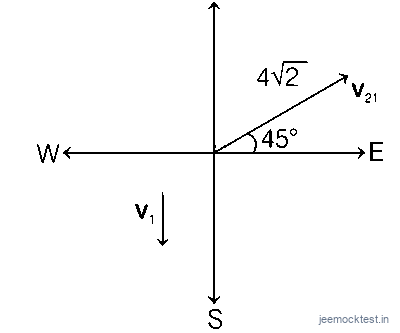
Select Option
Step-by-step Explanation
In problems involving motion in a plane, the key concept is vector addition of velocities. When two or more velocities act on a body simultaneously, the resultant velocity is obtained by adding the individual velocity vectors using the rules of vector algebra.
The fundamental formulas used are:
- Resolution of a vector into its components:
If a velocity vector makes an angle with the positive x-axis, its components are: - Resultant velocity vector:
If two velocity vectors and act on a body, the resultant velocity is: Its magnitude is: - Displacement from velocity:
For constant velocity, displacement in time is:
Step 1: Understand the directions and assign coordinate axes
Let’s define:
- Positive x-axis: East direction
- Positive y-axis: North direction
Step 2: Resolve the butterfly’s velocity into components
Given: Butterfly’s velocity m/s in North-East direction.
Since North-East is at to both North and East, the components are:
Step 3: Resolve the wind velocity into components
Wind is blowing from North to South at 1 m/s.
This means the wind velocity vector points South, i.e., in the negative y-direction.
So,
Step 4: Find the resultant velocity vector
The resultant velocity is the vector sum of the butterfly’s velocity and the wind velocity:
Step 5: Compute the magnitude of the resultant velocity
Step 6: Calculate the displacement in 3 seconds
Displacement
Step 7: Match with the given options
The resultant displacement is 15 m, which corresponds to option D.
Common Traps & Exam Tip:
Trap 1: Misinterpreting wind direction
Students often confuse "wind blowing from North to South" with "wind blowing toward North". The correct interpretation is that the wind velocity vector points South, so it should be assigned a negative y-component.
Trap 2: Incorrect angle for North-East
Some students mistakenly use or for North-East. North-East is exactly from both North and East.
Trap 3: Forgetting to compute displacement
The question asks for displacement, not velocity. Students may stop at finding the resultant velocity and forget to multiply by time.
Exam Tip: Always draw a quick sketch of the directions and label the components. This helps avoid sign errors and clarifies the vector addition.
Related Questions from Motion in a Plane
Two identical bodies, projected with the same speed at two different angles cover the same horizontal range . If the time of flight of these bodies are 5 s and 10 s , respectively, then the value of is
m. (Take )
At , a body of mass 100 g starts moving under the influence of a force After 2 s its position is . The ratio is .
If and coordinates of a projectile as a function of time are given as and , respectively, then the angle (in degrees) made by the projectile with horizontal when is .
The two projectiles are projected with the same initial velocities at the and with respect to the horizontal. The ratio of their ranges is . The value of is