JEE PYQ: Motion in a Plane - Question ID d625226036b5 (JEE Main 2026)
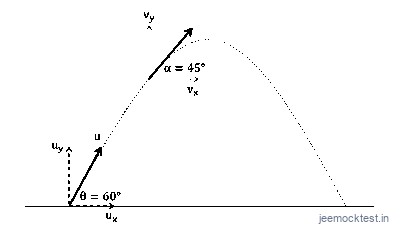
A projectile is thrown upward at an angle with the horizontal. The speed of the projectile is when its direction of motion is with the horizontal. The initial speed of the projectile is .
Select Option
Step-by-step Explanation
In projectile motion, assuming no air resistance, the acceleration due to gravity acts only in the vertical direction. This implies a fundamental principle: the horizontal component of the projectile's velocity remains constant throughout its flight. The vertical component, however, changes due to the influence of gravity.
Let the initial speed of the projectile be and its initial angle of projection with the horizontal be . The initial horizontal component of velocity is .
At any subsequent point in its trajectory, let the speed of the projectile be and its direction of motion make an angle with the horizontal. The horizontal component of velocity at this point is .
Since the horizontal component of velocity is conserved: Therefore, the core formula linking the initial state to any intermediate state (when considering velocity direction) is: Step-by-Step Derivation:
Let's denote the initial speed as and the initial angle of projection as . We are given:
- Initial angle of projection, .
- Speed of the projectile, .
- Direction of motion (angle with horizontal), .
Step 1: Identify the constant component of velocity. In projectile motion, the horizontal component of velocity remains constant throughout the trajectory (neglecting air resistance).
Step 2: Express the initial horizontal velocity component. The initial horizontal velocity component is given by: Substituting the given value of :
Step 3: Express the horizontal velocity component at the specified point. At the point where the speed is and the direction is , the horizontal velocity component is: Substituting the given values of and :
Step 4: Equate the horizontal velocity components. Since the horizontal velocity component is constant, we can equate the expressions from Step 2 and Step 3:
Step 5: Substitute trigonometric values and solve for . Recall the standard trigonometric values: Substitute these values into the equation from Step 4: Now, solve for : To rationalize the denominator, multiply the numerator and denominator by :
The initial speed of the projectile is .
Comparing this with the given options: A: B: C: 40 D: The calculated initial speed matches option B. Common Traps & Exam Tip:
Common Traps:
- Forgetting Constant Horizontal Velocity: A frequent mistake is to overlook the constancy of the horizontal velocity component. Students might try to use complex kinematic equations involving time or vertical motion components (), which are valid but not necessary here and can lead to more involved calculations.
- Incorrect Trigonometric Values: Errors in recalling or calculating values for and can lead to an incorrect final answer.
- Confusing Initial vs. Current Angles: Ensure that is used for the initial projection angle and for the angle at the specific point in the trajectory.
- Misapplying Velocity Components: Some might incorrectly assume that the total speed is conserved, or try to use only vertical components, which are affected by gravity.
Exam Tip: Always begin by identifying the fundamental principles applicable to the problem. For projectile motion, the conservation of the horizontal component of velocity is a powerful tool, especially when information about angles of projection and direction of motion is provided. This principle often provides the most direct and elegant solution, saving valuable time in competitive exams like JEE. Whenever you see angles of velocity direction at different points in a projectile's path, immediately think of .
Related Questions from Motion in a Plane
Two identical bodies, projected with the same speed at two different angles cover the same horizontal range . If the time of flight of these bodies are 5 s and 10 s , respectively, then the value of is
m. (Take )
At , a body of mass 100 g starts moving under the influence of a force After 2 s its position is . The ratio is .
If and coordinates of a projectile as a function of time are given as and , respectively, then the angle (in degrees) made by the projectile with horizontal when is .
The two projectiles are projected with the same initial velocities at the and with respect to the horizontal. The ratio of their ranges is . The value of is