JEE PYQ: Motion in a Plane - Question ID cc382ef42639 (JEE Main 2003)
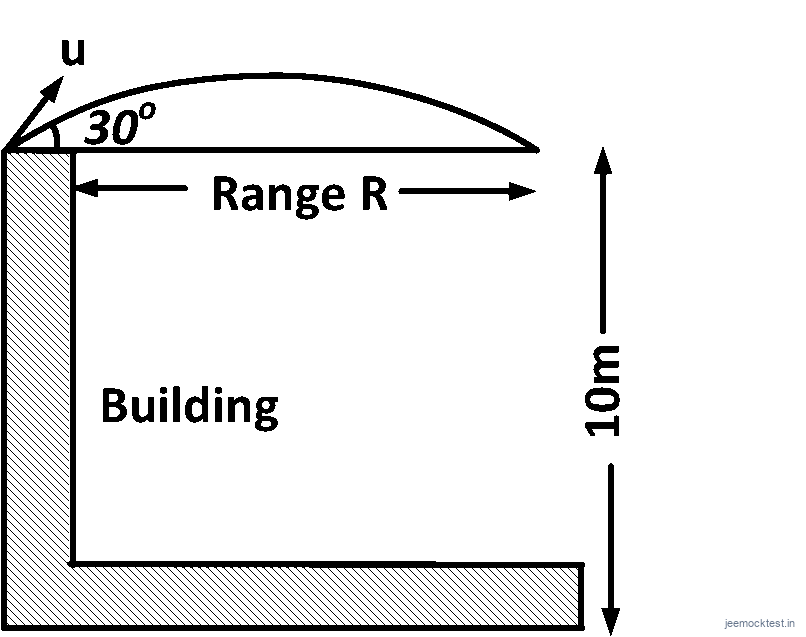
Select Option
Step-by-step Explanation
In projectile motion, an object moves under the influence of gravity alone after being launched with an initial velocity at an angle to the horizontal. The motion can be resolved into two independent components:
- Horizontal motion: Uniform motion with constant velocity since no acceleration acts horizontally (ignoring air resistance). The horizontal displacement is given by: where is the initial speed, is the launch angle, and is the time.
- Vertical motion: Uniformly accelerated motion under gravity. The vertical displacement is: where is the acceleration due to gravity.
The key idea here is that the ball is thrown from a height of 10 m and returns to the same height of 10 m above the ground. So, we are to find the horizontal distance traveled when the ball is again at m (i.e., at the same vertical level as the launch point).
Note: The initial vertical position is m, so the vertical displacement from the launch point is . However, the question asks for the position when the ball is at 10 m from the ground, which is the same as the launch height. So, we are effectively finding the horizontal range when the ball returns to its initial vertical level.
Step-by-Step Derivation:Given:
- Initial height of building, m
- Initial speed, m/s
- Launch angle,
- m/s²
- ,
We want to find the horizontal distance from the throwing point when the ball is again at height 10 m from the ground.
Let’s define the coordinate system: Let the origin be at the base of the building. Then, the initial position of the ball is at . The ball is thrown with velocity components:
The vertical position as a function of time is:
We want to find the time(s) when :
This gives two solutions:
So, the ball is at height 10 m again after 1 second.
Now, compute the horizontal distance traveled in this time:
We know that , so:
This matches option D.
Note: There is another time when the ball could be at 10 m — when it is descending and passes 10 m on the way down. However, since the building is only 10 m high, and the ball is thrown from 10 m, the only other time it is at 10 m is when it returns to the launch height (at s). It does not go below 10 m and come back up to 10 m again in this scenario.
Common Traps & Exam Tip:Trap 1: Students often confuse the vertical displacement. They may set (ground level) instead of m, leading to incorrect time calculations.
Trap 2: Some students forget that the ball starts from a height of 10 m and assume the motion is symmetric about the ground. They might calculate the time to reach maximum height and double it, which is incorrect here because the launch and landing heights are the same.
Trap 3: Misinterpreting the question: The question asks for the horizontal distance when the ball is at 10 m from the ground, not from the launch point. Since the launch point is 10 m above ground, this means when the ball returns to the launch height.
Exam Tip: Always draw a diagram. Label the initial height, velocity components, and the point of interest. Use the vertical motion equation to find the time(s) when the ball is at the desired height, then use horizontal motion to find the distance.
In this case, since the ball returns to the same height, the time of flight to that point is simply ? Wait — no! That formula is for when the projectile lands at the same vertical level as launch. Here, that condition is satisfied, so:
This confirms our earlier result. So, the horizontal range at this time is m.
Thus, the correct answer is D: 8.66 m.
Related Questions from Motion in a Plane
Two identical bodies, projected with the same speed at two different angles cover the same horizontal range . If the time of flight of these bodies are 5 s and 10 s , respectively, then the value of is
m. (Take )
At , a body of mass 100 g starts moving under the influence of a force After 2 s its position is . The ratio is .
If and coordinates of a projectile as a function of time are given as and , respectively, then the angle (in degrees) made by the projectile with horizontal when is .
The two projectiles are projected with the same initial velocities at the and with respect to the horizontal. The ratio of their ranges is . The value of is