JEE PYQ: Motion in a Plane - Question ID c71d14988d61 (JEE Main 2022)
A projectile is projected with velocity of 25 m/s at an angle with the horizontal. After t seconds its inclination with horizontal becomes zero. If R represents horizontal range of the projectile, the value of will be :
[use g = 10 m/s2]
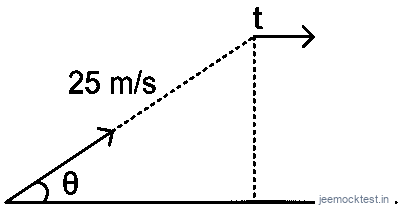
Select Option
Step-by-step Explanation
In projectile motion, the velocity of the projectile can be resolved into horizontal () and vertical () components. The key formulas used are:
- Initial velocity components:
- Inclination of velocity vector with horizontal: The angle that the velocity vector makes with the horizontal at any time is given by:
- Condition given in the problem: At time , the inclination becomes zero, meaning the projectile is moving horizontally at that instant. This implies:
- Horizontal range : The horizontal range of a projectile is given by:
Using these concepts, we will derive the value of in terms of and .
--- Step-by-Step Derivation:Step 1: Use the condition for zero inclination at time
At time , the vertical component of velocity becomes zero:
Solving for :
Given m/s and m/s²:
Step 2: Express the horizontal range in terms of
The horizontal range is:
Using the double-angle identity:
Substituting from Step 1:
Thus:
Solving for :
Step 3: Relate and to find
We have:
Using the Pythagorean identity:
However, instead of solving this equation, we can directly find :
Thus:
Step 4: Match with the given options
The derived expression for is:
This matches Option D.
--- Common Traps & Exam Tip:1. Misinterpreting the condition for zero inclination: Many students confuse the condition for zero inclination with the time of flight. The time of flight is when the projectile returns to the ground (), whereas zero inclination occurs when the vertical velocity becomes zero ().
2. Incorrect use of range formula: Students often forget to use the double-angle identity for or make algebraic mistakes while substituting values. Always verify the substitution of and carefully.
3. Overcomplicating the trigonometric relations: Instead of solving for directly, it is often easier to find or first, as done in this solution. This avoids unnecessary quadratic equations.
Exam Tip: When dealing with projectile motion problems involving angles and ranges, always:
- Resolve the velocity into components.
- Use the condition given (here, at time ) to find a relation involving .
- Express the range in terms of and substitute known values.
- Look for trigonometric identities to simplify the expression.
Related Questions from Motion in a Plane
Two identical bodies, projected with the same speed at two different angles cover the same horizontal range . If the time of flight of these bodies are 5 s and 10 s , respectively, then the value of is
m. (Take )
At , a body of mass 100 g starts moving under the influence of a force After 2 s its position is . The ratio is .
If and coordinates of a projectile as a function of time are given as and , respectively, then the angle (in degrees) made by the projectile with horizontal when is .
The two projectiles are projected with the same initial velocities at the and with respect to the horizontal. The ratio of their ranges is . The value of is