JEE PYQ: Motion in a Plane - Question ID b2fbec8ee5e3 (JEE Main 2025)
A ball of mass 100 g is projected with velocity at with horizontal. The decrease in kinetic energy of the ball during the motion from point of projection to highest point is
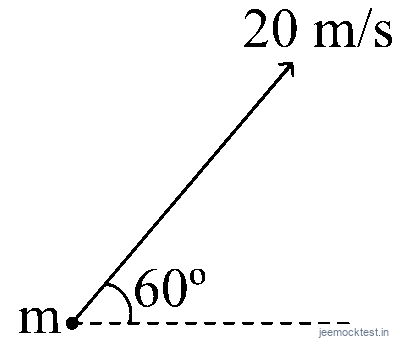
Select Option
Step-by-step Explanation
In projectile motion, the velocity of the ball can be resolved into two perpendicular components:
- Horizontal component: (remains constant throughout the motion, since no acceleration acts horizontally).
- Vertical component: (changes due to gravity, becoming zero at the highest point).
The kinetic energy () of the ball is given by: where is the mass and is the speed of the ball.
At the highest point of the trajectory, the vertical component of velocity becomes zero, so the speed of the ball is only due to its horizontal component. The decrease in kinetic energy is the difference between the initial kinetic energy and the kinetic energy at the highest point.
Step-by-Step Derivation:
Step 1: Convert mass to SI units
Given mass .
Step 2: Resolve initial velocity into components
Initial velocity at .
- Horizontal component: .
- Vertical component: .
Initial speed , so: Step 4: Compute kinetic energy at the highest point
At the highest point, , so the speed is . Step 5: Calculate the decrease in kinetic energy
Common Traps & Exam Tip:
- Incorrect mass unit: Students often forget to convert mass from grams to kilograms, leading to wrong kinetic energy values. Always ensure SI units are used.
- Misidentifying velocity at highest point: Some assume the speed at the highest point is zero, ignoring the horizontal component. Remember, only the vertical component becomes zero.
- Energy conservation confusion: While total mechanical energy (kinetic + potential) is conserved, kinetic energy alone decreases as potential energy increases. Do not confuse the two.
Final Answer: The decrease in kinetic energy is 15 J, which corresponds to option C.
Related Questions from Motion in a Plane
Two identical bodies, projected with the same speed at two different angles cover the same horizontal range . If the time of flight of these bodies are 5 s and 10 s , respectively, then the value of is
m. (Take )
At , a body of mass 100 g starts moving under the influence of a force After 2 s its position is . The ratio is .
If and coordinates of a projectile as a function of time are given as and , respectively, then the angle (in degrees) made by the projectile with horizontal when is .
The two projectiles are projected with the same initial velocities at the and with respect to the horizontal. The ratio of their ranges is . The value of is