JEE PYQ: Motion in a Plane - Question ID a93335844523 (JEE Main 2005)
Select Option
Step-by-step Explanation
In two-dimensional motion, acceleration is defined as the rate of change of velocity with respect to time. Since velocity is a vector quantity, both its magnitude and direction matter. The average acceleration over a time interval is given by:
where:
- is the initial velocity vector,
- is the final velocity vector,
- is the time interval.
Let’s define the coordinate system:
- East direction: positive -axis
- North direction: positive -axis
Final velocity: north
Time interval:
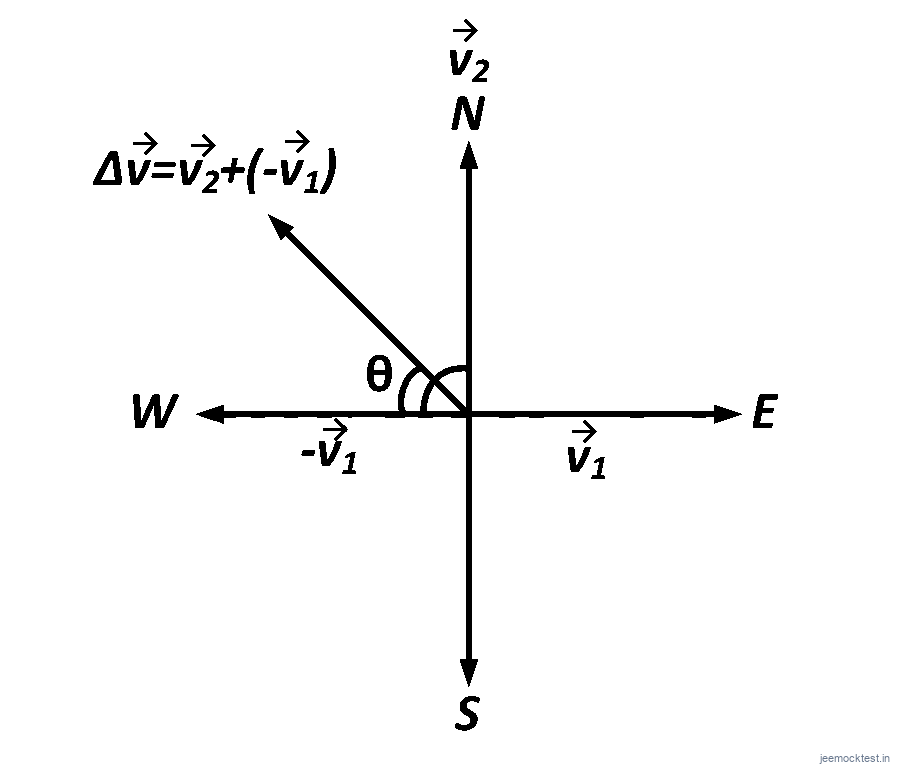
Compute the change in velocity:
Now, compute the average acceleration:
Find the magnitude of :
Determine the direction of : The vector points in the second quadrant, i.e., towards the north-west direction (since is negative and is positive).
Thus, the average acceleration is towards north-west.
Common Traps & Exam Tip:Students often make the following mistakes:
- Treating velocity as a scalar: They compute the difference in magnitudes only, ignoring direction. This leads to incorrect acceleration values.
- Incorrect vector subtraction: Subtracting from incorrectly, e.g., , which reverses the direction of .
- Direction confusion: Misidentifying the resultant direction of . The vector points north-west, not north-east.
- Magnitude error: Forgetting to take the square root when computing the magnitude of .
Hence, the correct answer is Option C.
Related Questions from Motion in a Plane
Two identical bodies, projected with the same speed at two different angles cover the same horizontal range . If the time of flight of these bodies are 5 s and 10 s , respectively, then the value of is
m. (Take )
At , a body of mass 100 g starts moving under the influence of a force After 2 s its position is . The ratio is .
If and coordinates of a projectile as a function of time are given as and , respectively, then the angle (in degrees) made by the projectile with horizontal when is .
The two projectiles are projected with the same initial velocities at the and with respect to the horizontal. The ratio of their ranges is . The value of is