JEE PYQ: Motion in a Plane - Question ID a4cef82689c6 (JEE Main 2019)
Select Option
Step-by-step Explanation
In this problem, we analyze the apparent position of a moving sound source (the jet aeroplane) due to the finite speed of sound. The key concept is:
- Wavefront Propagation: Sound travels at speed in still air. When the aeroplane moves, the wavefronts emitted at different times reach the observer at different angles, creating an illusion of the plane’s position.
- Relative Motion & Apparent Angle: The observer hears the sound coming from an angle with the ground, but sees the plane directly overhead. This discrepancy arises because the plane has moved during the time sound travels from its earlier position to the observer.
- Key Formula: If the plane moves horizontally at speed , and sound travels at speed , the apparent angle of the sound source satisfies: This relation comes from the geometry of wavefronts and the relative motion of the source and observer.
Step 1: Define Variables & Geometry
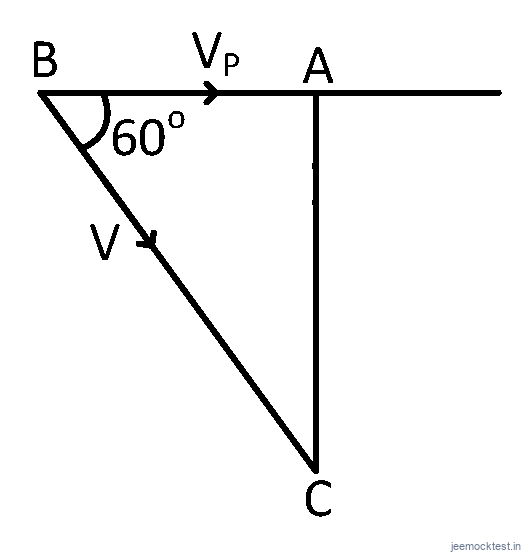
- Let the observer be at point on the ground.
- At time , the plane is at point , at a horizontal distance from , and at height .
- The plane moves horizontally with speed (toward the observer, from north to south).
- Sound emitted at from reaches at time , since sound travels the distance at speed .
Step 2: Position of Plane When Sound Reaches Observer
- During the time , the plane moves a distance toward .
- At time , the plane is directly above , so its horizontal position is . Thus:
Step 3: Relate Angle of Sound Arrival to Geometry
- The observer hears the sound coming from an angle with the ground. This means the wavefront arrives at an angle , so: Since , we have:
Step 4: Substitute and Solve for
- From Step 2, , and from the sound travel time: Substitute : Now, substitute into : Solving for :
Step 5: Match with Given Options
- The speed of the plane is , which corresponds to option D.
Students often confuse the apparent angle of sound arrival with the actual position of the plane. A frequent mistake is assuming the plane is at the angle from which the sound is heard, leading to incorrect trigonometric relations. Always remember:
- The sound heard at is from the plane’s earlier position, not its current position.
- The plane’s speed is derived from the time delay of sound travel and the displacement during that time.
- Drawing a clear diagram with the plane’s initial and final positions is crucial to avoid misinterpreting the geometry.
Related Questions from Motion in a Plane
Two identical bodies, projected with the same speed at two different angles cover the same horizontal range . If the time of flight of these bodies are 5 s and 10 s , respectively, then the value of is
m. (Take )
At , a body of mass 100 g starts moving under the influence of a force After 2 s its position is . The ratio is .
If and coordinates of a projectile as a function of time are given as and , respectively, then the angle (in degrees) made by the projectile with horizontal when is .
The two projectiles are projected with the same initial velocities at the and with respect to the horizontal. The ratio of their ranges is . The value of is