JEE PYQ: Motion in a Plane - Question ID 95b3b5edff5a (JEE Main 2020)
Select Option
Step-by-step Explanation
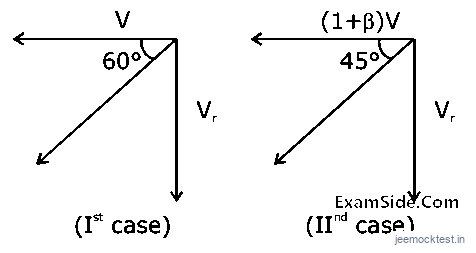
In this problem, we analyze the motion of raindrops relative to a moving car. The key concept is relative velocity. When the car is stationary, the driver observes the raindrops falling vertically downward. However, when the car moves, the driver perceives the raindrops as approaching at an angle due to the combination of the car's horizontal velocity and the raindrops' vertical velocity.
Let:
- = velocity of raindrops relative to the ground (vertical, downward).
- = speed of the car (horizontal, forward).
- = angle at which the driver sees the raindrops relative to the horizontal.
The relative velocity of the raindrops with respect to the car is: Since is vertical and is horizontal, the magnitude of the relative velocity is: The angle that the relative velocity makes with the horizontal is given by: This is because the vertical component of the relative velocity is (downward), and the horizontal component is (opposite to the car's motion).
Step-by-Step Derivation:
Step 1: Analyze the first scenario (car moving at speed )
When the car moves at speed , the driver sees the raindrops at an angle from the horizontal. Using the relative velocity concept:
We know , so:
Step 2: Analyze the second scenario (car moving at speed )
When the car's speed increases to , the angle changes to . Again, using the relative velocity concept:
We know , so:
Step 3: Equate the two expressions for
From Step 1 and Step 2, we have:
The terms cancel out:
Solving for :
Step 4: Calculate the numerical value of
We know , so:
This value is close to , which corresponds to option B.
- Misidentifying the angle: Students often confuse whether the angle is measured from the vertical or horizontal. Here, the angle is given from the horizontal, so is correct. If misread as from the vertical, the formula would incorrectly become .
- Incorrect relative velocity direction: The relative velocity of the raindrops with respect to the car is , not . Mixing up the order leads to the wrong angle calculation.
- Algebraic errors: When solving for , students might incorrectly cancel terms or misapply the tangent function. Always double-check the trigonometric identities and algebraic manipulations.
- Approximation errors: While is standard, some students might use a rougher approximation (e.g., ), leading to an incorrect value. Use precise values for such calculations.
Exam Tip: Always draw a velocity vector diagram to visualize the relative motion. Label the directions clearly (e.g., car moving right, raindrops falling down). This helps avoid confusion about the angle and the components of velocity.
Related Questions from Motion in a Plane
Two identical bodies, projected with the same speed at two different angles cover the same horizontal range . If the time of flight of these bodies are 5 s and 10 s , respectively, then the value of is
m. (Take )
At , a body of mass 100 g starts moving under the influence of a force After 2 s its position is . The ratio is .
If and coordinates of a projectile as a function of time are given as and , respectively, then the angle (in degrees) made by the projectile with horizontal when is .
The two projectiles are projected with the same initial velocities at the and with respect to the horizontal. The ratio of their ranges is . The value of is