JEE PYQ: Motion in a Plane - Question ID 93fd5cd93bfb (JEE Main 2025)
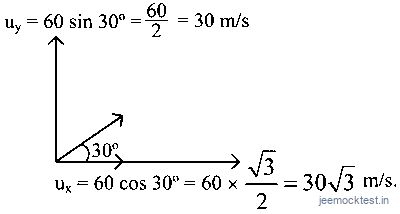
A particle is projected at an angle of from horizontal at a speed of . The height traversed by the particle in the first second is and height traversed in the last second, before it reaches the maximum height, is . The ratio is __________.
[Take, ]
Your Answer
Step-by-step Explanation
In projectile motion, the trajectory of a particle projected at an angle with the horizontal can be analyzed by resolving its initial velocity into horizontal () and vertical () components:
- (constant, as no acceleration in horizontal direction)
- (changes due to gravity, downward)
The vertical motion is governed by the equations of uniformly accelerated motion:
- Velocity at time :
- Displacement at time :
The time to reach maximum height () is when :
The height traversed in a given time interval is the difference in vertical displacement between the start and end of that interval.
Step-by-Step Derivation:Given:
- Initial speed,
- Projection angle,
- Acceleration due to gravity,
Step 1: Compute initial vertical velocity
Step 2: Compute time to reach maximum height
Step 3: Compute height traversed in the first second ()
Height traversed in the first second is the vertical displacement from to :
Step 4: Compute height traversed in the last second before reaching maximum height ()
The "last second" before reaching maximum height is from to (since s).
Compute vertical displacement at and :
Height traversed in the last second:
Step 5: Compute the ratio
Common Traps & Exam Tip:Trap 1: Misidentifying the "last second". Students often assume the last second is from to , which is incorrect because the particle reaches maximum height at s. The last second is from to .
Trap 2: Forgetting that height traversed is the difference in vertical displacement, not the displacement itself. Some students mistakenly use or directly as or .
Exam Tip: Always compute first. Then, for any time interval, compute at the start and end of the interval and take the difference. This avoids confusion about "height traversed".
Related Questions from Motion in a Plane
Two identical bodies, projected with the same speed at two different angles cover the same horizontal range . If the time of flight of these bodies are 5 s and 10 s , respectively, then the value of is
m. (Take )
At , a body of mass 100 g starts moving under the influence of a force After 2 s its position is . The ratio is .
If and coordinates of a projectile as a function of time are given as and , respectively, then the angle (in degrees) made by the projectile with horizontal when is .
The two projectiles are projected with the same initial velocities at the and with respect to the horizontal. The ratio of their ranges is . The value of is