JEE PYQ: Motion in a Plane - Question ID 90af0a4b5134 (JEE Main 2021)
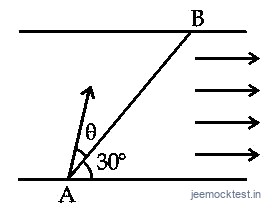
Your Answer
Step-by-step Explanation
To solve this problem, we analyze the motion of the swimmer in two dimensions using the principle of relative velocity. The key idea is that the swimmer’s velocity relative to the ground is the vector sum of:
- The swimmer’s velocity relative to the water, (magnitude , direction at angle to line AB).
- The river’s velocity relative to the ground, (magnitude , direction along the river flow).
The resultant velocity must point exactly along the line AB so that the swimmer reaches point B without drifting downstream or upstream.
Mathematically, we resolve both velocities into components parallel and perpendicular to AB and set the perpendicular component of to zero.
Step-by-Step Derivation:1. Define the geometry and velocities
Let the river flow along the positive x–axis. Line AB makes an angle of with the river flow (x–axis). The swimmer’s velocity relative to the water, , has magnitude and makes an angle with line AB. The river’s velocity also has magnitude and is directed along the x–axis.
2. Express velocities in component form
Resolve into components parallel and perpendicular to AB:
- Parallel to AB:
- Perpendicular to AB:
3. Compute the resultant velocity
4. Impose the condition for zero drift
For the swimmer to move exactly along AB, the y–component of must vanish:
Divide both sides by (nonzero):
Recognize the left side as :
The general solution is:
The physically meaningful solution in the context of swimming across the river is:
However, angles are conventionally measured as positive in the counterclockwise direction from AB. Therefore, the swimmer must aim upstream relative to AB, i.e., on the opposite side of AB from the river flow.
5. Conclusion
The angle with the line AB that ensures the swimmer reaches point B is .
Students often confuse the reference direction for . They may measure from the river flow instead of from line AB, leading to incorrect trigonometric setups. Always label the reference line clearly (here, AB) and resolve all vectors consistently with respect to that line.
Another common error is neglecting the vector addition of velocities. Remember: the swimmer’s resultant velocity relative to the ground is the vector sum of their velocity relative to the water and the water’s velocity relative to the ground.
Related Questions from Motion in a Plane
Two identical bodies, projected with the same speed at two different angles cover the same horizontal range . If the time of flight of these bodies are 5 s and 10 s , respectively, then the value of is
m. (Take )
At , a body of mass 100 g starts moving under the influence of a force After 2 s its position is . The ratio is .
If and coordinates of a projectile as a function of time are given as and , respectively, then the angle (in degrees) made by the projectile with horizontal when is .
The two projectiles are projected with the same initial velocities at the and with respect to the horizontal. The ratio of their ranges is . The value of is