JEE PYQ: Motion in a Plane - Question ID 8444c4d77e86 (JEE Main 2025)
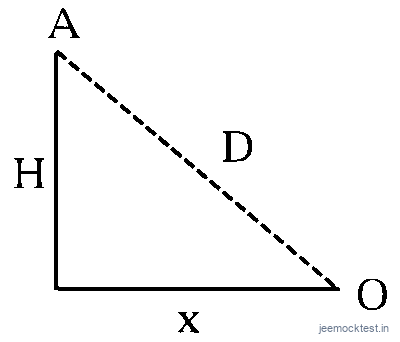
A helicopter flying horizontally with a speed of 360 km/h at an altitude of 2 km, drops an object at an instant. The object hits the ground at a point O, 20 s after it is dropped. Displacement of 'O' from the position of helicopter where the object was released is :
(use acceleration due to gravity g = 10 m/s2 and neglect air resistance)
Select Option
Step-by-step Explanation
This problem deals with projectile motion, where an object is released from a moving platform and subsequently falls under the influence of gravity. The key principle here is the independence of horizontal and vertical components of motion.
Core Formula & Concept:When an object is dropped from a horizontally moving helicopter, it initially possesses the same horizontal velocity as the helicopter. Its initial vertical velocity, however, is zero (as it is 'dropped'). Subsequently, the object undergoes projectile motion under constant gravitational acceleration 'g' acting vertically downwards, while its horizontal velocity remains constant (neglecting air resistance).
The core formulas used are:
- Horizontal Motion: Since there is no horizontal acceleration (air resistance is neglected), the horizontal velocity () remains constant. The horizontal displacement (range, ) is given by: where is the time of flight.
- Vertical Motion: Under constant downward acceleration , and with initial vertical velocity , the vertical displacement () is given by: Since , this simplifies to:
- Total Displacement: The displacement of the impact point 'O' from the release point can be visualized as the hypotenuse of a right-angled triangle. The two perpendicular sides of this triangle are the horizontal displacement () and the vertical displacement (). Thus, the magnitude of the total displacement () is given by the Pythagorean theorem:
1. Convert Given Values to Consistent SI Units:
- Speed of helicopter (and initial horizontal speed of object), . To convert km/h to m/s, we multiply by or :
- Altitude, . To convert km to m:
- Time of flight, .
- Acceleration due to gravity, .
2. Verify Vertical Motion (Optional but good practice):
We are given the altitude m and time s. Let's check if these are consistent with the vertical motion equation with :
The given altitude and time are perfectly consistent, confirming the parameters of the projectile motion.
3. Calculate Horizontal Displacement (Range):
Using the formula for horizontal motion, :
4. Calculate Total Displacement:
The displacement of 'O' from the position of the helicopter where the object was released is the magnitude of the resultant displacement vector. This is found using the Pythagorean theorem, as the horizontal and vertical displacements are perpendicular:
Substitute the calculated values for and given :
5. Convert Final Displacement to Kilometers:
The options are given in kilometers, so we convert the final result:
Comparing this with the given options, the correct answer is C: km.
Common Traps & Exam Tip:Common Traps:
- Unit Conversion Errors: A frequent mistake is to mix units, for example, using speed in km/h with time in seconds, or altitude in km with in m/s. Always convert all quantities to a consistent system (e.g., SI units: meters, kilograms, seconds) at the beginning.
- Incorrect Initial Vertical Velocity: Some students might assume an initial downward velocity if they misinterpret "drops an object". "Drops" implies the object starts with the same velocity as the platform, meaning its initial vertical velocity relative to the ground is zero.
- Calculating Only Horizontal Distance: The question asks for the "Displacement of 'O' from the position of helicopter where the object was released", which is the straight-line distance (magnitude of the resultant vector), not just the horizontal range.
- Confusion between Distance and Displacement: While the horizontal distance covered is and vertical distance covered is , the total displacement is the vector sum, and its magnitude is .
Exam Tip:
Always draw a simple diagram to visualize the motion. This helps in correctly identifying the horizontal and vertical components of initial velocity, acceleration, and displacement. Separate the motion into its independent horizontal and vertical components. This simplifies complex 2D problems into two simpler 1D problems. Also, take a moment to check for consistency between given parameters (like checking if the given altitude and time of flight align with ); this can help catch potential misinterpretations or calculation errors early on.
Related Questions from Motion in a Plane
Two identical bodies, projected with the same speed at two different angles cover the same horizontal range . If the time of flight of these bodies are 5 s and 10 s , respectively, then the value of is
m. (Take )
At , a body of mass 100 g starts moving under the influence of a force After 2 s its position is . The ratio is .
If and coordinates of a projectile as a function of time are given as and , respectively, then the angle (in degrees) made by the projectile with horizontal when is .
The two projectiles are projected with the same initial velocities at the and with respect to the horizontal. The ratio of their ranges is . The value of is