JEE PYQ: Motion in a Plane - Question ID 79281a67730e (JEE Main 2020)
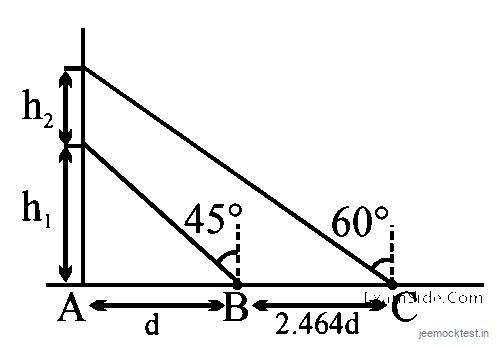
Select Option
Step-by-step Explanation
In problems involving angles of elevation and horizontal distances, the key concept is trigonometry in right-angled triangles. Specifically:
- The tangent of an angle in a right triangle is the ratio of the opposite side (height) to the adjacent side (horizontal distance).
- For an observer at a point on the ground, the angle that a vertically rising object makes with the vertical line from the observer satisfies:
- When the observer moves horizontally, the horizontal distance changes, but the vertical motion of the object alters the height, changing the angle of elevation.
Here, we use the tangent function to relate the angles and to the heights and , and the horizontal distances and .
Step-by-Step Derivation:Step 1: Define variables and initial setup
Let:
- = height of balloon when seen at from point B.
- = horizontal distance from point A (directly below balloon) to point B.
- When balloon rises further by , its new height = .
- The girl moves further away by , so her new horizontal distance from A = (point C).
Step 2: Use tangent relation for first observation ()
At point B, the angle with the vertical is . The horizontal distance from B to A is , and the height is . Since , we have:
Step 3: Use tangent relation for second observation ()
At point C, the angle with the vertical is . The horizontal distance from C to A is , and the height is . We know: So:
Step 4: Solve for
From the above: We are given , which implies . But more precisely, , and . So: Thus:
Step 5: Conclusion
Therefore, , which corresponds to option B.
Common Traps & Exam Tip:Common Mistakes:
- Students often confuse the angle with the vertical vs. the angle with the horizontal. Here, the angle is with respect to the vertical, so , not .
- Misinterpreting the movement of the observer: the girl moves further by , so the total distance from A becomes , not .
- Using approximate values without recognizing that leads to exact simplification. Students who plug in decimal approximations may lose precision.
Always draw a clear diagram labeling all distances and angles. Use exact trigonometric values (like ) instead of decimal approximations when possible to avoid rounding errors. Double-check whether the angle is with respect to the vertical or horizontal—this changes the tangent relation.
Related Questions from Motion in a Plane
Two identical bodies, projected with the same speed at two different angles cover the same horizontal range . If the time of flight of these bodies are 5 s and 10 s , respectively, then the value of is
m. (Take )
At , a body of mass 100 g starts moving under the influence of a force After 2 s its position is . The ratio is .
If and coordinates of a projectile as a function of time are given as and , respectively, then the angle (in degrees) made by the projectile with horizontal when is .
The two projectiles are projected with the same initial velocities at the and with respect to the horizontal. The ratio of their ranges is . The value of is