JEE PYQ: Motion in a Plane - Question ID 5a2d6b917e6c (JEE Main 2023)
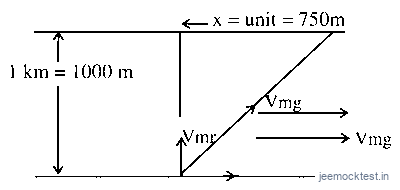
The speed of a swimmer is in still water. If the swimmer makes his strokes normal to the flow of river of width , he reaches a point down the stream on the opposite bank.
The speed of the river water is ___________
Your Answer
Step-by-step Explanation
In problems involving motion in a plane with two perpendicular velocities, we use the concept of relative velocity and vector addition. Here, the swimmer's motion is influenced by two independent velocities:
- Swimmer's velocity in still water (): This is the velocity the swimmer can achieve due to his own effort, directed normal (perpendicular) to the river flow.
- River's velocity (): This is the velocity of the river water, directed along the river flow (downstream).
The resultant velocity of the swimmer relative to the ground is the vector sum of these two velocities:
Since the swimmer strokes normal to the river flow, and are perpendicular. Thus, the magnitude of the resultant velocity is: However, for this problem, we are more interested in the time taken to cross the river and the drift downstream.
The key formulas used are:
- Time to cross the river (): Since the swimmer strokes perpendicular to the river flow, the time taken to cross the river depends only on the swimmer's velocity in still water and the width of the river:
- Drift downstream (): The river's velocity causes the swimmer to drift downstream. The distance drifted is:
Given:
- Speed of swimmer in still water,
- Width of the river,
- Drift downstream,
Step 1: Calculate the time taken to cross the river.
The swimmer strokes normal to the river flow, so the time taken to cross the river is:
Step 2: Relate the drift downstream to the river's velocity.
The drift downstream is caused by the river's velocity. Using the formula for drift: Substitute the known values:
Step 3: Solve for the river's velocity ().
Rearrange the equation to solve for :
Common Traps & Exam Tip:1. Misinterpreting the direction of velocities: Students often confuse the direction of the swimmer's velocity and the river's velocity. It is crucial to note that the swimmer strokes normal (perpendicular) to the river flow, not at an angle. This means the swimmer's velocity and the river's velocity are perpendicular to each other.
2. Incorrect unit conversion: The width of the river is given in kilometers, while the drift is given in meters. Students sometimes forget to convert the drift to kilometers, leading to incorrect calculations. Always ensure all units are consistent.
3. Using the resultant velocity incorrectly: Some students try to use the resultant velocity formula () to solve for . However, this is unnecessary for this problem because we are given the drift downstream, which directly relates to the river's velocity and the time taken to cross.
Exam Tip: Always draw a diagram to visualize the scenario. Label the swimmer's velocity, river's velocity, and the resultant path. This helps in understanding the directions and applying the correct formulas.
Related Questions from Motion in a Plane
Two identical bodies, projected with the same speed at two different angles cover the same horizontal range . If the time of flight of these bodies are 5 s and 10 s , respectively, then the value of is
m. (Take )
At , a body of mass 100 g starts moving under the influence of a force After 2 s its position is . The ratio is .
If and coordinates of a projectile as a function of time are given as and , respectively, then the angle (in degrees) made by the projectile with horizontal when is .
The two projectiles are projected with the same initial velocities at the and with respect to the horizontal. The ratio of their ranges is . The value of is