JEE PYQ: Motion in a Plane - Question ID 5257ad10986b (JEE Main 2026)
ID: 5257ad10986bJEE Main 2026Single Correct MCQ
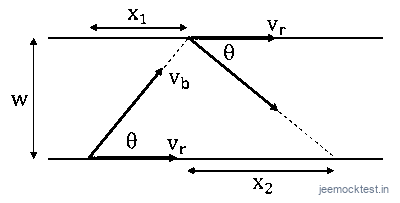
A river of width 200 m is flowing from west to east with a speed of 18 km/h. A boat, moving with speed of 36 km/h in still water, is made to travel one-round trip (bank to bank of the river). Minimum time taken by the boat for this journey and also the displacement along the river bank are ______ and ______ respectively.
Select Option
Step-by-step Explanation
Core Formula & Concept:
This problem deals with relative motion, specifically the motion of a boat in a flowing river. The fundamental concept here is the vector addition of velocities: the velocity of the boat relative to the ground (vbg) is the vector sum of the velocity of the boat relative to the water (vb) and the velocity of the river relative to the ground (vr).
vbg=vb+vr
For a river of width W, if the boat aims to cross it in the minimum possible time, its velocity vector relative to the water (vb) must be directed perpendicular to the river's flow. In this scenario, the component of the boat's velocity relative to the ground that is perpendicular to the river flow is simply vb, the boat's speed in still water. The time taken for such a crossing is given by:
t=Boat speed component perpendicular to flowRiver Width=vbW
During this minimum-time crossing, the river's current will carry the boat downstream (or upstream, depending on direction, but here it's downstream). This displacement along the river bank is called drift, and it's calculated as:
Drift=vr×t
For a round trip (bank to bank and back to the original bank), the total time will be the sum of times for each leg, and the total displacement along the river bank will be the sum of drifts for each leg. It is crucial to understand that "minimum time for the journey" implies minimizing the time for each individual leg, even if it results in a significant drift.
Step-by-Step Derivation:
Let's first convert the given speeds to consistent SI units (m/s):
River speed, vr=18 km/h=18×3600 s1000 m=18×185 m/s=5 m/s.
Boat speed in still water, vb=36 km/h=36×3600 s1000 m=36×185 m/s=10 m/s.
River width, W=200 m.
The journey consists of two parts:
Part 1: Crossing from the starting bank to the opposite bank.
To minimize the time for this crossing, the boat must head directly across the river relative to the water. This means its velocity relative to the ground will have a component vb perpendicular to the river flow.
Time taken for the first leg, t1=vbWt1=10 m/s200 m=20 s
During this time, the boat is carried downstream (Eastward) by the river's current.
Drift during the first leg, x1=vr×t1x1=5 m/s×20 s=100 m (Eastward)Part 2: Crossing back from the opposite bank to the starting bank.
To minimize the time for this return crossing, the boat again must head directly across the river relative to the water, but in the opposite direction (e.g., if it went North, now it goes South). The speed component perpendicular to the river flow is still vb.
Time taken for the second leg, t2=vbWt2=10 m/s200 m=20 s
During this return trip, the river's current continues to carry the boat downstream (Eastward).
Drift during the second leg, x2=vr×t2x2=5 m/s×20 s=100 m (Eastward)Total minimum time for the journey:
The total time for the round trip is the sum of the times for each leg.
Tmin=t1+t2=20 s+20 s=40 sTotal displacement along the river bank:
The total displacement along the river bank is the sum of the drifts from both legs. Since the river always flows from West to East, both drifts are in the Eastward direction.
Xtotal=x1+x2=100 m+100 m=200 m (Eastward)
Therefore, the minimum time taken by the boat for this journey is 40 s, and the displacement along the river bank is 200 m.
Comparing this with the given options, the correct choice is C.
Common Traps & Exam Tip:
1. Units Conversion: A very frequent mistake is to forget converting km/h to m/s. Always perform unit conversions at the very beginning to avoid errors.
2. Misinterpreting "Minimum Time": Many students confuse "minimum time to cross" with "crossing directly opposite the starting point" (i.e., zero drift). To cross directly opposite, the boat must head upstream at an angle, and the effective speed across the river becomes vb2−vr2. This strategy takes a longer time (vb2−vr2W) compared to simply pointing the boat perpendicular to the river flow. The problem specifically asks for "minimum time", which implies maximizing the velocity component perpendicular to the river flow (which is vb).
3. Misinterpreting "Displacement Along the River Bank": For a round trip, some might assume the boat must return to its exact starting point on the original bank, thus expecting zero net displacement. However, the question simply asks for the "displacement along the river bank" under the condition of minimum time. Since the boat is constantly pushed downstream by the river current in both legs, the drifts accumulate, leading to a non-zero net displacement along the bank.
Exam Tip: Always draw a vector diagram for relative motion problems. Clearly label velocities and their components. This visual aid can significantly help in understanding the direction of motion and resolving velocities correctly, reducing conceptual errors.