JEE PYQ: Motion in a Plane - Question ID 511cce373287 (JEE Main 2025)
ID: 511cce373287JEE Main 2025Single Correct MCQ
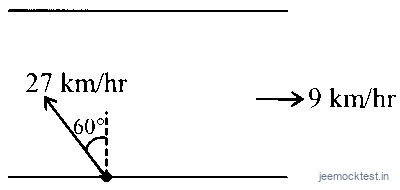
A river is flowing from west to east direction with speed of 9kmh−1. If a boat capable of moving at a maximum speed of 27kmh−1 in still water, crosses the river in half a minute, while moving with maximum speed at an angle of 150∘ to direction of river flow, then the width of the river is :
Select Option
Step-by-step Explanation
Core Formula & Concept:
The fundamental principle governing this problem is the concept of relative velocity and the independence of motion in perpendicular directions.
When an object (like a boat) moves in a medium (like a river), its velocity relative to the ground is the vector sum of its velocity relative to the medium and the medium's velocity relative to the ground. Mathematically, this is expressed as:
vbg=vbw+vwg
where:
* vbg is the velocity of the boat relative to the ground (or bank).
* vbw is the velocity of the boat relative to the water (its speed in still water).
* vwg is the velocity of the water relative to the ground (river flow speed).
For motion in two dimensions, it's convenient to resolve these vector velocities into perpendicular components. Typically, we set up a coordinate system where one axis (say, x-axis) is along the direction of river flow, and the other axis (y-axis) is perpendicular to the river flow, representing the direction across the river.
The motion along the x-axis (parallel to the river flow) and the motion along the y-axis (perpendicular to the river flow) are independent of each other. This means:
1. The time taken to cross the river (width W) depends only on the component of the boat's velocity perpendicular to the river flow. If vbg,y is this component, then W=vbg,y×t.
2. Any drift downstream or upstream depends on the component of the boat's velocity parallel to the river flow.
Step-by-Step Derivation:
1. Define Coordinate System and Given Quantities:
Let's set the positive x-axis in the direction of the river flow (West to East) and the positive y-axis perpendicular to the river flow (representing the direction across the river).
* Speed of river, vr=9kmh−1.
* Speed of boat in still water, vb=27kmh−1.
* Time taken to cross, t=0.5min.
* Angle of boat's velocity relative to water, θ=150∘ with respect to the direction of river flow (x-axis).
2. Convert Units to SI:
It's crucial to convert all given quantities to a consistent system of units, preferably SI units (meters and seconds), to avoid errors.
* vr=9kmh−1=9×3600s1000m=189×5ms−1=2.5ms−1.
* vb=27kmh−1=27×3600s1000m=1827×5ms−1=23×5ms−1=7.5ms−1.
* t=0.5min=0.5×60s=30s.
3. Resolve Velocities into Components:
* River Velocity (vwg): Since the river flows along the positive x-axis:
vwg,x=2.5ms−1vwg,y=0ms−1
* Boat's Velocity relative to Water (vbw): The boat moves at 27kmh−1 (or 7.5ms−1) at an angle of 150∘ to the direction of river flow (x-axis).
vbw,x=vbcos(150∘)=7.5×(−23)=−3.753ms−1.
vbw,y=vbsin(150∘)=7.5×(21)=3.75ms−1.
4. Calculate Boat's Velocity relative to Ground (vbg):
We use the relative velocity formula: vbg=vbw+vwg. We sum the respective components:
* vbg,x=vbw,x+vwg,x=−3.753+2.5ms−1.
(This component determines the boat's downstream/upstream drift).
* vbg,y=vbw,y+vwg,y=3.75+0=3.75ms−1.
(This component is the effective speed of the boat across the river).
5. Calculate the Width of the River:
The width of the river (W) is the displacement along the y-axis. It is given by the product of the boat's velocity component perpendicular to the river flow and the time taken to cross.
W=vbg,y×tW=3.75ms−1×30sW=(415)×30mW=4450mW=112.5m
Therefore, the width of the river is 112.5m.
The final answer is 112.5 m.
Common Traps & Exam Tip:
1. Angle Misinterpretation: A common mistake is to incorrectly interpret the angle 150∘. It is given as 150∘ "to direction of river flow". If the river flows East (positive x-axis), an angle of 150∘ means the boat's velocity relative to water is directed 30∘ North of West, resulting in negative x-component and positive y-component for vbw. Students might mistakenly use 150∘ for the resultant velocity or use 30∘ assuming it's with the perpendicular. Always draw a clear vector diagram!
2. Unit Inconsistency: Mixing kmh−1 with minutes and expecting an answer in meters without proper conversion is a frequent error. Always convert all units to a consistent system (e.g., SI units: meters and seconds) at the beginning of the problem.
3. Confusing Velocities: Students often mix up the boat's velocity relative to water (vbw) with its velocity relative to the ground (vbg). The given angle and maximum speed refer to vbw, while the actual crossing time depends on vbg,y.
4. Using Incorrect Velocity Component: Only the velocity component *perpendicular* to the river flow is effective in crossing the river. The component *parallel* to the river flow contributes to the drift, not the crossing time or width.
Exam Tip: For relative motion problems, always visualize the vectors and establish a clear coordinate system. Break down velocities into components along and perpendicular to the relevant direction (here, river flow). This systematic approach minimizes errors and helps in applying the independence of motion principle effectively. Double-check trigonometric values for common angles.