JEE PYQ: Motion in a Plane - Question ID 4faed3735073 (JEE Main 2021)
Select Option
Step-by-step Explanation
In this problem, we analyze the motion of a food packet dropped from a horizontally moving helicopter. The key physics concepts involved are:
- Projectile Motion: When the packet is released, it has an initial horizontal velocity equal to the helicopter’s speed , but zero initial vertical velocity. The packet then follows a parabolic trajectory under the influence of gravity.
- Independence of Motion: The horizontal and vertical motions of the packet are independent. The horizontal motion is uniform (constant velocity ), while the vertical motion is uniformly accelerated (acceleration downward).
- Time of Flight: The time taken for the packet to reach the ground depends only on the vertical motion. Using the equation for free-fall from height :
- Horizontal Range: The horizontal distance covered by the packet during its time of flight is:
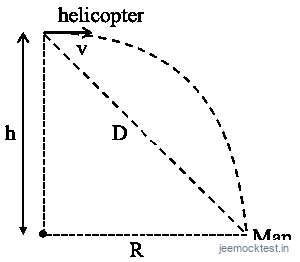
- Distance from Helicopter to Man: The helicopter continues moving horizontally while the packet is in the air. At the moment the packet lands, the helicopter has moved an additional horizontal distance . The man is directly below the point where the packet lands, so the straight-line distance from the helicopter to the man is the hypotenuse of a right triangle with legs (vertical) and (horizontal). Thus, the distance is:
Let’s derive the expression for the distance of the helicopter from the man when the food packet is dropped.
- Determine the time of flight ():
The packet is dropped from height with zero initial vertical velocity. The vertical motion is governed by: Solving for :
- Calculate the horizontal distance () covered by the packet:
The packet has an initial horizontal velocity (same as the helicopter). The horizontal distance covered in time is:
- Determine the position of the helicopter at time :
While the packet is falling, the helicopter continues moving horizontally at speed . The horizontal distance covered by the helicopter in time is: However, the man is located at the point where the packet lands, which is away from the drop point. Thus, the horizontal separation between the helicopter and the man at time is: Wait, this seems incorrect! Let’s re-examine the geometry.
The man is directly below the point where the packet lands. The helicopter was at the drop point when the packet was released. At time , the packet has moved horizontally by , and the helicopter has also moved horizontally by the same distance . Thus, the helicopter is directly above the man at time , and the straight-line distance from the helicopter to the man is simply the vertical distance . This contradicts the problem statement, so let’s rethink.
Correction: The problem asks for the distance of the helicopter from the man when the food packet is dropped, not when it lands. At the instant of release, the packet and the helicopter are at the same position. The man is on the ground, vertically below the helicopter at a horizontal distance we need to find. However, the packet will land at a point away from the drop point. The man must be at this landing point for the packet to reach him. Thus, at the moment of release, the helicopter is at a horizontal distance from the man, and the vertical distance is . The straight-line distance is:
- Simplify the expression:
The distance is: This matches option C:
Students often make the following mistakes in this problem:
- Misinterpreting the question: Many students calculate the distance when the packet lands instead of when it is dropped. At the moment of release, the helicopter and packet are at the same position, and the man is at the future landing point. The distance is the hypotenuse of the triangle formed by the horizontal range and the height.
- Ignoring the helicopter’s motion: Some students assume the helicopter stops moving after dropping the packet, leading to incorrect horizontal distance calculations. The helicopter continues moving at speed , but this does not affect the distance at the instant of release.
- Incorrect time of flight: Students may use instead of , forgetting the factor of 2 in the free-fall equation.
- Algebraic errors: When squaring terms or combining fractions, students may make sign errors or misplace terms. Always double-check the algebra, especially when dealing with square roots and exponents.
Exam Tip: For projectile motion problems, always:
- Separate the motion into horizontal and vertical components.
- Use the correct initial conditions (e.g., for a dropped object).
- Draw a diagram to visualize the geometry and distances involved.
- Pay close attention to the wording of the question to determine what is being asked (e.g., distance at release vs. at landing).
Related Questions from Motion in a Plane
Two identical bodies, projected with the same speed at two different angles cover the same horizontal range . If the time of flight of these bodies are 5 s and 10 s , respectively, then the value of is
m. (Take )
At , a body of mass 100 g starts moving under the influence of a force After 2 s its position is . The ratio is .
If and coordinates of a projectile as a function of time are given as and , respectively, then the angle (in degrees) made by the projectile with horizontal when is .
The two projectiles are projected with the same initial velocities at the and with respect to the horizontal. The ratio of their ranges is . The value of is