JEE PYQ: Motion in a Plane - Question ID 4dd866733ec2 (JEE Main 2022)
A projectile is launched at an angle '' with the horizontal with a velocity 20 ms1. After 10 s, its inclination with horizontal is ''. The value of tan will be : (g = 10 ms2).
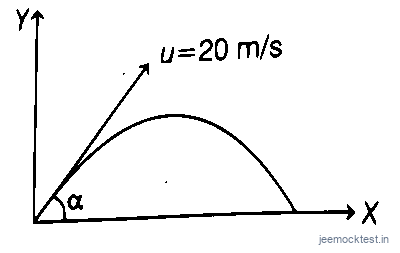
Select Option
Step-by-step Explanation
In projectile motion, the motion of an object launched at an angle can be resolved into two independent components:
- Horizontal motion: Uniform motion with constant velocity since no acceleration acts horizontally (ignoring air resistance). The horizontal velocity component is: where is the initial velocity and is the launch angle.
- Vertical motion: Uniformly accelerated motion under gravity. The vertical velocity component at any time is: where is the acceleration due to gravity.
The inclination of the projectile with the horizontal at any time is the angle whose tangent is the ratio of the vertical velocity component to the horizontal velocity component: This is the key formula we will use to find after 10 seconds.
--- Step-by-Step Derivation:
Step 1: Write down initial velocity components
Initial velocity , angle
Horizontal component:
Vertical component at :
Step 2: Find vertical velocity at s
Using , and
Step 3: Horizontal velocity remains constant
(unchanged)
Step 4: Compute
Simplify numerator:
So,
Split the fraction:
since
Step 5: Match with given options
We have derived:
This matches Option B.
Trap 1: Forgetting that horizontal velocity is constant
Students often mistakenly apply acceleration to the horizontal component. Remember: does not change.
Trap 2: Sign error in vertical velocity
The vertical velocity decreases due to gravity, so . A common mistake is using , which would imply upward acceleration.
Trap 3: Misinterpreting
is the ratio of current vertical velocity to horizontal velocity, not initial velocity components.
Exam Tip: Always resolve motion into horizontal and vertical components. Use for inclination at any instant. Double-check signs and units.
Related Questions from Motion in a Plane
Two identical bodies, projected with the same speed at two different angles cover the same horizontal range . If the time of flight of these bodies are 5 s and 10 s , respectively, then the value of is
m. (Take )
At , a body of mass 100 g starts moving under the influence of a force After 2 s its position is . The ratio is .
If and coordinates of a projectile as a function of time are given as and , respectively, then the angle (in degrees) made by the projectile with horizontal when is .
The two projectiles are projected with the same initial velocities at the and with respect to the horizontal. The ratio of their ranges is . The value of is