JEE PYQ: Motion in a Plane - Question ID 3ee74dce3c39 (JEE Main 2019)
Select Option
Step-by-step Explanation
This problem involves the concept of projectile motion in a plane, specifically the range of a projectile fired from ground level. The key physics principles and formulas are:
- Range of a Projectile: The horizontal distance traveled by a projectile launched with speed at an angle with the horizontal (ignoring air resistance) is given by: where is the acceleration due to gravity.
- Maximum Range: The range is maximized when , i.e., when . Thus, the maximum range is:
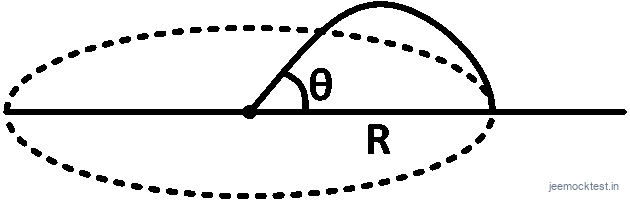
- Area Covered on the Ground: When bullets are fired in all possible directions from a point on horizontal ground, the set of all landing points forms a circular region on the ground. The radius of this circle is the maximum range . Therefore, the area covered is:
Thus, the area covered is proportional to the fourth power of the initial speed .
--- Step-by-Step Derivation:Let’s denote:
- : speed of bullets from gun A
- : speed of bullets from gun B
- : acceleration due to gravity (same for both)
Step 1: Find maximum range for each gun
For gun A:
For gun B:
Step 2: Find area covered on the ground
The bullets fired in all directions land within a circle of radius . So, the area covered is:
For gun A:
For gun B:
Step 3: Compute the ratio of areas
Thus, the ratio of maximum areas covered is .
Conclusion: The correct answer is A: 1 : 16.
--- Common Traps & Exam Tip:
Trap 1: Confusing range with area
Many students compute the maximum range and take the ratio , then mistakenly assume the area ratio is the same. But area depends on , so the ratio becomes . Students often forget to square the range when computing area.
Trap 2: Ignoring the "all possible directions" condition
Some students think only about one direction (e.g., 45°) and miss that the question asks for the area covered by bullets fired in all directions. This leads them to consider only linear distances, not circular coverage.
Trap 3: Misapplying the range formula
Students sometimes use instead of , leading to incorrect range calculations.
Exam Tip:
Always remember: When projectiles are fired in all directions from a point on level ground, the landing points form a circle with radius equal to the maximum range. The area of this circle is proportional to , not . This is a key insight for such problems.
Related Questions from Motion in a Plane
Two identical bodies, projected with the same speed at two different angles cover the same horizontal range . If the time of flight of these bodies are 5 s and 10 s , respectively, then the value of is
m. (Take )
At , a body of mass 100 g starts moving under the influence of a force After 2 s its position is . The ratio is .
If and coordinates of a projectile as a function of time are given as and , respectively, then the angle (in degrees) made by the projectile with horizontal when is .
The two projectiles are projected with the same initial velocities at the and with respect to the horizontal. The ratio of their ranges is . The value of is