JEE PYQ: Motion in a Plane - Question ID 3861c096ae9a (JEE Main 2022)
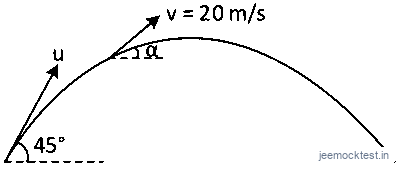
A body is projected from the ground at an angle of 45 with the horizontal. Its velocity after 2s is 20 ms1. The maximum height reached by the body during its motion is __________ m. (use g = 10 ms2)
Your Answer
Step-by-step Explanation
In projectile motion, a body is launched at an angle to the horizontal and moves under the influence of gravity. The motion can be resolved into two independent components:
- Horizontal motion: Uniform motion with constant velocity (no acceleration).
- Vertical motion: Accelerated motion under gravity ( downward).
Key formulas used:
- Initial velocity components: where is the initial speed and is the projection angle.
- Velocity components at time :
- Magnitude of velocity at time :
- Maximum height reached:
Step 1: Resolve initial velocity
Given , we have:
Step 2: Express velocity at
At , the horizontal velocity remains unchanged: The vertical velocity decreases due to gravity: The magnitude of velocity at is given as : Substitute:
Step 3: Solve for
Square both sides: Simplify: Expand the second term: Simplify: Since , we get:
Step 4: Compute maximum height
The maximum height is reached when the vertical velocity becomes zero. Using: Substitute :
Common Traps & Exam Tip:
- Ignoring vector nature of velocity: Students often forget that the velocity at any time is the vector sum of horizontal and vertical components. They may incorrectly assume the given speed is only vertical or horizontal.
- Sign errors in vertical velocity: The vertical velocity decreases with time due to gravity. A common mistake is using instead of .
- Misapplying maximum height formula: Some students use instead of , forgetting to use the vertical component of initial velocity.
- Algebraic errors in solving for : Expanding and simplifying the squared terms can be error-prone. Double-check each step to avoid sign or arithmetic mistakes.
Exam Tip: Always resolve the motion into horizontal and vertical components first. Use vector addition for velocity and remember that horizontal motion is uniform while vertical motion is uniformly accelerated.
Related Questions from Motion in a Plane
Two identical bodies, projected with the same speed at two different angles cover the same horizontal range . If the time of flight of these bodies are 5 s and 10 s , respectively, then the value of is
m. (Take )
At , a body of mass 100 g starts moving under the influence of a force After 2 s its position is . The ratio is .
If and coordinates of a projectile as a function of time are given as and , respectively, then the angle (in degrees) made by the projectile with horizontal when is .
The two projectiles are projected with the same initial velocities at the and with respect to the horizontal. The ratio of their ranges is . The value of is