JEE PYQ: Motion in a Plane - Question ID 2f6934af2fb1 (JEE Main 2025)
The angle of projection of a particle is measured from the vertical axis as and the maximum height reached by the particle is . Here as function of can be presented as
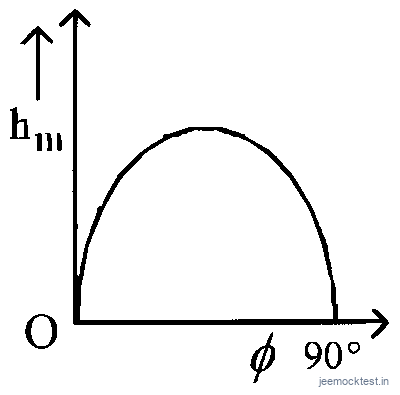
Select Option
Step-by-step Explanation
The problem deals with projectile motion, specifically focusing on the maximum height achieved by a particle. In projectile motion, when a particle is launched with an initial velocity at an angle with respect to the *horizontal* axis, the motion can be resolved into horizontal and vertical components. The vertical motion is governed by gravity. The initial vertical component of the velocity is . At the maximum height (), the vertical component of the velocity momentarily becomes zero. Using the kinematic equation for the vertical motion, where , (taking upward direction as positive), and : Rearranging this equation, we get the standard formula for maximum height: Here, is the initial speed of projection, is the angle of projection with the *horizontal*, and is the acceleration due to gravity.
Step-by-Step Derivation:
1. Understand the given angle: The problem states that the angle of projection of the particle is measured from the *vertical axis* as . This is crucial. In most standard projectile motion formulas, the angle is measured from the horizontal. 2. Relate to the standard horizontal angle : Let the initial speed of projection be . If is the angle with the vertical axis, then the standard angle of projection with the horizontal axis, , can be found from the geometric relationship: Therefore, the angle with the horizontal is: 3. Substitute into the maximum height formula: Now, we substitute this expression for into the standard maximum height formula derived above: Substitute : 4. Apply trigonometric identity: We use the trigonometric identity . Applying this identity for : Therefore, . 5. Final expression for : Substitute this back into the equation for : This expression gives the maximum height as a function of the initial speed , the angle (measured from the vertical), and the acceleration due to gravity . Comparing this derived expression with the given options, the correct option corresponds to:
Common Traps & Exam Tip:
1. Incorrect Angle Reference: The most frequent mistake students make is directly using as the angle with the horizontal, leading to . Always pay close attention to whether the angle is given with respect to the horizontal or the vertical axis. A quick sketch can clarify this relationship. 2. Trigonometric Identity Error: Some might incorrectly use or make other trigonometric errors. Remember and . 3. Missing Square: Forgetting to square the sine or cosine term, leading to , is another common error. Exam Tip: Whenever angles are specified in a projectile motion problem, it's always good practice to draw a small diagram showing the initial velocity vector, the horizontal axis, and the vertical axis. Mark the given angle and then deduce the angle with the horizontal (if not directly given) before applying any standard formulas. This avoids misinterpretation and helps in correctly applying trigonometric identities.
Related Questions from Motion in a Plane
Two identical bodies, projected with the same speed at two different angles cover the same horizontal range . If the time of flight of these bodies are 5 s and 10 s , respectively, then the value of is
m. (Take )
At , a body of mass 100 g starts moving under the influence of a force After 2 s its position is . The ratio is .
If and coordinates of a projectile as a function of time are given as and , respectively, then the angle (in degrees) made by the projectile with horizontal when is .
The two projectiles are projected with the same initial velocities at the and with respect to the horizontal. The ratio of their ranges is . The value of is