JEE PYQ: Motion in a Plane - Question ID 2ee841d79d26 (JEE Main 2023)
A child stands on the edge of the cliff above the ground and throws a stone horizontally with an initial speed of . Neglecting the air resistance, the speed with which the stone hits the ground will be (given, ).
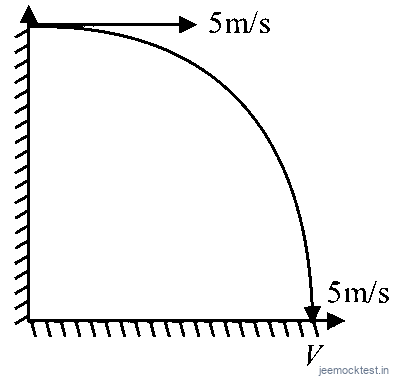
Select Option
Step-by-step Explanation
This problem involves projectile motion in a plane, specifically a horizontally launched projectile from a height. The key concepts are:
- Independence of horizontal and vertical motions: The horizontal () and vertical () components of motion are independent of each other under gravity (neglecting air resistance).
- Horizontal motion: Since no horizontal force acts (air resistance neglected), the horizontal velocity remains constant:
- Vertical motion: The stone is subject to constant downward acceleration due to gravity (). The vertical velocity increases from zero (since the stone is thrown horizontally) as it falls: where is the height of the cliff.
- Resultant velocity on impact: The speed of the stone when it hits the ground is the magnitude of the velocity vector, combining horizontal and vertical components:
Step 1: Identify given data
- Height of cliff,
- Initial horizontal speed,
- Acceleration due to gravity,
- Initial vertical speed, (thrown horizontally)
Step 2: Compute vertical velocity on impact
Using the kinematic equation for free fall from rest: Since ,
Step 3: Horizontal velocity remains unchanged
Since no horizontal acceleration occurs,
Step 4: Compute resultant speed on impact
The speed is the magnitude of the velocity vector:
Step 5: Match with given options
The calculated speed is , which corresponds to option D.
Common Traps & Exam Tip:Students often make the following mistakes:
- Ignoring horizontal velocity: Some assume the stone falls straight down and only calculate , leading to , which is not among the options. This overlooks the horizontal component.
- Incorrectly combining components: Adding and directly () instead of using the Pythagorean theorem. This is a fundamental error in vector addition.
- Misapplying kinematic equations: Using without considering the correct time of flight. While time can be calculated, it’s unnecessary here and adds complexity.
Exam Tip: Always treat horizontal and vertical motions separately, then combine them vectorially at the end. In horizontally launched projectiles, the initial vertical velocity is zero, simplifying calculations.
Related Questions from Motion in a Plane
Two identical bodies, projected with the same speed at two different angles cover the same horizontal range . If the time of flight of these bodies are 5 s and 10 s , respectively, then the value of is
m. (Take )
At , a body of mass 100 g starts moving under the influence of a force After 2 s its position is . The ratio is .
If and coordinates of a projectile as a function of time are given as and , respectively, then the angle (in degrees) made by the projectile with horizontal when is .
The two projectiles are projected with the same initial velocities at the and with respect to the horizontal. The ratio of their ranges is . The value of is