JEE PYQ: Motion in a Plane - Question ID 219add5c5413 (JEE Main 2022)
A fighter jet is flying horizontally at a certain altitude with a speed of 200 ms1. When it passes directly overhead an anti-aircraft gun, a bullet is fired from the gun, at an angle with the horizontal, to hit the jet. If the bullet speed is 400 m/s, the value of will be ___________.
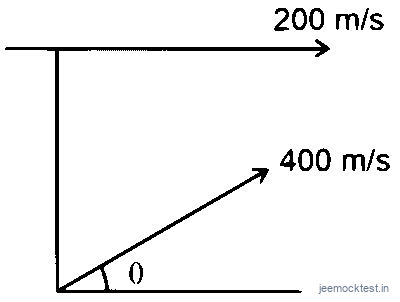
Your Answer
Step-by-step Explanation
In this problem, we analyze the relative motion of two objects—the fighter jet and the bullet—moving in a plane. The key concept is relative velocity and the independence of horizontal and vertical motions in projectile motion.
The bullet is fired at an angle with an initial speed . The jet is moving horizontally at . For the bullet to hit the jet, their relative position must coincide at some time after firing.
We use the following kinematic equations for projectile motion:
- Horizontal displacement of bullet:
- Vertical displacement of bullet:
- Horizontal displacement of jet: (since it's directly overhead at )
- Vertical displacement of jet: (jet flies horizontally at constant altitude)
For the bullet to hit the jet, two conditions must be satisfied:
- Horizontal coincidence:
- Vertical coincidence: (since the jet remains at the same altitude)
From these, we derive the necessary angle .
--- Step-by-Step Derivation:
Step 1: Horizontal Coincidence
The bullet and jet must meet horizontally at time :
Assuming , we can divide both sides by :
Substitute and :
This gives:
\theta = 60^\circ \quad \text{(since\cos 60^\circ = \frac{1}{2})}
Step 2: Vertical Coincidence (Verification)
We must ensure that at the same time , the bullet returns to the same altitude (i.e., ). Using the vertical motion equation:
Factor out :
Solutions are (initial time) or:
From Step 1, we have . However, we already used horizontal coincidence to find . Now, substitute to verify consistency:
At this time, the horizontal distance covered by the jet is:
The bullet's horizontal distance is:
Both distances match, confirming that satisfies both horizontal and vertical coincidence.
Conclusion:
The angle at which the bullet must be fired is .
Trap 1: Ignoring Relative Motion
Students often forget that the jet is moving and treat the problem as a stationary target. This leads to incorrect assumptions about the bullet's trajectory. Always consider the relative velocity between the projectile and the target.
Trap 2: Overcomplicating Vertical Motion
Some students unnecessarily solve for time using vertical motion, even though horizontal coincidence alone suffices to find . While verification is good, the primary solution comes from horizontal motion.
Trap 3: Misapplying Trigonometry
Students may confuse and when resolving velocity components. Remember: is for horizontal motion, and is for vertical motion.
Exam Tip:
For projectile-hitting-moving-target problems, always:
- Write down the position equations for both objects.
- Set their positions equal at time .
- Solve for the unknown (here, ) using horizontal motion first, then verify with vertical motion.
Related Questions from Motion in a Plane
Two identical bodies, projected with the same speed at two different angles cover the same horizontal range . If the time of flight of these bodies are 5 s and 10 s , respectively, then the value of is
m. (Take )
At , a body of mass 100 g starts moving under the influence of a force After 2 s its position is . The ratio is .
If and coordinates of a projectile as a function of time are given as and , respectively, then the angle (in degrees) made by the projectile with horizontal when is .
The two projectiles are projected with the same initial velocities at the and with respect to the horizontal. The ratio of their ranges is . The value of is