JEE PYQ: Motion in a Plane - Question ID 189199d70862 (JEE Main 2021)
Your Answer
Step-by-step Explanation
In problems involving relative motion in a plane (such as a swimmer crossing a river), the key concept is vector addition of velocities. The swimmer's velocity relative to the water () and the river's velocity relative to the ground () combine to give the swimmer's resultant velocity relative to the ground ().
The fundamental relation is:
For the swimmer to reach a point directly opposite on the other side of the river, the net horizontal displacement due to the river's flow must be zero. This means the horizontal component of the swimmer's velocity relative to the water must exactly cancel the river's velocity.
Key formulas used:
- Components of a vector: If a vector makes an angle with the positive x-axis, its components are:
- Condition for zero net horizontal displacement: (where is the horizontal component of the swimmer's velocity relative to water).
Step 1: Define the coordinate system
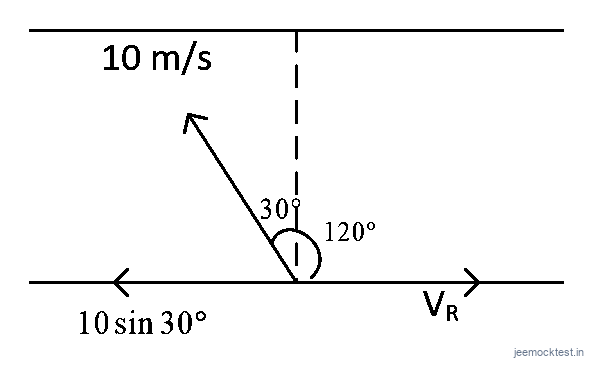
Let the river flow along the positive x-axis. The swimmer's velocity relative to the water () is given as 10 m/s at an angle of with the river flow (x-axis).
Step 2: Resolve the swimmer's velocity into components
The angle is measured from the positive x-axis (river flow direction). The components of are:
Using trigonometric values: Thus:
Step 3: Apply the condition for zero net horizontal displacement
For the swimmer to reach the point directly opposite, the resultant horizontal velocity must be zero. The river's velocity () is along the positive x-axis with magnitude m/s. The net horizontal velocity is:
For zero net horizontal displacement:
Thus:
Step 4: Verify the result
The swimmer's vertical component ( m/s) ensures they cross the river, while the horizontal component ( m/s) cancels the river's flow ( m/s), resulting in no net horizontal drift. This confirms the swimmer reaches the point directly opposite.
Conclusion: The value of to the nearest integer is 5.
Common Traps & Exam Tip:
- Misinterpreting the angle: Students often confuse whether the angle is measured with respect to the river flow or the perpendicular. Here, is with respect to the river flow (x-axis), not the perpendicular (y-axis). Drawing a diagram is crucial.
- Sign errors in components: The horizontal component of the swimmer's velocity is negative because it opposes the river flow. Forgetting the negative sign leads to , which is physically meaningless.
- Ignoring the condition for zero drift: Some students assume the swimmer's resultant velocity must be perpendicular to the river, which is not the case here. The key is zero net horizontal displacement, not perpendicularity.
- Trigonometric errors: Using (incorrect) instead of is a common mistake. Always verify trigonometric values for angles greater than .
Related Questions from Motion in a Plane
Two identical bodies, projected with the same speed at two different angles cover the same horizontal range . If the time of flight of these bodies are 5 s and 10 s , respectively, then the value of is
m. (Take )
At , a body of mass 100 g starts moving under the influence of a force After 2 s its position is . The ratio is .
If and coordinates of a projectile as a function of time are given as and , respectively, then the angle (in degrees) made by the projectile with horizontal when is .
The two projectiles are projected with the same initial velocities at the and with respect to the horizontal. The ratio of their ranges is . The value of is