JEE PYQ: Motion in a Plane - Question ID 057f0bf33bec (JEE Main 2018)
Select Option
Step-by-step Explanation
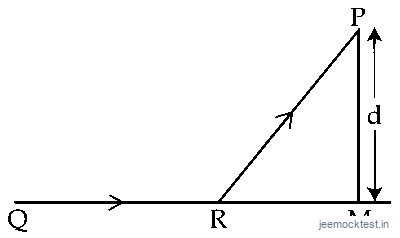
The problem involves finding the optimal point \( R \) on the highway such that the total time taken by the car to travel from \( Q \) to \( P \) via \( R \) is minimized. This is a classic optimization problem in kinematics, where the car changes its speed when it leaves the highway and enters the field.
Key concepts and formulas used:
- Time as a function of distance and speed: \( t = \frac{\text{distance}}{\text{speed}} \).
- Pythagorean theorem: Used to express the distance traveled in the field from \( R \) to \( P \).
- Calculus-based optimization: To minimize the total time \( T \), we express \( T \) as a function of \( x = RM \), then find the value of \( x \) that minimizes \( T \) by setting \( \frac{dT}{dx} = 0 \).
- Speed relation: The car’s speed in the field is half its speed on the highway: \( v_{\text{field}} = \frac{v}{2} \).
Let:
- \( v \) = speed of the car on the highway.
- \( \frac{v}{2} \) = speed of the car in the field.
- \( d \) = perpendicular distance from the highway to point \( P \) (i.e., \( MP = d \)).
- \( x = RM \) = distance along the highway from \( R \) to \( M \).
- \( MQ = L \) (given in the figure, though not explicitly stated, it’s the initial distance from \( Q \) to \( M \)).
The car travels from \( Q \) to \( R \) on the highway (distance \( QR = L - x \)), then from \( R \) to \( P \) in the field (distance \( RP = \sqrt{x^2 + d^2} \)).
Step-by-Step Derivation:1. Express the total time \( T \) as a function of \( x \): \[ T(x) = \frac{QR}{v} + \frac{RP}{v/2} = \frac{L - x}{v} + \frac{\sqrt{x^2 + d^2}}{v/2} \] Simplify: \[ T(x) = \frac{L - x}{v} + \frac{2\sqrt{x^2 + d^2}}{v} \] Factor out \( \frac{1}{v} \): \[ T(x) = \frac{1}{v} \left( L - x + 2\sqrt{x^2 + d^2} \right) \]
2. To minimize \( T(x) \), we minimize the expression inside the parentheses (since \( v \) is constant): \[ f(x) = L - x + 2\sqrt{x^2 + d^2} \] Differentiate \( f(x) \) with respect to \( x \): \[ \frac{df}{dx} = -1 + 2 \cdot \frac{1}{2} (x^2 + d^2)^{-1/2} \cdot 2x = -1 + \frac{2x}{\sqrt{x^2 + d^2}} \]
3. Set the derivative equal to zero for critical points: \[ -1 + \frac{2x}{\sqrt{x^2 + d^2}} = 0 \implies \frac{2x}{\sqrt{x^2 + d^2}} = 1 \] Square both sides to eliminate the square root: \[ \frac{4x^2}{x^2 + d^2} = 1 \implies 4x^2 = x^2 + d^2 \implies 3x^2 = d^2 \] Solve for \( x \): \[ x = \frac{d}{\sqrt{3}} \]
4. Verify that this critical point is a minimum by checking the second derivative or observing the behavior of \( f(x) \). The second derivative is positive, confirming a minimum.
Thus, the optimal distance \( RM \) is \( \frac{d}{\sqrt{3}} \).
Common Traps & Exam Tip:Trap 1: Incorrect distance expression. Students often misidentify the distance \( QR \) as \( x \) instead of \( L - x \). Always label the distances carefully based on the figure.
Trap 2: Forgetting the speed change. The car’s speed in the field is half its highway speed, so the time in the field must be divided by \( \frac{v}{2} \), not \( v \). This is a common oversight.
Trap 3: Algebraic errors in differentiation. When differentiating \( \sqrt{x^2 + d^2} \), students sometimes forget the chain rule or misapply it. Double-check the derivative: \[ \frac{d}{dx} \sqrt{x^2 + d^2} = \frac{x}{\sqrt{x^2 + d^2}} \]
Exam Tip: For optimization problems involving two media (e.g., highway and field), always:
- Express the total time as a function of the variable you’re optimizing (here, \( x = RM \)).
- Differentiate and set the derivative to zero.
- Solve for the variable and verify it’s a minimum.
Related Questions from Motion in a Plane
Two identical bodies, projected with the same speed at two different angles cover the same horizontal range . If the time of flight of these bodies are 5 s and 10 s , respectively, then the value of is
m. (Take )
At , a body of mass 100 g starts moving under the influence of a force After 2 s its position is . The ratio is .
If and coordinates of a projectile as a function of time are given as and , respectively, then the angle (in degrees) made by the projectile with horizontal when is .
The two projectiles are projected with the same initial velocities at the and with respect to the horizontal. The ratio of their ranges is . The value of is