JEE PYQ: Motion in a Plane - Question ID 04c190e6c172 (JEE Main 2022)
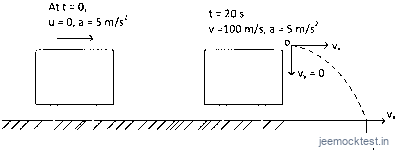
At t = 0, truck, starting from rest, moves in the positive x-direction at uniform acceleration of 5 ms2. At t = 20 s, a ball is released from the top of the truck. The ball strikes the ground in 1 s after the release. The velocity of the ball, when it strikes the ground, will be :
(Given g = 10 ms2)
Select Option
Step-by-step Explanation
This problem involves projectile motion from a moving frame of reference (the accelerating truck). The key concepts are:
- Uniformly accelerated motion along the x-axis: The truck starts from rest and accelerates at . Position: Velocity:
- Free-fall under gravity along the y-axis: The ball is released at and falls for . Vertical motion is governed by downward. Velocity: (with at release).
- Relative velocity: The ball’s velocity relative to the ground is the vector sum of its horizontal velocity (same as the truck’s velocity at the instant of release) and its vertical velocity due to gravity.
1. Determine the truck’s velocity at :
The truck accelerates from rest at . At , in the direction.
2. Horizontal velocity of the ball at release:
Since the ball is released from the truck, it inherits the truck’s horizontal velocity at that instant. Thus,
3. Vertical motion of the ball:
The ball is released from rest vertically () and falls for under gravity . The vertical velocity when it strikes the ground is downward, i.e., in the direction.
4. Combine horizontal and vertical velocities:
The ball’s velocity vector relative to the ground is
5. Match with the given options:
The derived vector corresponds exactly to option A.
Common Traps & Exam Tip:Trap 1: Students often forget that the ball inherits the truck’s horizontal velocity at the instant of release. They mistakenly assume the ball starts from rest horizontally, leading to incorrect horizontal velocity.
Trap 2: Confusing the direction of the vertical velocity. Since the ball falls downward, the vertical component is negative (), not positive.
Exam Tip: Always break the motion into horizontal and vertical components. Treat each component independently, then combine the results vectorially.
Related Questions from Motion in a Plane
Two identical bodies, projected with the same speed at two different angles cover the same horizontal range . If the time of flight of these bodies are 5 s and 10 s , respectively, then the value of is
m. (Take )
At , a body of mass 100 g starts moving under the influence of a force After 2 s its position is . The ratio is .
If and coordinates of a projectile as a function of time are given as and , respectively, then the angle (in degrees) made by the projectile with horizontal when is .
The two projectiles are projected with the same initial velocities at the and with respect to the horizontal. The ratio of their ranges is . The value of is