JEE PYQ: Motion in a Straight Line - Question ID fbe579312d0c (JEE Main 2023)
Select Option
Step-by-step Explanation
In kinematics, the position of a particle moving along a straight line is often given as a function of time, . The velocity of the particle at any instant is defined as the first derivative of the position with respect to time:
This formula gives the instantaneous velocity at time . The magnitude of velocity is simply the absolute value of , i.e., , since velocity is a vector quantity and its magnitude represents speed.
In this problem, the position function is: We are to find the magnitude of velocity at seconds.
--- Step-by-Step Derivation:Step 1: Differentiate the position function to find velocity
Given: We compute the derivative of with respect to : Using basic differentiation rules: - - Derivative of a constant is zero
So,Step 2: Evaluate velocity at seconds
Substitute into :Step 3: Determine the magnitude of velocity
Since velocity is a scalar in one-dimensional motion (along a straight line), its magnitude is the absolute value of . Here, m/s, which is positive, so:Step 4: Match with given options
The magnitude of velocity at s is , which corresponds to Option B. --- Common Traps & Exam Tip:Trap 1: Forgetting to differentiate – Some students mistakenly plug directly into the position function and think that gives velocity. But velocity is not position; it's the rate of change of position. Always differentiate first.
Trap 2: Misapplying differentiation rules – Errors like (forgetting to multiply by 2) or (forgetting the derivative of is 1) are common. Double-check each term.
Trap 3: Ignoring the sign of velocity – The question asks for the magnitude of velocity, not the velocity itself. Even if were negative, the magnitude would be positive. However, in this case, m/s is already positive, so no issue arises.
Exam Tip: Always write down the velocity function explicitly before substituting values. This helps avoid calculation errors and makes your reasoning clear to examiners.
Final Answer: B:
Related Questions from Motion in a Straight Line
A gas balloon is going up with a constant velocity of . When this balloon reached a height of 75 m , a stone is dropped from it and balloon keeps moving up with the same velocity. The height of the balloon when the stone hits the ground is m. (Take )
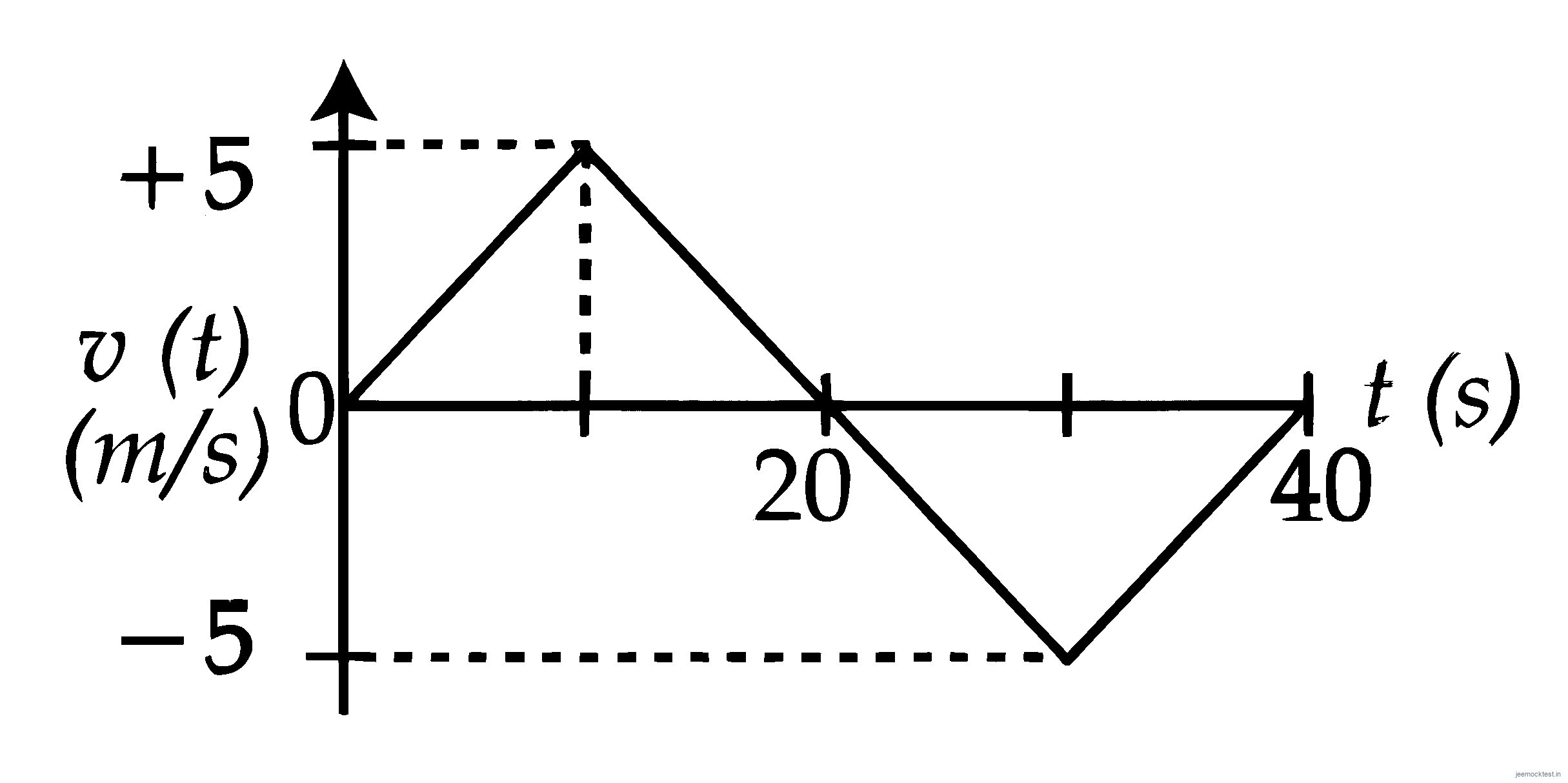
The velocity versus time plot of a particle is shown in the figure, for a time interval of 40 s . The total distance travelled by the particle and the average velocity during this period are, respectively
.
Two cars and are moving in the same direction along a straight line with speeds and , respectively such that car is moving ahead of car . A person in car throws a stone with a speed so that it hits the car with a speed of . The value of is .
A particle starts moving from time and its coordinate is given as
A. The particle returns to its original position (origin) 0.866 units later
B. The particle is 1 unit away from origin at its turning point
C. Acceleration of the particle is non-negative
D. The particle is 0.5 units away from origin at its turning point
E. Particle never turns back as acceleration is non-negative
Choose the correct answer from the options given below :