JEE PYQ: Motion in a Straight Line - Question ID 2b8b065cdd64 (JEE Main 2026)
A particle starts moving from time and its coordinate is given as
A. The particle returns to its original position (origin) 0.866 units later
B. The particle is 1 unit away from origin at its turning point
C. Acceleration of the particle is non-negative
D. The particle is 0.5 units away from origin at its turning point
E. Particle never turns back as acceleration is non-negative
Choose the correct answer from the options given below :
Select Option
Step-by-step Explanation
In kinematics of one-dimensional motion, the position of a particle is given by a function of time . From this we derive:
- Velocity
- Acceleration
- A turning point occurs where the velocity changes sign, i.e., .
- The particle “returns to the origin” when at some .
Step 1: Find when the particle returns to the origin.
Set : Nonzero roots are . The positive root is Hence statement A (“0.866 units later”) is correct.
Step 2: Locate the turning points.
Velocity . Set : The positive turning point is at . Compute : The distance from the origin is . Thus statement B (“1 unit away”) is correct, while statement D (“0.5 units away”) is incorrect.
Step 3: Examine the acceleration.
Acceleration . For , . Therefore statement C (“acceleration is non-negative”) is correct.
Step 4: Check whether the particle ever turns back.
The velocity changes sign at , so the particle does reverse direction. Statement E (“never turns back”) is incorrect.
Conclusion:
Correct statements are A, B, and C. The matching option is B.
Common Traps & Exam Tip:1. Sign errors in roots: Students often forget the negative root , but only the positive root matters for “returns later.” 2. Confusing position with distance: At the turning point, , so the distance is , not . 3. Acceleration misinterpretation: Non-negative acceleration does not prevent velocity from changing sign; it only means the acceleration never points opposite to the positive -axis.
Related Questions from Motion in a Straight Line
A gas balloon is going up with a constant velocity of . When this balloon reached a height of 75 m , a stone is dropped from it and balloon keeps moving up with the same velocity. The height of the balloon when the stone hits the ground is m. (Take )
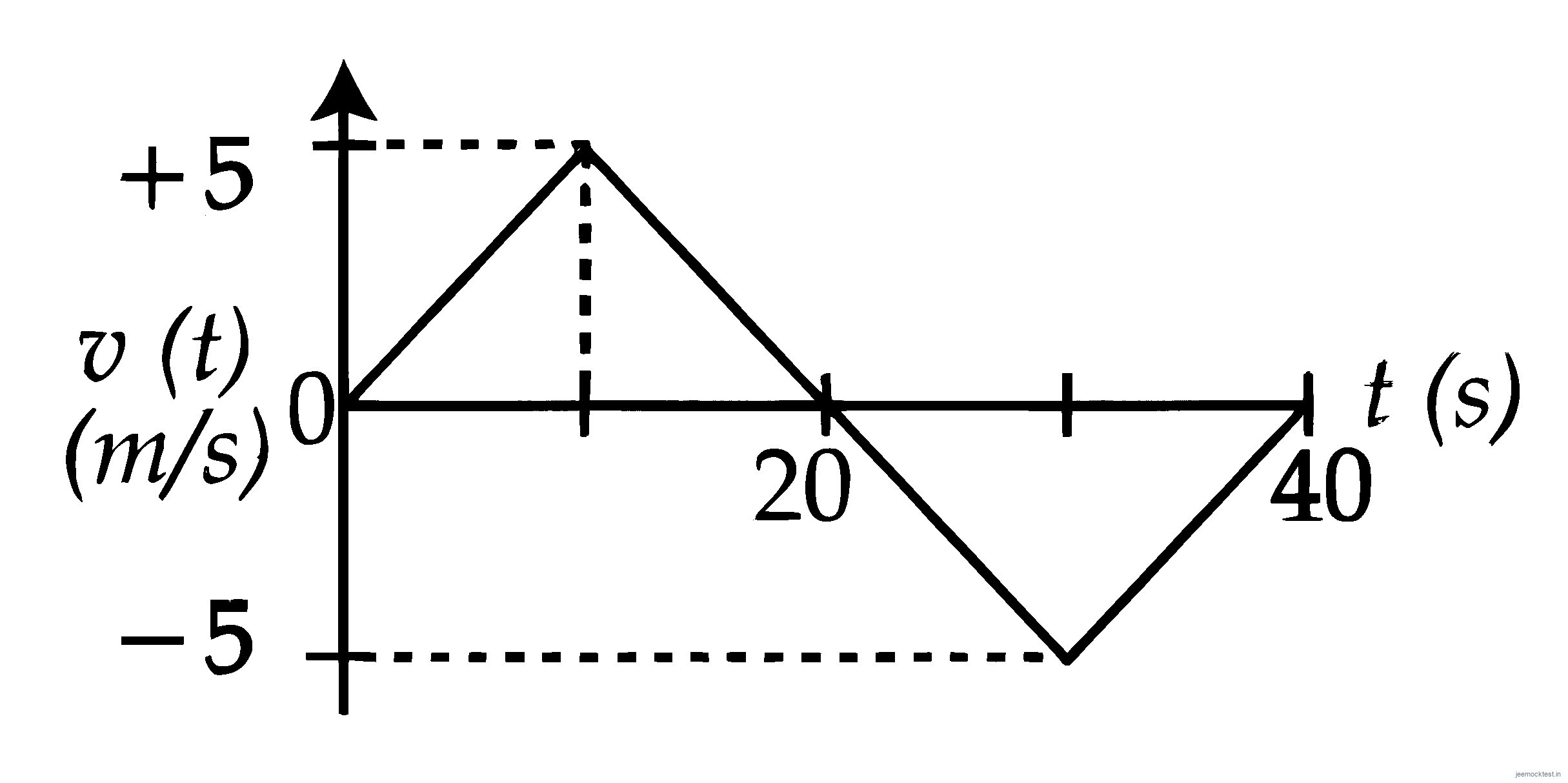
The velocity versus time plot of a particle is shown in the figure, for a time interval of 40 s . The total distance travelled by the particle and the average velocity during this period are, respectively
.
Two cars and are moving in the same direction along a straight line with speeds and , respectively such that car is moving ahead of car . A person in car throws a stone with a speed so that it hits the car with a speed of . The value of is .
Water drops fall from a tap on the floor, 5 m below, at regular intervals of time, the first drop strikes the floor when the sixth drop begins to fall. The height at which the fourth drop will be from ground, at the instant when the first drop strikes the ground is m.