JEE PYQ: Motion in a Straight Line - Question ID f669169d7cee (JEE Main 2019)
What is the magnitude of the acceleration at t = 1 ?
Select Option
Step-by-step Explanation
Let's solve the problem systematically, ensuring clarity at each step.
Core Formula & Concept:In kinematics, the position vector of a particle describes its location in space as a function of time. The velocity is the first time derivative of the position vector, and the acceleration is the first time derivative of the velocity vector (or the second time derivative of the position vector). Mathematically:
The magnitude of the acceleration vector is given by:
where and are the components of the acceleration vector along the and directions, respectively.
Step-by-Step Derivation:Step 1: Write the given position vector
The position vector of the particle is:
Step 2: Compute the velocity vector
Differentiate with respect to time to obtain the velocity vector :
Differentiating each component:
Thus, the velocity vector is:
Step 3: Compute the acceleration vector
Differentiate with respect to time to obtain the acceleration vector :
Differentiating each component:
Thus, the acceleration vector is:
Step 4: Compute the magnitude of the acceleration at
The acceleration vector is constant (does not depend on ), so its magnitude at any time (including ) is:
Step 5: Match with the given options
The magnitude of the acceleration at is , which corresponds to option A.
Common Traps & Exam Tip:1. Mistaking velocity for acceleration: Some students stop at finding the velocity vector and mistakenly compute its magnitude instead of proceeding to find acceleration. Always ensure you differentiate twice to obtain acceleration.
2. Incorrect differentiation: Forgetting to apply the chain rule or misapplying differentiation rules (e.g., treating as a constant) can lead to wrong components. Double-check each differentiation step.
3. Sign errors in components: The component of the position vector is . Students sometimes overlook the negative sign when differentiating, leading to instead of . This propagates to the acceleration calculation.
4. Assuming acceleration depends on time: In this problem, the acceleration is constant because the position vector is quadratic in . However, students might unnecessarily substitute into the acceleration components before computing the magnitude, which is redundant here but could be critical in other problems.
Exam Tip: Always verify whether the acceleration is time-dependent or constant. If it's constant, compute its magnitude once; if not, substitute the given time before computing the magnitude.
Related Questions from Motion in a Straight Line
A gas balloon is going up with a constant velocity of . When this balloon reached a height of 75 m , a stone is dropped from it and balloon keeps moving up with the same velocity. The height of the balloon when the stone hits the ground is m. (Take )
The velocity versus time plot of a particle is shown in the figure, for a time interval of 40 s . The total distance travelled by the particle and the average velocity during this period are, respectively
.
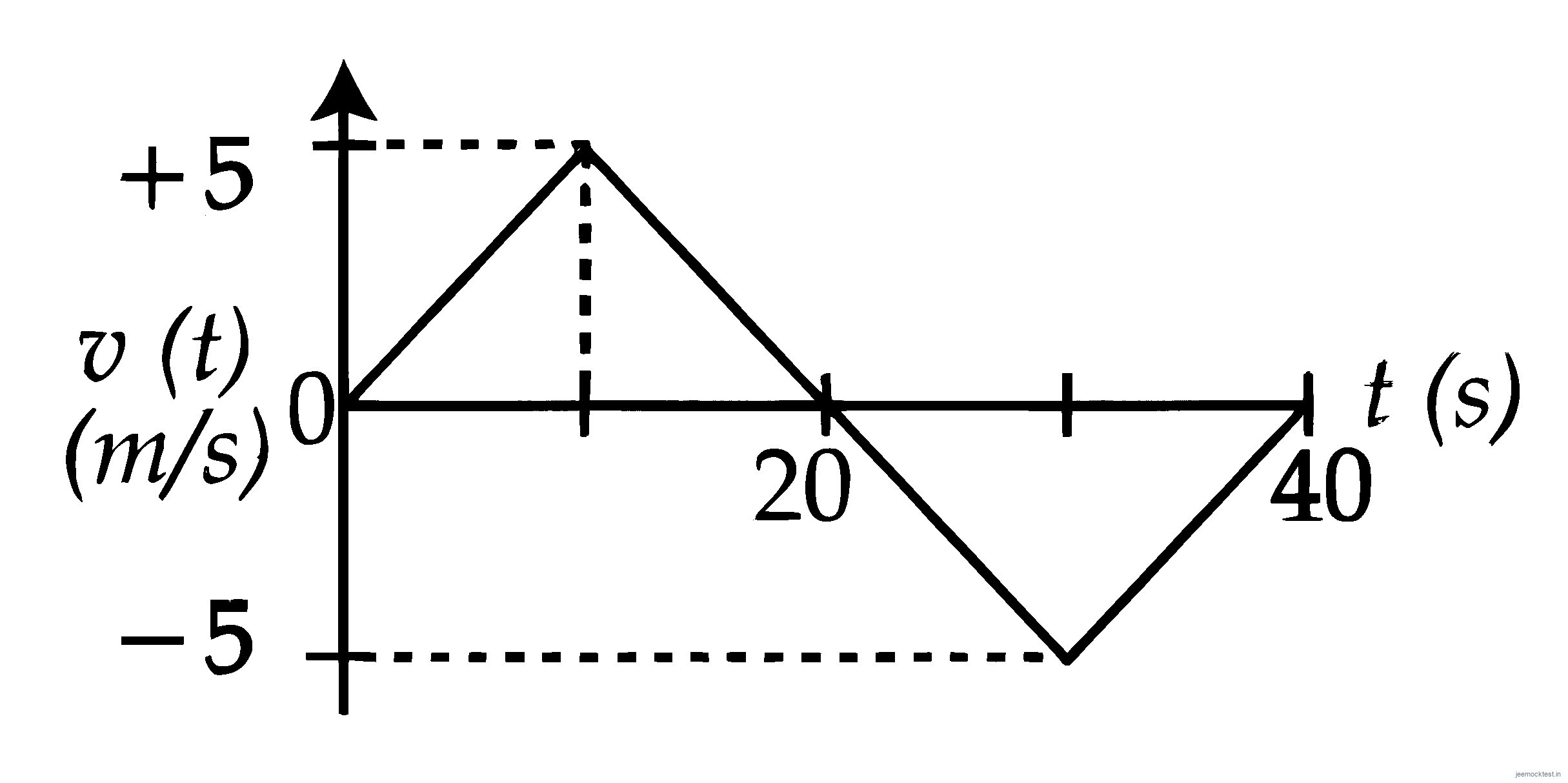
Two cars and are moving in the same direction along a straight line with speeds and , respectively such that car is moving ahead of car . A person in car throws a stone with a speed so that it hits the car with a speed of . The value of is .
A particle starts moving from time and its coordinate is given as
A. The particle returns to its original position (origin) 0.866 units later
B. The particle is 1 unit away from origin at its turning point
C. Acceleration of the particle is non-negative
D. The particle is 0.5 units away from origin at its turning point
E. Particle never turns back as acceleration is non-negative
Choose the correct answer from the options given below :