JEE PYQ: Motion in a Straight Line - Question ID f28a6671e406 (JEE Main 2020)
x2 = at2 + 2bt + c. If the acceleration of the particle depends on x as x–n, where n is an integer, the value of n is __________
Your Answer
Step-by-step Explanation
In one-dimensional motion, the position \( x \) of a particle is given as a function of time \( t \). To find the acceleration, we follow these steps:
- Velocity (\( v \)): The first derivative of position with respect to time, \( v = \frac{dx}{dt} \).
- Acceleration (\( a \)): The first derivative of velocity with respect to time, or the second derivative of position with respect to time, \( a = \frac{dv}{dt} = \frac{d^2x}{dt^2} \).
- Given Relationship: The acceleration depends on \( x \) as \( a \propto x^{-n} \), where \( n \) is an integer. Our goal is to find \( n \).
The key concept here is to express acceleration in terms of \( x \) using the given position-time relationship \( x^2 = at^2 + 2bt + c \), and then compare it with the given form \( a \propto x^{-n} \).
Step-by-Step Derivation:
Step 1: Differentiate the given position-time equation implicitly.
Given:
Differentiate both sides with respect to \( t \):
Simplify:
Here, \( \frac{dx}{dt} = v \) (velocity).
Step 2: Differentiate again to find acceleration.
Differentiate Equation 1 with respect to \( t \):
Using the product rule on the left side:
Substitute \( \frac{dx}{dt} = v \) and \( \frac{d^2x}{dt^2} = a \) (acceleration):
Rearrange to solve for acceleration \( a \):
This expression is not yet in terms of \( x \) alone. We need to eliminate \( v \).
Step 3: Express \( v \) in terms of \( x \).
From Equation 1:
Square both sides:
Substitute \( v^2 \) into Equation 2:
Simplify the numerator using the given \( x^2 = at^2 + 2bt + c \):
Expand:
Cancel terms:
Thus, acceleration becomes:
This shows that acceleration is inversely proportional to \( x^3 \):
Step 4: Compare with the given form \( a \propto x^{-n} \).
From the derived relationship \( a \propto x^{-3} \), we see that \( n = 3 \).
- Implicit Differentiation Mistake: Students often forget to apply the product rule when differentiating \( x \frac{dx}{dt} \). This leads to incorrect expressions for acceleration.
- Substitution Error: Failing to substitute \( x^2 = at^2 + 2bt + c \) correctly when simplifying the numerator can result in an incorrect expression for acceleration.
- Algebraic Simplification: Not expanding and canceling terms properly in the numerator can make the problem seem more complicated than it is.
- Exam Tip: Always express acceleration in terms of \( x \) alone before comparing with the given form. This ensures clarity and avoids confusion with intermediate variables like \( v \) or \( t \).
Final Answer: The value of \( n \) is \( \boxed{3} \).
Related Questions from Motion in a Straight Line
A gas balloon is going up with a constant velocity of . When this balloon reached a height of 75 m , a stone is dropped from it and balloon keeps moving up with the same velocity. The height of the balloon when the stone hits the ground is m. (Take )
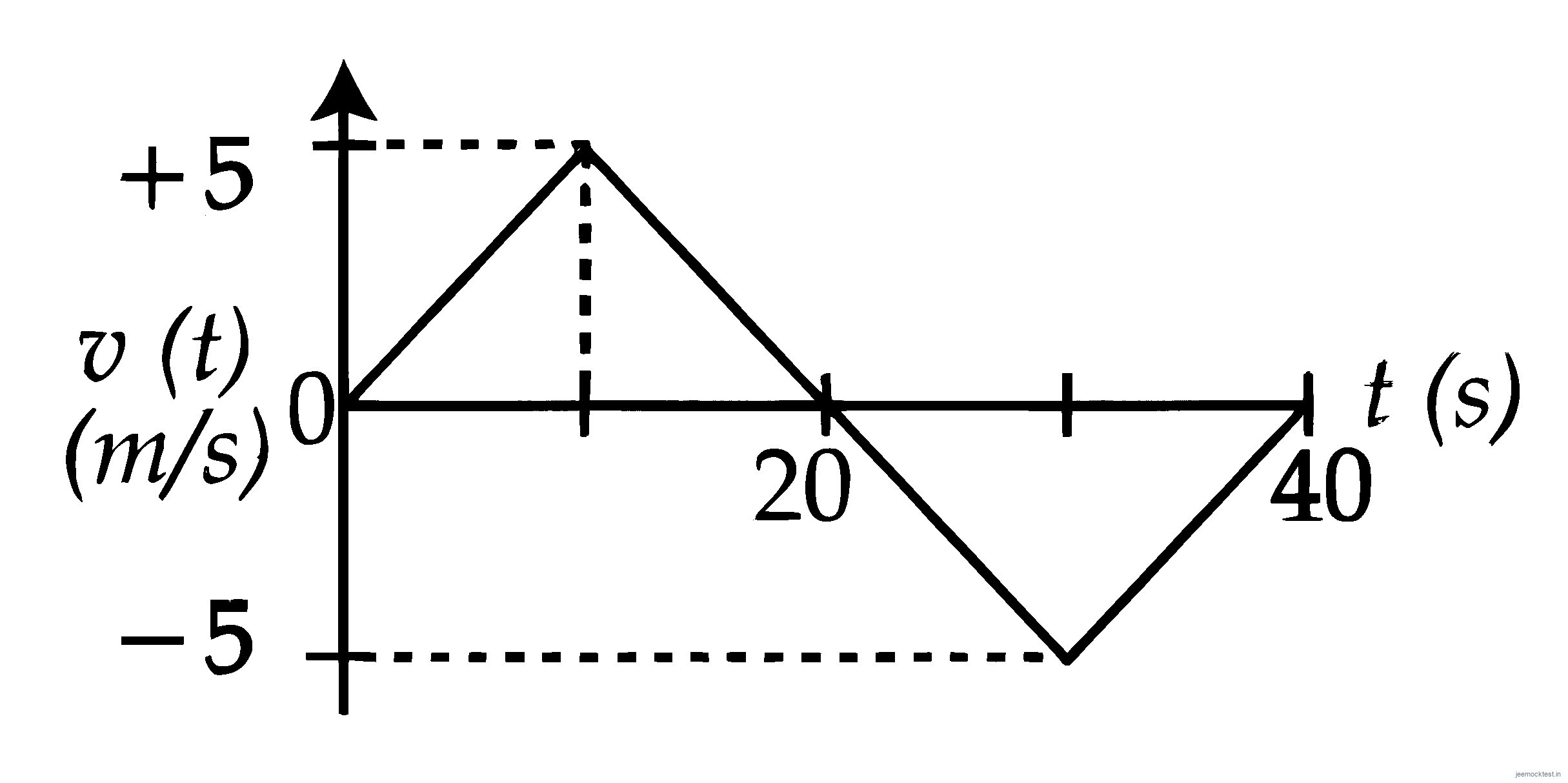
The velocity versus time plot of a particle is shown in the figure, for a time interval of 40 s . The total distance travelled by the particle and the average velocity during this period are, respectively
.
Two cars and are moving in the same direction along a straight line with speeds and , respectively such that car is moving ahead of car . A person in car throws a stone with a speed so that it hits the car with a speed of . The value of is .
A particle starts moving from time and its coordinate is given as
A. The particle returns to its original position (origin) 0.866 units later
B. The particle is 1 unit away from origin at its turning point
C. Acceleration of the particle is non-negative
D. The particle is 0.5 units away from origin at its turning point
E. Particle never turns back as acceleration is non-negative
Choose the correct answer from the options given below :