JEE PYQ: Motion in a Straight Line - Question ID e5a7eb16c49a (JEE Main 2023)
The distance travelled by an object in time is given by . The instantaneous speed of the object at will be:
Select Option
Step-by-step Explanation
In kinematics, the instantaneous speed of an object is defined as the magnitude of its instantaneous velocity. When the position (or distance travelled) \( s \) of an object is given as a function of time \( t \), the instantaneous velocity \( v(t) \) is obtained by differentiating \( s(t) \) with respect to \( t \):
Here, \( s(t) = (2.5) t^{2} \) is the distance travelled as a function of time. The instantaneous speed at any time \( t \) is simply the absolute value of \( v(t) \), since speed is a scalar quantity and always non-negative.
Step-by-Step Derivation:Step 1: Write down the given distance-time relation.
Step 2: Differentiate \( s(t) \) with respect to \( t \) to find the velocity function \( v(t) \).
Using the power rule of differentiation: Apply this to \( s(t) \):Step 3: Evaluate the velocity at \( t = 5 \, \text{s} \).
Substitute \( t = 5 \) into \( v(t) \):Step 4: Interpret the result.
Since speed is the magnitude of velocity, and \( v(5) = 25 \, \text{ms}^{-1} \) is already positive, the instantaneous speed at \( t = 5 \, \text{s} \) is:Step 5: Match with the given options.
The correct option is D: \( 25 \, \text{ms}^{-1} \). Common Traps & Exam Tip:
Trap 1: Confusing distance with speed.
Some students mistakenly think that substituting \( t = 5 \) directly into \( s(t) \) gives speed. This yields \( s(5) = 2.5 \cdot 25 = 62.5 \, \text{m} \), which is distance, not speed. Speed is the rate of change of distance, not the distance itself.
Trap 2: Forgetting to differentiate.
A common oversight is to skip differentiation and assume speed equals the coefficient of \( t^2 \). This leads to incorrect values like 2.5 or 5.
Trap 3: Misapplying units.
Ensure that the final answer is in \( \text{ms}^{-1} \), not \( \text{m} \) or \( \text{s}^{-2} \). Differentiating \( s(t) \) in meters gives velocity in \( \text{ms}^{-1} \).
Exam Tip:
Always remember: Speed at an instant is the derivative of distance with respect to time. If the distance function is quadratic in \( t \), the speed function will be linear. This pattern is common in kinematics problems.
Related Questions from Motion in a Straight Line
A gas balloon is going up with a constant velocity of . When this balloon reached a height of 75 m , a stone is dropped from it and balloon keeps moving up with the same velocity. The height of the balloon when the stone hits the ground is m. (Take )
The velocity versus time plot of a particle is shown in the figure, for a time interval of 40 s . The total distance travelled by the particle and the average velocity during this period are, respectively
.
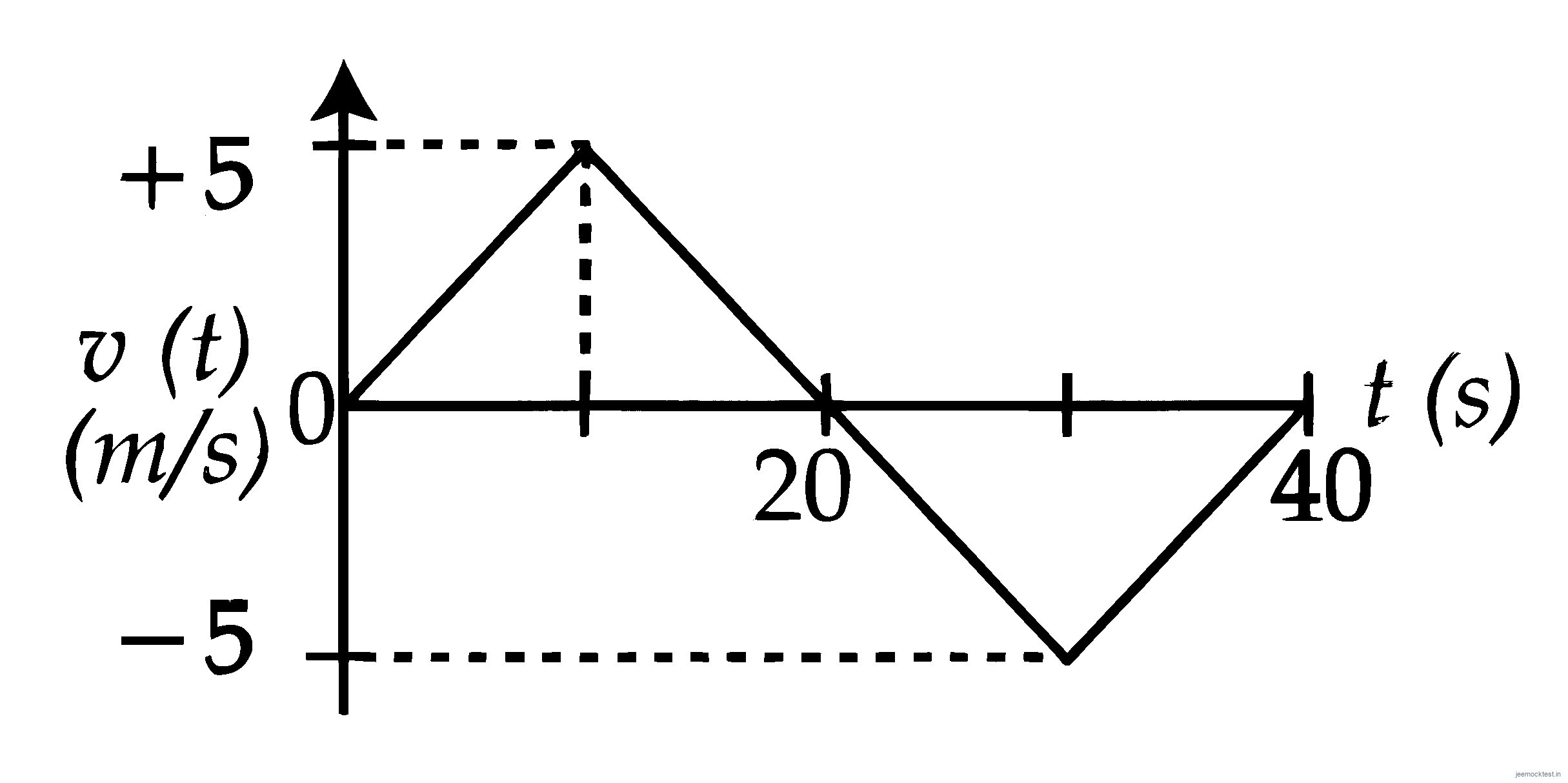
Two cars and are moving in the same direction along a straight line with speeds and , respectively such that car is moving ahead of car . A person in car throws a stone with a speed so that it hits the car with a speed of . The value of is .
A particle starts moving from time and its coordinate is given as
A. The particle returns to its original position (origin) 0.866 units later
B. The particle is 1 unit away from origin at its turning point
C. Acceleration of the particle is non-negative
D. The particle is 0.5 units away from origin at its turning point
E. Particle never turns back as acceleration is non-negative
Choose the correct answer from the options given below :