JEE PYQ: Motion in a Straight Line - Question ID e1d5bb605b90 (JEE Main 2019)
Select Option
Step-by-step Explanation
In problems involving motion with constant acceleration, the following kinematic relations are fundamental:
- Displacement () as a function of time () and acceleration (): where is the initial velocity.
- Final velocity () as a function of initial velocity, acceleration, and time:
- Relation between displacement, initial velocity, final velocity, and acceleration (without explicit time):
Since both cars start from rest, their initial velocities are zero (). The key idea is to express the race distance in terms of each car’s acceleration and travel time, then relate the time difference and speed difference at the finish.
Step-by-Step Derivation:Let:
- = acceleration of car A
- = acceleration of car B
- = time taken by car A to finish
- = time taken by car B to finish
- = speed of car A at finish
- = speed of car B at finish
1. Express the race distance in two ways:
Since both cars cover the same distance from rest:
Equate the two expressions:
2. Relate the time difference:
Car A finishes seconds earlier than car B:
3. Express the speed difference at finish:
Since both cars start from rest, their final speeds are:
The problem states that car A passes the finish with speed more than car B:
4. Substitute from (2) into (1):
Expand the right side: Bring all terms to one side:This is a quadratic in . However, instead of solving for , we use equation (3) to eliminate .
5. Express in terms of and :
From (3): Substitute :6. Solve for from equation (1):
From (1): Substitute : Square both sides: This brings us back to the earlier quadratic. Instead, let’s use a substitution to simplify.7. Introduce a ratio variable:
Let . Then , and from (2): Substitute into (1): Cancel : Take square roots (assuming positive accelerations and times):8. Express in terms of and :
From (4): Substitute : Substitute : Simplify the numerator: Thus: So:Thus, the correct expression for is:
Common Traps & Exam Tip:Students often make these mistakes:
- Incorrectly relating time and speed: Many assume that the speed difference is directly proportional to the acceleration difference, ignoring the quadratic relation between time and distance.
- Algebraic errors in substitution: The quadratic in can be messy; substituting a ratio variable (like ) simplifies the algebra.
- Misapplying kinematic equations: Forgetting that both cars start from rest and using incorrect initial conditions leads to wrong expressions.
- Overcomplicating the problem: Some students try to solve for explicitly, which is unnecessary. The key is to express everything in terms of the given time difference .
Exam Tip: Always start by writing down known quantities and relations. Use symmetry and substitution to reduce variables. In this problem, introducing simplifies the algebra significantly.
Related Questions from Motion in a Straight Line
A gas balloon is going up with a constant velocity of . When this balloon reached a height of 75 m , a stone is dropped from it and balloon keeps moving up with the same velocity. The height of the balloon when the stone hits the ground is m. (Take )
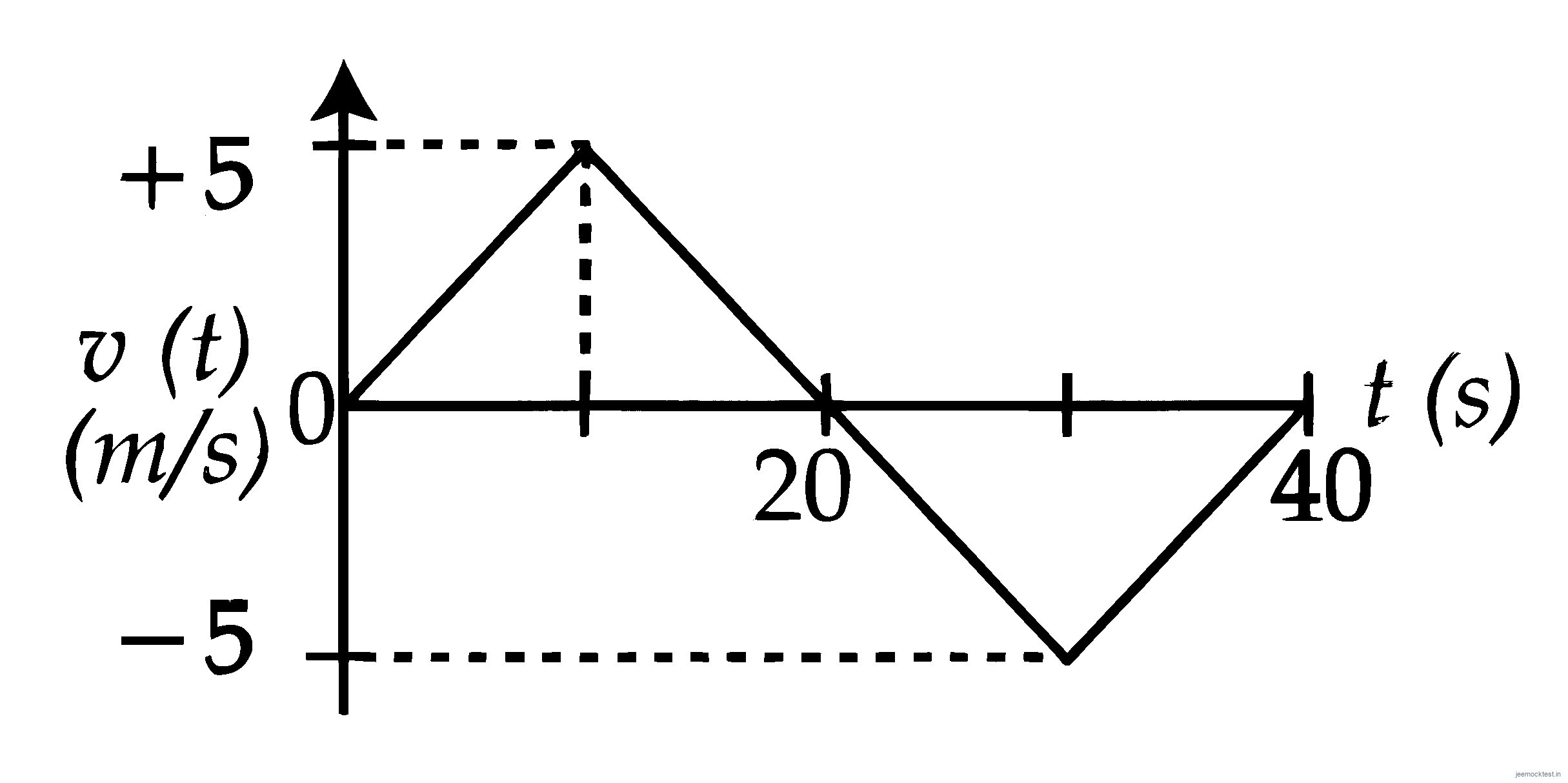
The velocity versus time plot of a particle is shown in the figure, for a time interval of 40 s . The total distance travelled by the particle and the average velocity during this period are, respectively
.
Two cars and are moving in the same direction along a straight line with speeds and , respectively such that car is moving ahead of car . A person in car throws a stone with a speed so that it hits the car with a speed of . The value of is .
A particle starts moving from time and its coordinate is given as
A. The particle returns to its original position (origin) 0.866 units later
B. The particle is 1 unit away from origin at its turning point
C. Acceleration of the particle is non-negative
D. The particle is 0.5 units away from origin at its turning point
E. Particle never turns back as acceleration is non-negative
Choose the correct answer from the options given below :