JEE PYQ: Motion in a Straight Line - Question ID e0f9e0ad9245 (JEE Main 2019)
x(t) = at + bt2 – ct3
where a, b and c are constants. When the particle attains zero acceleration, then its velocity will be :
Select Option
Step-by-step Explanation
In kinematics, the motion of a particle along a straight line is described by its position function . The velocity and acceleration are obtained by successive time derivatives of :
- Velocity:
- Acceleration:
When the acceleration becomes zero, the particle’s velocity at that instant is what we must find.
Step-by-Step Derivation:Given position function:
Step 1 – Compute velocity :
Step 2 – Compute acceleration :
Step 3 – Find the time when acceleration is zero:
Set :Step 4 – Compute velocity at :
Substitute into : Simplify each term:Conclusion:
The velocity when acceleration is zero is , which corresponds to option C. Common Traps & Exam Tip:Many students mistakenly stop after finding and forget to substitute back into the velocity expression. Others confuse the order of derivatives, leading to incorrect expressions for or . Always double-check each derivative and substitution step.
Related Questions from Motion in a Straight Line
A gas balloon is going up with a constant velocity of . When this balloon reached a height of 75 m , a stone is dropped from it and balloon keeps moving up with the same velocity. The height of the balloon when the stone hits the ground is m. (Take )
The velocity versus time plot of a particle is shown in the figure, for a time interval of 40 s . The total distance travelled by the particle and the average velocity during this period are, respectively
.
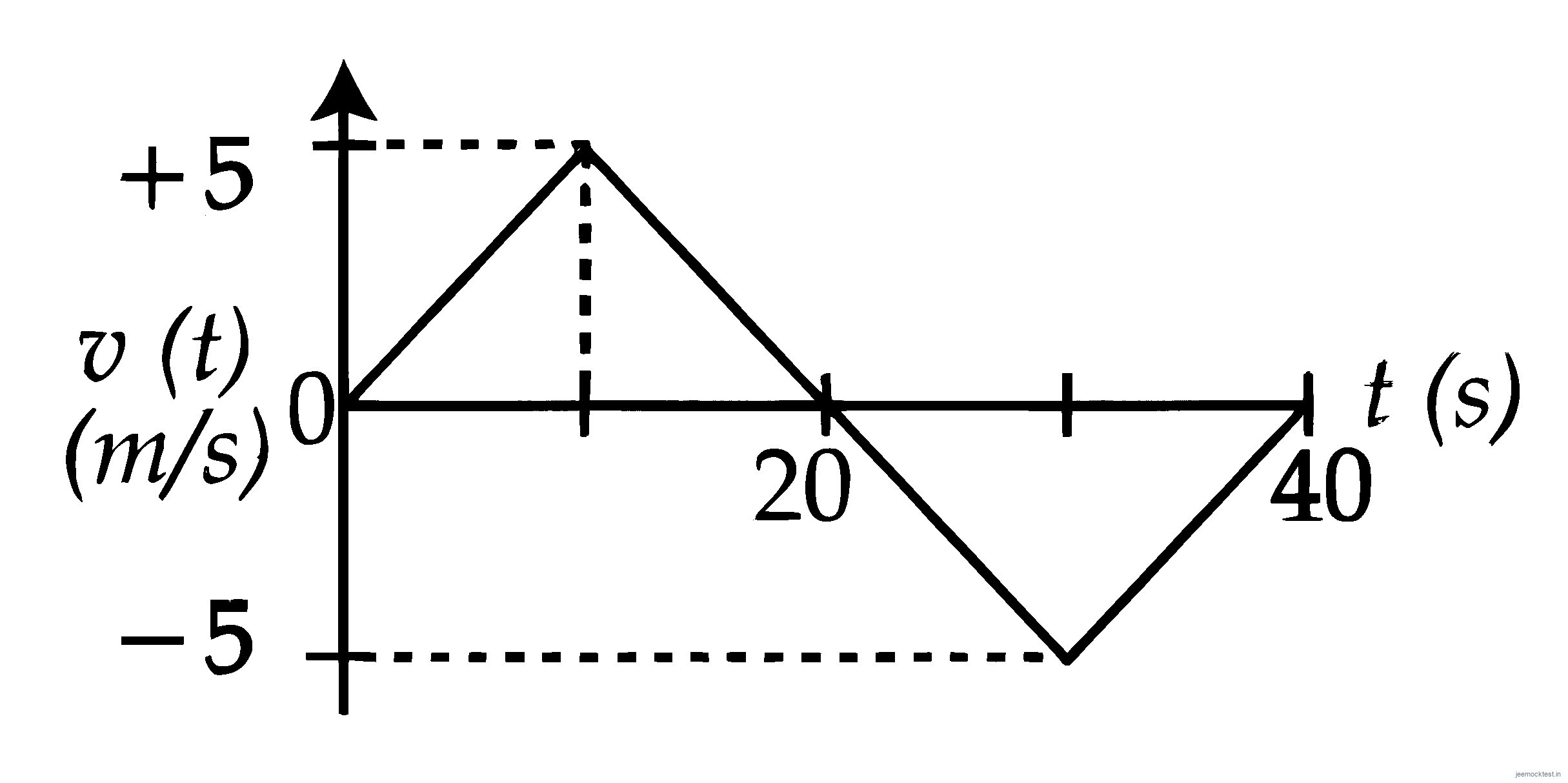
Two cars and are moving in the same direction along a straight line with speeds and , respectively such that car is moving ahead of car . A person in car throws a stone with a speed so that it hits the car with a speed of . The value of is .
A particle starts moving from time and its coordinate is given as
A. The particle returns to its original position (origin) 0.866 units later
B. The particle is 1 unit away from origin at its turning point
C. Acceleration of the particle is non-negative
D. The particle is 0.5 units away from origin at its turning point
E. Particle never turns back as acceleration is non-negative
Choose the correct answer from the options given below :