JEE PYQ: Motion in a Straight Line - Question ID ded24d6bbdc8 (JEE Main 2002)
Select Option
Step-by-step Explanation
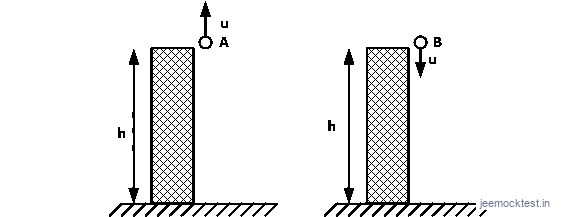
In this problem, we analyze the motion of two balls thrown vertically from a building under the influence of gravity. The key concept here is the conservation of mechanical energy or equivalently, the kinematic equations of motion under constant acceleration (gravity, ).
The fundamental physics principle at play is that the change in kinetic energy of an object moving under gravity depends only on the vertical displacement and not on the path taken or the direction of initial velocity, provided air resistance is neglected.
The relevant kinematic equation for velocity under constant acceleration is: where: - = final velocity, - = initial velocity, - = acceleration (here, , acceleration due to gravity), - = displacement.
We must be careful with the sign convention: - Let’s take upward as positive. - Then, acceleration (since gravity acts downward). - Displacement will be negative if the object moves downward from the point of projection.
Alternatively, using energy conservation: where is the height of the building, and is the speed just before hitting the ground.
Step-by-Step Derivation:Let’s define: - : height of the building (positive value), - : magnitude of initial speed of both balls A and B, - : acceleration due to gravity (positive scalar), - : speed of ball A (thrown upward) when it hits the ground, - : speed of ball B (thrown downward) when it hits the ground.
For Ball A (thrown upward):
- Initial velocity: (upward), - Displacement: (since it goes from top to ground, downward), - Acceleration: . Using the kinematic equation:For Ball B (thrown downward):
- Initial velocity: (downward), - Displacement: (same as above), - Acceleration: . Using the kinematic equation:Thus, we observe: (since speed is positive)
Alternatively, using energy conservation: For both balls, initial kinetic energy is , and initial potential energy is (taking ground as reference). When they hit the ground, potential energy is zero, and kinetic energy is . So, This holds for both balls, regardless of direction of throw. Hence, .
Common Traps & Exam Tip:Trap 1: Students often confuse the direction of initial velocity and think that throwing upward slows the ball down, leading to a smaller final speed. However, the upward throw only changes the time of flight, not the final speed, because the ball gains kinetic energy equivalent to the potential energy lost during the fall.
Trap 2: Misapplying sign conventions. If signs are not handled carefully, especially for displacement and acceleration, the result may appear incorrect. Always define a consistent coordinate system.
Trap 3: Assuming mass affects the final velocity. Since acceleration due to gravity is independent of mass, and air resistance is neglected, the final speed depends only on initial speed and height, not mass. Option D is a distractor.
Exam Tip: In problems involving vertical motion under gravity, always consider using energy conservation — it simplifies the analysis by avoiding vector directions and sign errors. The final speed depends only on the initial speed and the vertical distance fallen, not on the path taken.
Conclusion: The correct answer is B: .
Related Questions from Motion in a Straight Line
A gas balloon is going up with a constant velocity of . When this balloon reached a height of 75 m , a stone is dropped from it and balloon keeps moving up with the same velocity. The height of the balloon when the stone hits the ground is m. (Take )
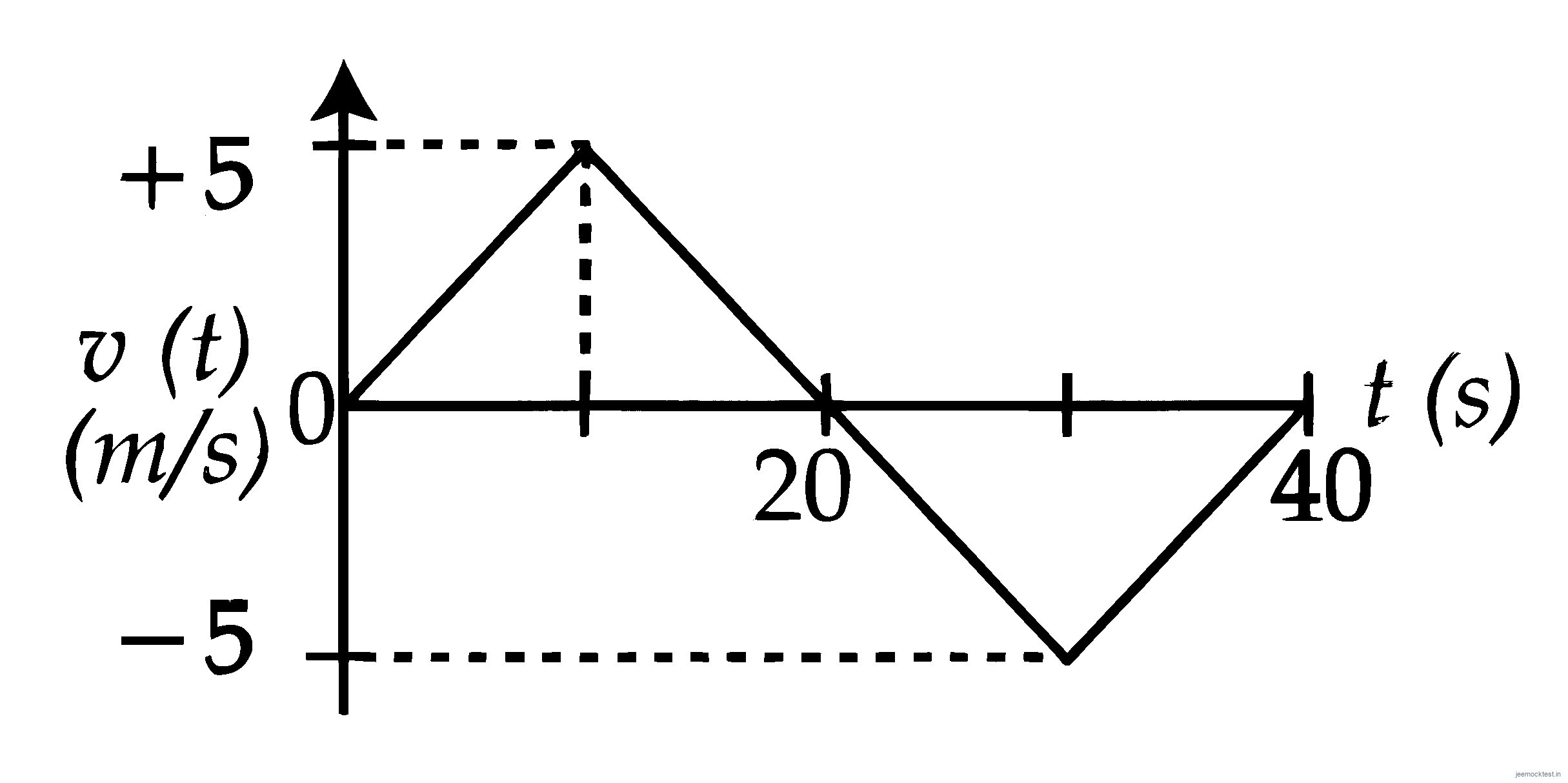
The velocity versus time plot of a particle is shown in the figure, for a time interval of 40 s . The total distance travelled by the particle and the average velocity during this period are, respectively
.
Two cars and are moving in the same direction along a straight line with speeds and , respectively such that car is moving ahead of car . A person in car throws a stone with a speed so that it hits the car with a speed of . The value of is .
A particle starts moving from time and its coordinate is given as
A. The particle returns to its original position (origin) 0.866 units later
B. The particle is 1 unit away from origin at its turning point
C. Acceleration of the particle is non-negative
D. The particle is 0.5 units away from origin at its turning point
E. Particle never turns back as acceleration is non-negative
Choose the correct answer from the options given below :