JEE PYQ: Motion in a Straight Line - Question ID de3b30f45622 (JEE Main 2018)
Select Option
Step-by-step Explanation
In problems involving braking and stopping distances, the key physics concept is kinematic motion under constant deceleration. When brakes are applied, the automobile experiences a constant negative acceleration (deceleration), bringing it to rest.
The fundamental kinematic equation used here is: where:
- = final velocity (0 m/s, since the vehicle stops),
- = initial velocity (in m/s),
- = acceleration (negative, since it's deceleration),
- = stopping distance.
Since the braking force (and hence deceleration) is assumed constant and the same in both cases, the stopping distance is proportional to the square of the initial speed. This is a crucial insight: doubling the speed quadruples the stopping distance.
Step-by-Step Derivation:Step 1: Convert speeds to consistent units (m/s)
Initial speed at 40 km/h:
Initial speed at 80 km/h:
Step 2: Use kinematic equation to find deceleration
For the first case ( m/s, m, ): We don’t need the exact value of , only its constancy.
Step 3: Apply same deceleration to second case
For the second case ( m/s, same , ):
Step 4: Relate stopping distances using speed ratio
From Step 2 and Step 3: Thus:
Common Traps & Exam Tip:Students often mistakenly assume that stopping distance is directly proportional to speed (i.e., doubling speed doubles distance). This leads them to choose 80 m (Option B) instead of 160 m. The correct relationship is quadratic: stopping distance scales with the square of the speed.
Exam Tip: Always convert speeds to consistent units (preferably m/s) and use the kinematic equation for braking problems. Remember: no skidding implies constant deceleration, so the ratio of stopping distances equals the square of the speed ratio.
Related Questions from Motion in a Straight Line
A gas balloon is going up with a constant velocity of . When this balloon reached a height of 75 m , a stone is dropped from it and balloon keeps moving up with the same velocity. The height of the balloon when the stone hits the ground is m. (Take )
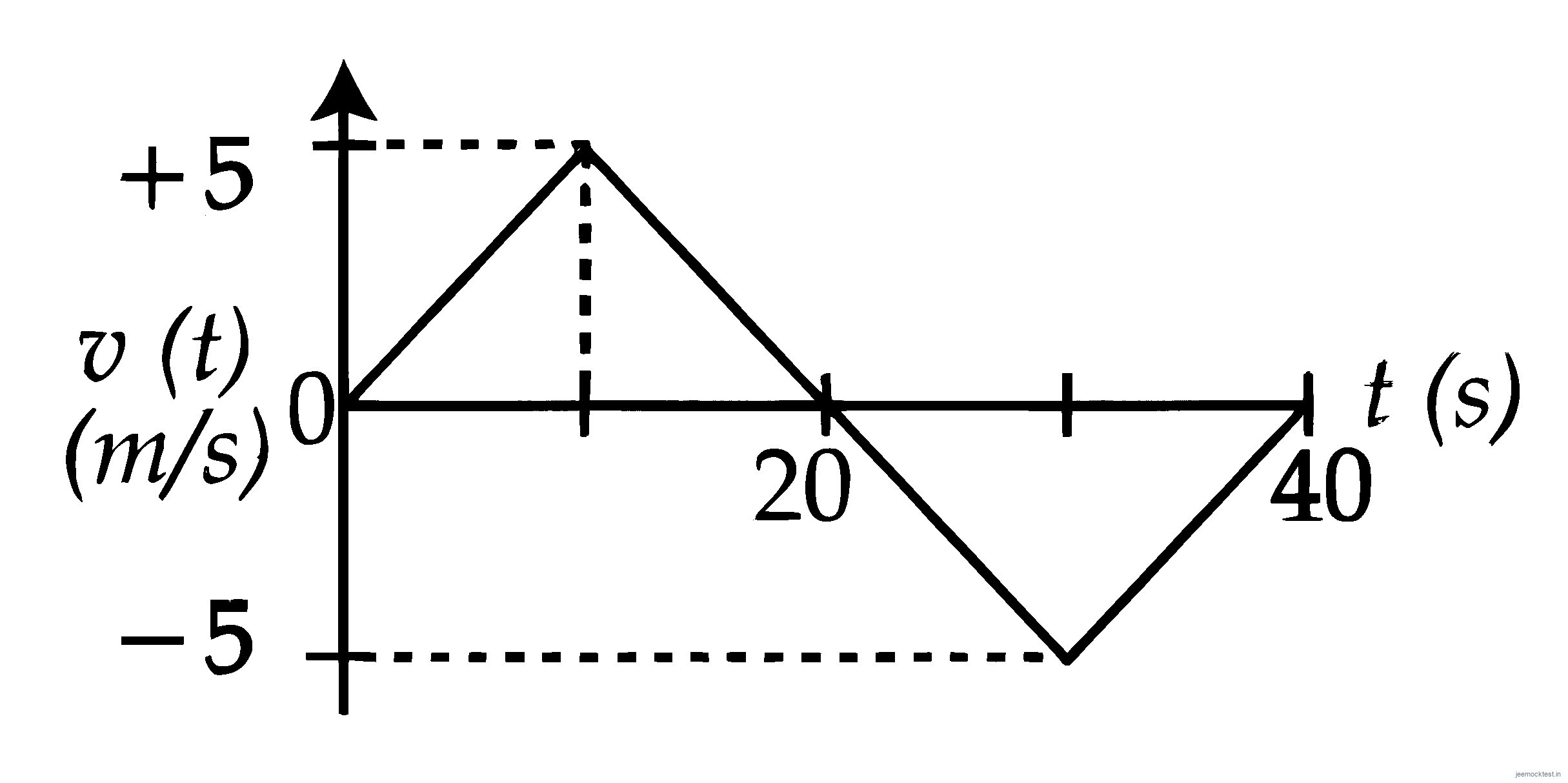
The velocity versus time plot of a particle is shown in the figure, for a time interval of 40 s . The total distance travelled by the particle and the average velocity during this period are, respectively
.
Two cars and are moving in the same direction along a straight line with speeds and , respectively such that car is moving ahead of car . A person in car throws a stone with a speed so that it hits the car with a speed of . The value of is .
A particle starts moving from time and its coordinate is given as
A. The particle returns to its original position (origin) 0.866 units later
B. The particle is 1 unit away from origin at its turning point
C. Acceleration of the particle is non-negative
D. The particle is 0.5 units away from origin at its turning point
E. Particle never turns back as acceleration is non-negative
Choose the correct answer from the options given below :