JEE PYQ: Units & Measurements - Question ID da2c301c32ea (JEE Main 2026)
A spherical body of radius and density falls freely through a viscous liquid having density and viscosity and attains a terminal velocity . Estimated maximum error in the quantity is : (Ignore errors associated with , and , gravitational acceleration)
Select Option
Step-by-step Explanation
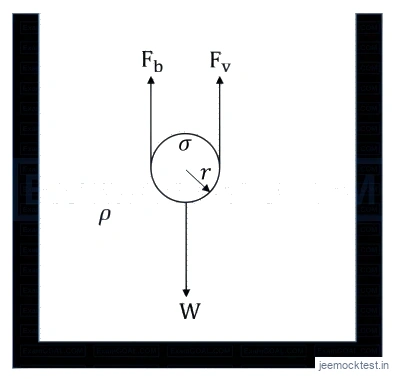
When a spherical body falls freely through a viscous liquid, it experiences three primary forces:
- Gravitational Force (): Downward force due to gravity, given by , where is the radius, is the density of the sphere, and is gravitational acceleration.
- Buoyant Force (): Upward force due to the displaced liquid, given by , where is the density of the liquid.
- Viscous Drag Force (): Opposing force due to viscosity, given by Stokes' Law: , where is the viscosity of the liquid, and is the velocity of the sphere.
At terminal velocity (), the net force on the sphere is zero, meaning the downward forces balance the upward forces:
Substituting the expressions for , , and : Simplifying, we solve for :Since errors in , , and are ignored, the maximum error in depends only on the errors in and .
Step-by-Step Derivation:To find the maximum error in , we use the formula for relative error in a product or quotient. For a function of the form:
where is a constant (since errors in , , and are ignored), the relative error in is given by: Calculating the partial derivatives: 1. Partial derivative with respect to : Thus, 2. Partial derivative with respect to : Thus, Adding these contributions, the maximum relative error in is:Therefore, the maximum error in is:
However, the question asks for the estimated maximum error in the quantity , which is typically expressed as the relative error . The options are given in terms of this relative error, so the correct choice is: Common Traps & Exam Tip:Students often make the following mistakes in this question:
- Incorrect Sign Handling: Some students forget that errors are always added in quadrature or as absolute values, leading to incorrect signs (e.g., subtracting instead of adding).
- Misapplying the Error Formula: The error in is , not . Students may overlook the exponent and treat as .
- Ignoring the Negative Exponent: The term contributes to the error, but students may mistakenly treat it as due to confusion with the term.
- Confusing Absolute and Relative Errors: The question asks for the relative error in , not the absolute error. Students may incorrectly compute instead of .
Exam Tip: Always write down the formula for explicitly and identify which variables contribute to the error. Use the rule that for a function , the relative error is . This will help avoid mistakes with exponents and signs.
Related Questions from Units & Measurements
In a Vernier calipers, when both jaws touch each other, zero of the Vernier scale is shifted to the right of zero of the main scale and Vernier division coincides with a main scale reading. If the value of 1 main scale division is 1 mm and there are 10 Vernier scale divisions, then the Vernier caliper has
Dimensions of universal gravitational constant () in terms of Planck's constant (), distance (), mass () and time () are _______.
The time period of a simple harmonic oscillator is . Measured value of mass of the object is 10 g with an accuracy of 10 mg and time for 50 oscillations of the spring is found to be 60 s using a watch of 2 s resolution. Percentage error in determination of spring constant is ________%.
When both jaws of vernier callipers touch each other, zero mark of the vernier scale is right to zero mark of main scale, mark on vernier scale coincides with certain mark on the main scale. While measuring the length of a cylinder, observer observes 15 divisions on main scale and division of vernier scale coincides with a main scale division. Measured length of cylinder is mm.
(Least count of Vernier calliper )