JEE PYQ: Motion in a Straight Line - Question ID d81de6ff9d33 (JEE Main 2014)
Select Option
Step-by-step Explanation
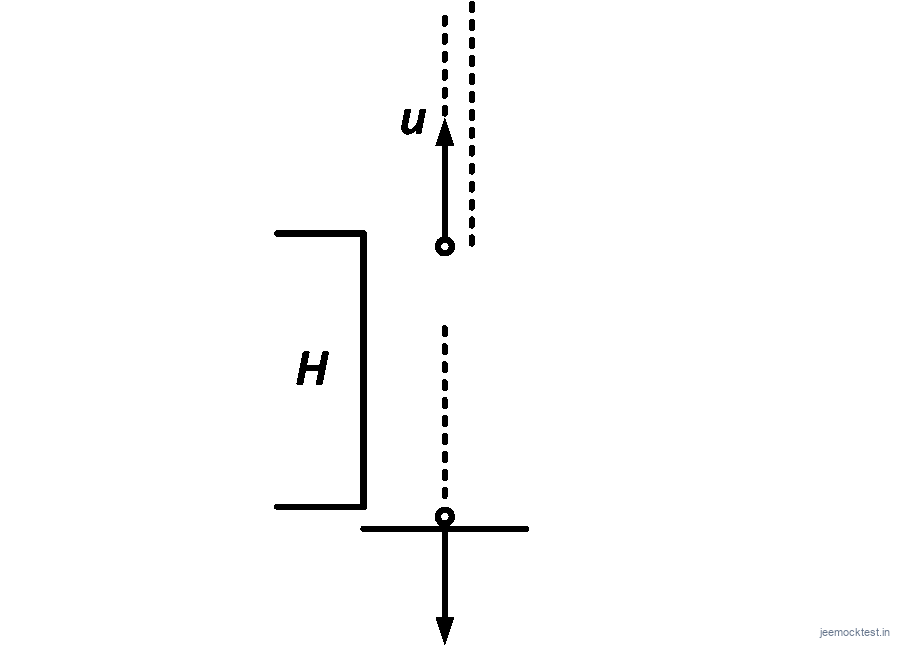
In this problem, we analyze the motion of a particle under constant gravitational acceleration () when thrown vertically upward from a tower of height . The key concepts and formulas involved are:
- Equations of Motion: For uniformly accelerated motion along a straight line, the displacement (), initial velocity (), acceleration (), and time () are related by: Here, (since upward is taken as positive and gravity acts downward).
- Time to Reach Highest Point (): At the highest point, the final velocity becomes zero. Using :
- Total Time to Hit the Ground (): The particle is thrown upward, reaches the highest point, then falls back down past the tower to the ground. The total displacement from the point of projection to the ground is (negative because it ends below the starting point). Using the displacement equation: This is a quadratic in .
- Relation Between Times: The problem states that the total time to hit the ground () is times the time to reach the highest point ():
Step 1: Express (time to reach highest point)
At the highest point, velocity . Using :
Step 2: Express (total time to hit the ground)
The particle is projected upward from height and lands on the ground, so the net displacement is . Using the displacement equation: Rearrange: This is a quadratic equation in :
Step 3: Use the given relation
Substitute into :
Step 4: Substitute into the quadratic equation
Plug into : Simplify: Multiply through by to eliminate denominators: Factor out : Rearrange: Factor the right side:
Step 5: Match with the given options
The derived relation is: This matches Option C.
Common Traps & Exam Tip:- Sign Convention: Many students confuse the sign of displacement and acceleration. Always take upward as positive and downward (including gravity) as negative. The displacement to the ground is , not .
- Quadratic Equation Setup: Students often incorrectly set up the displacement equation for as , forgetting that the particle ends below the starting point. This leads to the wrong relation.
- Time Relation Misinterpretation: The phrase "time taken to hit the ground is times that taken to reach the highest point" is sometimes misread as , reversing the relation. Always verify which time is larger.
- Algebraic Simplification: In the final steps, students may fail to factor as , missing the match with Option C. Practice factoring quadratics to avoid this.
Exam Tip: When solving such problems, always:
- Define a clear sign convention.
- Write down known values and relations explicitly.
- Substitute carefully, especially when dealing with quadratic equations.
- Cross-check units and dimensions in the final relation to eliminate absurd options.
Related Questions from Motion in a Straight Line
A gas balloon is going up with a constant velocity of . When this balloon reached a height of 75 m , a stone is dropped from it and balloon keeps moving up with the same velocity. The height of the balloon when the stone hits the ground is m. (Take )
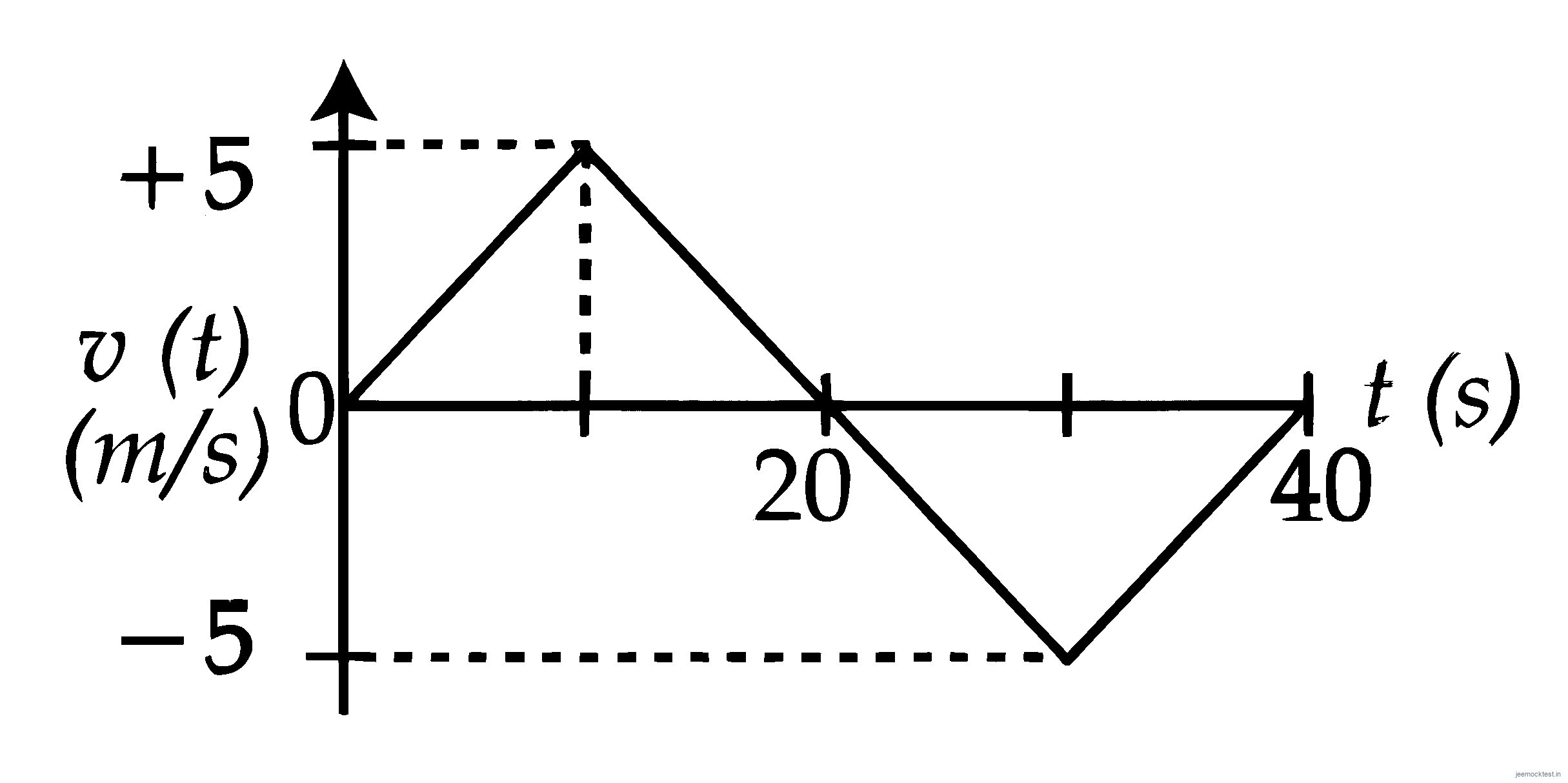
The velocity versus time plot of a particle is shown in the figure, for a time interval of 40 s . The total distance travelled by the particle and the average velocity during this period are, respectively
.
Two cars and are moving in the same direction along a straight line with speeds and , respectively such that car is moving ahead of car . A person in car throws a stone with a speed so that it hits the car with a speed of . The value of is .
A particle starts moving from time and its coordinate is given as
A. The particle returns to its original position (origin) 0.866 units later
B. The particle is 1 unit away from origin at its turning point
C. Acceleration of the particle is non-negative
D. The particle is 0.5 units away from origin at its turning point
E. Particle never turns back as acceleration is non-negative
Choose the correct answer from the options given below :