JEE PYQ: Motion in a Straight Line - Question ID d5c326eec609 (JEE Main 2023)
Given below are two statements
Statement I : Area under velocity- time graph gives the distance travelled by the body in a given time.
Statement II : Area under acceleration- time graph is equal to the change in velocity- in the given time.
In the light of given statements, choose the correct answer from the options given below.
Select Option
Step-by-step Explanation
In kinematics, the relationships between displacement (), velocity (), and acceleration () are derived from calculus. The key formulas are:
- Velocity is the time derivative of displacement: Conversely, displacement is the integral of velocity over time: Geometrically, this integral corresponds to the area under the velocity-time graph.
- Acceleration is the time derivative of velocity: Therefore, the change in velocity is the integral of acceleration over time: This integral is the area under the acceleration-time graph.
However, a crucial distinction must be made:
- The area under the velocity-time graph gives the displacement, not necessarily the distance. Distance is the total path length and is always non-negative, whereas displacement can be negative if the body reverses direction.
- The area under the acceleration-time graph directly gives the change in velocity, which is always correct.
Analyzing Statement I:
Statement I claims: “Area under velocity-time graph gives the distance travelled by the body in a given time.”
- From calculus, the integral of velocity over time is displacement:
- If the velocity is always positive (or always negative), then the magnitude of displacement equals the distance travelled. However, if the velocity changes sign (i.e., the body reverses direction), the integral gives the net displacement, which is less than the total distance.
-
Example: A body moves forward with m/s for 2 s, then backward with m/s for 2 s.
- Displacement = m.
- Distance = m.
- Hence, Statement I is incorrect.
Analyzing Statement II:
Statement II claims: “Area under acceleration-time graph is equal to the change in velocity in the given time.”
- From the definition of acceleration:
- Integrating both sides from to :
- The right-hand side is precisely the area under the - graph between and .
- Therefore, Statement II is true.
Conclusion:
Statement I is incorrect, but Statement II is true. The correct option is C.
Common Traps & Exam Tip:Students often confuse displacement with distance. The area under the - graph gives displacement, not distance, unless the velocity never changes sign. Always check whether the motion involves a reversal in direction. For the - graph, the area always gives the change in velocity, so no such ambiguity exists.
Exam Tip: When in doubt, sketch a simple - graph with a sign change to verify the distinction between displacement and distance.
Related Questions from Motion in a Straight Line
A gas balloon is going up with a constant velocity of . When this balloon reached a height of 75 m , a stone is dropped from it and balloon keeps moving up with the same velocity. The height of the balloon when the stone hits the ground is m. (Take )
The velocity versus time plot of a particle is shown in the figure, for a time interval of 40 s . The total distance travelled by the particle and the average velocity during this period are, respectively
.
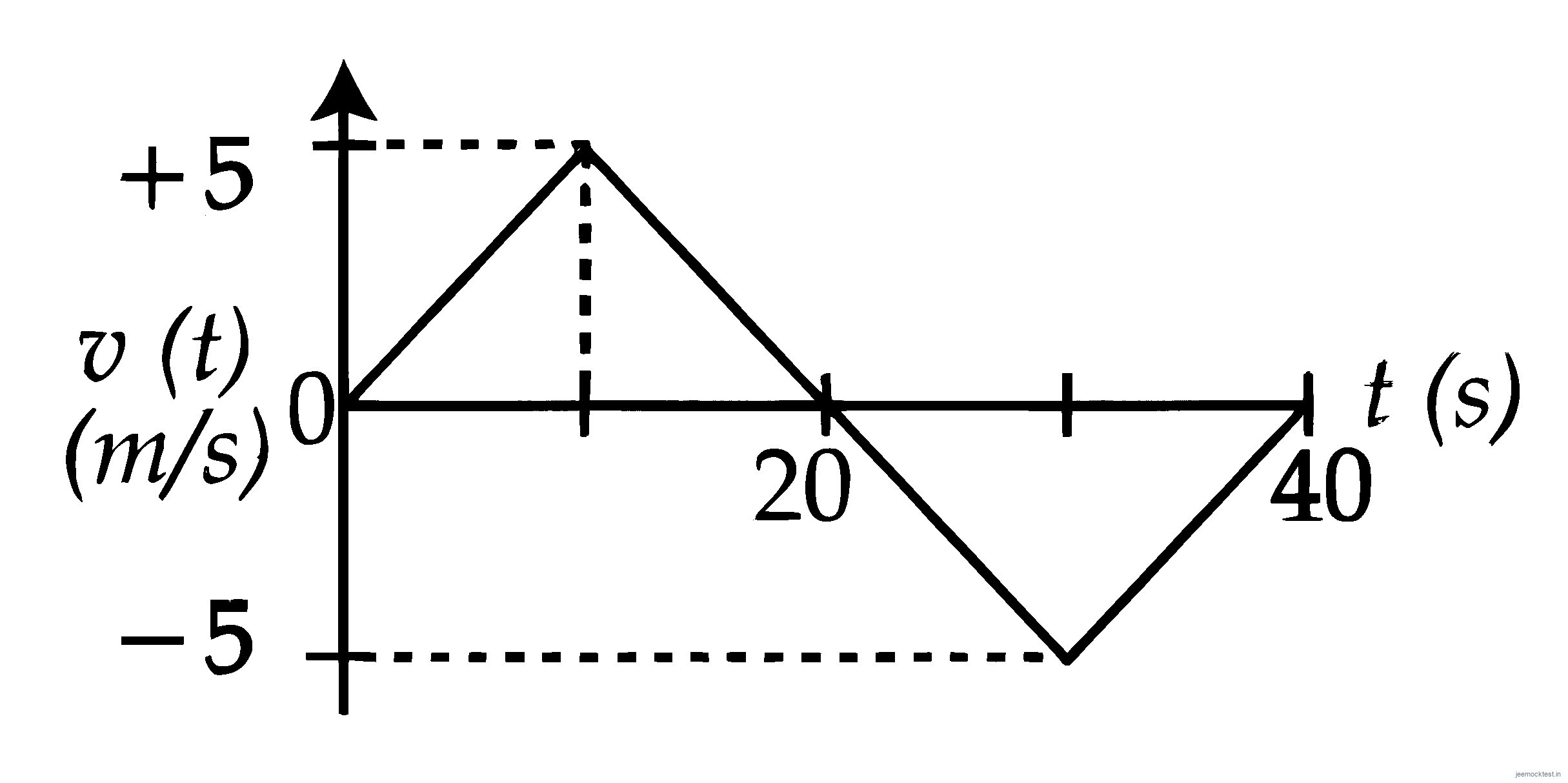
Two cars and are moving in the same direction along a straight line with speeds and , respectively such that car is moving ahead of car . A person in car throws a stone with a speed so that it hits the car with a speed of . The value of is .
A particle starts moving from time and its coordinate is given as
A. The particle returns to its original position (origin) 0.866 units later
B. The particle is 1 unit away from origin at its turning point
C. Acceleration of the particle is non-negative
D. The particle is 0.5 units away from origin at its turning point
E. Particle never turns back as acceleration is non-negative
Choose the correct answer from the options given below :