JEE PYQ: Motion in a Straight Line - Question ID d4fe173e9217 (JEE Main 2011)
where v is the instantaneous speed. The time taken by the object, to come to rest, would be :
Select Option
Step-by-step Explanation
This problem involves non-uniform deceleration—the deceleration is not constant but depends on the instantaneous speed \( v \). The given relation is: This is a first-order differential equation relating velocity and time. To find the time taken for the object to come to rest, we must solve this differential equation with the initial condition \( v(0) = 6.25 \, \text{m/s} \) and find the time \( t \) when \( v(t) = 0 \).
Key concepts used:
- Separation of variables in differential equations.
- Integration of power functions.
- Application of initial conditions to solve for constants.
Step 1: Rewrite the differential equation
We are given: This can be rewritten as: This is a separable differential equation.Step 2: Integrate both sides
Integrate the left side with respect to \( v \), and the right side with respect to \( t \): The left integral: The right integral: So, combining: where \( C = C_2 - C_1 \) is the combined constant of integration.Step 3: Apply the initial condition
At \( t = 0 \), \( v = 6.25 \, \text{m/s} \): So the equation becomes:Step 4: Solve for \( t \) when \( v = 0 \)
When the object comes to rest, \( v = 0 \):Conclusion:
The time taken by the object to come to rest is 2 seconds, which corresponds to option A. --- Common Traps & Exam Tip:
Trap 1: Misinterpreting the differential equation
Students often confuse \( \frac{dv}{dt} = -2.5 \sqrt{v} \) with constant deceleration. They might try to use \( v = u + at \), which is invalid here because acceleration is not constant. Always check if acceleration depends on velocity or time.
Trap 2: Incorrect integration
A common mistake is to integrate \( \frac{dv}{\sqrt{v}} \) incorrectly as \( \ln|\sqrt{v}| \) instead of \( 2\sqrt{v} \). Remember:
Here, \( n = -1/2 \), so the integral is \( 2 v^{1/2} \).
Trap 3: Forgetting to apply initial conditions
Without applying \( v(0) = 6.25 \), the constant \( C \) remains unknown, and the solution cannot be completed. Always use initial conditions to solve for constants.
Exam Tip:
When acceleration depends on velocity, separation of variables is usually the way to go. Write \( \frac{dv}{f(v)} = g(t) dt \), then integrate both sides. This technique is frequently tested in JEE and should be practiced thoroughly.
Related Questions from Motion in a Straight Line
A gas balloon is going up with a constant velocity of . When this balloon reached a height of 75 m , a stone is dropped from it and balloon keeps moving up with the same velocity. The height of the balloon when the stone hits the ground is m. (Take )
The velocity versus time plot of a particle is shown in the figure, for a time interval of 40 s . The total distance travelled by the particle and the average velocity during this period are, respectively
.
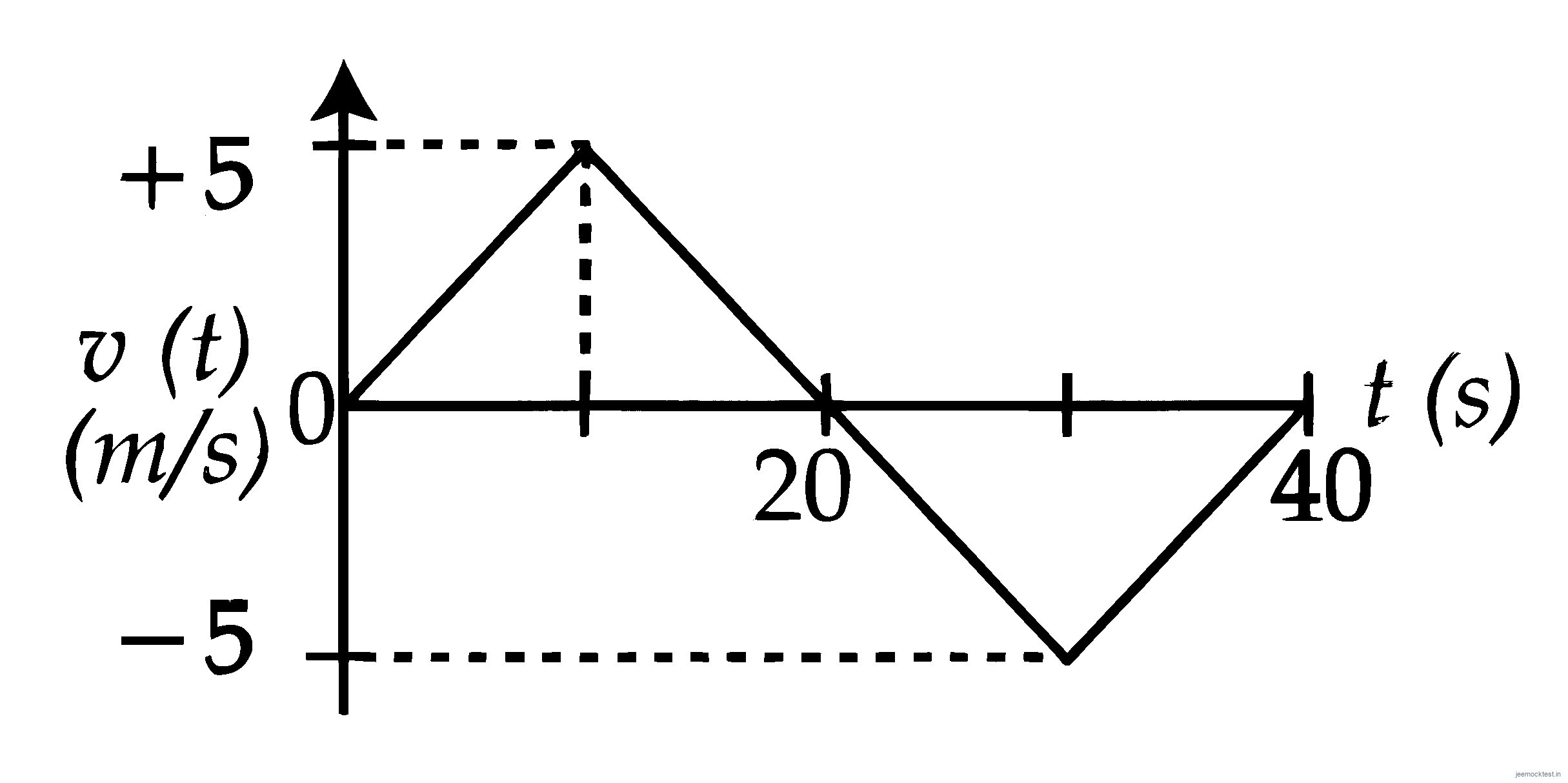
Two cars and are moving in the same direction along a straight line with speeds and , respectively such that car is moving ahead of car . A person in car throws a stone with a speed so that it hits the car with a speed of . The value of is .
A particle starts moving from time and its coordinate is given as
A. The particle returns to its original position (origin) 0.866 units later
B. The particle is 1 unit away from origin at its turning point
C. Acceleration of the particle is non-negative
D. The particle is 0.5 units away from origin at its turning point
E. Particle never turns back as acceleration is non-negative
Choose the correct answer from the options given below :