JEE PYQ: Motion in a Straight Line - Question ID c775fc558079 (JEE Main 2023)
A car travels a distance of '' with speed and then same distance '' with speed in the same direction. The average speed of the car is :
Select Option
Step-by-step Explanation
In kinematics, the average speed of an object over a journey is defined as the total distance traveled divided by the total time taken. Mathematically, This definition holds regardless of the number of segments or changes in speed during the journey.
When a journey consists of multiple segments, each with its own speed and distance, the total time is the sum of the times taken for each segment. For a segment of distance traveled at speed , the time taken is .
Step-by-Step Derivation:Let’s break down the problem:
- The car travels a distance at speed . The time taken for this segment is:
- The car then travels the same distance at speed . The time taken for this segment is:
- The total distance traveled by the car is:
- The total time taken for the entire journey is:
- Now, apply the definition of average speed:
- Simplify the denominator:
- Substitute back into the average speed expression:
- The terms cancel out:
This matches Option B.
Common Traps & Exam Tip:
Trap 1: Arithmetic Mean Misconception
Many students mistakenly assume that the average speed is the arithmetic mean of the two speeds, i.e., (Option D). This is incorrect because the car spends different amounts of time traveling at each speed unless . The arithmetic mean only works when the time intervals are equal, not the distances.
Trap 2: Harmonic Mean Confusion
Some students recall that average speed for equal distances is the harmonic mean of the speeds, but they misapply the formula. The correct harmonic mean for two speeds is , not (Option A). The latter is half the correct value.
Trap 3: Distance-Time Mismatch
Students may incorrectly compute total time as (Option C), which is wrong because it assumes the car travels the entire distance at the average of and . This ignores the fact that the car’s speed changes after the first segment.
Exam Tip:
Always start by writing down the definition of average speed and compute total distance and total time separately. For equal distances, the average speed is the harmonic mean of the speeds. For equal times, it is the arithmetic mean. Never assume symmetry unless explicitly given!
Related Questions from Motion in a Straight Line
A gas balloon is going up with a constant velocity of . When this balloon reached a height of 75 m , a stone is dropped from it and balloon keeps moving up with the same velocity. The height of the balloon when the stone hits the ground is m. (Take )
The velocity versus time plot of a particle is shown in the figure, for a time interval of 40 s . The total distance travelled by the particle and the average velocity during this period are, respectively
.
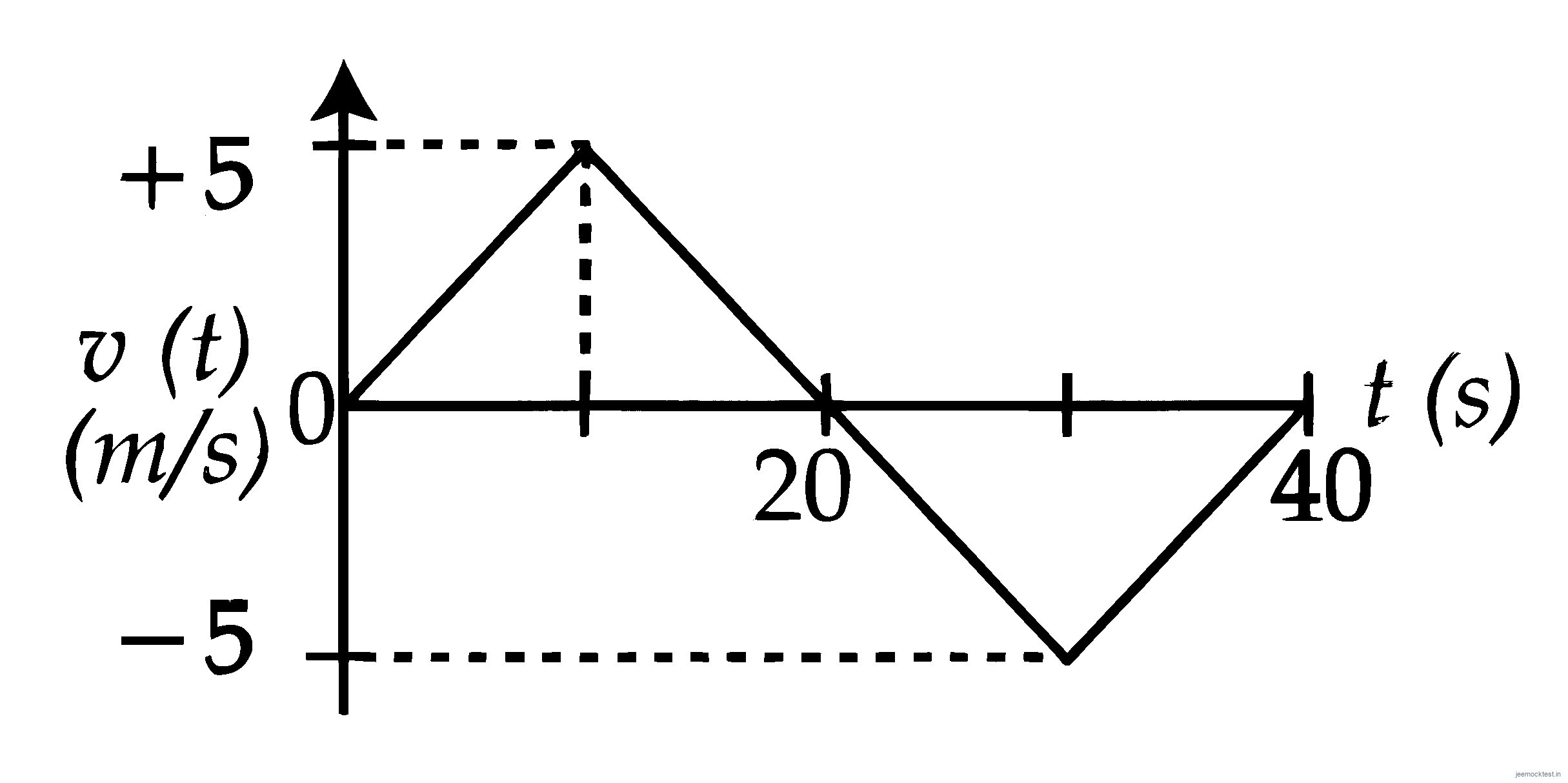
Two cars and are moving in the same direction along a straight line with speeds and , respectively such that car is moving ahead of car . A person in car throws a stone with a speed so that it hits the car with a speed of . The value of is .
A particle starts moving from time and its coordinate is given as
A. The particle returns to its original position (origin) 0.866 units later
B. The particle is 1 unit away from origin at its turning point
C. Acceleration of the particle is non-negative
D. The particle is 0.5 units away from origin at its turning point
E. Particle never turns back as acceleration is non-negative
Choose the correct answer from the options given below :