JEE PYQ: Motion in a Straight Line - Question ID c24bf0c30458 (JEE Main 2022)
From the top of a tower, a ball is thrown vertically upward which reaches the ground in 6 s. A second ball thrown vertically downward from the same position with the same speed reaches the ground in 1.5 s. A third ball released, from the rest from the same location, will reach the ground in ____________ s.
Your Answer
Step-by-step Explanation
When a ball is thrown vertically (upward or downward) or simply dropped from a height, its motion is governed by the kinematic equations of uniformly accelerated motion under gravity. The key formulas are:
where:- = displacement (positive downward or upward, depending on convention),
- = initial velocity,
- = acceleration due to gravity (taken as downward),
- = time taken.
In this problem, we have three scenarios from the same height :
- Ball thrown upward with speed , reaches ground in .
- Ball thrown downward with same speed , reaches ground in .
- Ball dropped from rest (), reaches ground in (to be found).
Step 1: Define Variables and Equations
Let be the height of the tower, the initial speed (same for upward and downward throws), and . For the upward throw: - Initial velocity is (since upward is negative in our downward-positive convention). - Displacement (downward). - Time . Using : For the downward throw: - Initial velocity is . - Displacement . - Time .Step 2: Equate Equations (1) and (2)
Since both equal : Bring all terms to one side: Substitute :Step 3: Find Height
Use equation (2):Step 4: Find Time for Ball Dropped from Rest ()
Use , with , : Common Traps & Exam Tip:
Trap 1: Sign Convention Confusion
Students often mix up the sign of when throwing upward. If downward is taken as positive, upward velocity must be negative. Incorrect sign leads to wrong and .
Trap 2: Assuming Value
Some students use for simplicity, which gives coincidentally here, but in other problems, it may lead to rounding errors. Always use unless specified.
Trap 3: Overcomplicating with Two Variables
Some try to solve for and separately without realizing that equating the two expressions for eliminates one variable immediately.
Exam Tip:
Always define a consistent sign convention (e.g., downward positive) and stick to it. Write down all given data clearly. Use the two scenarios to eliminate one unknown ( or ) and solve systematically.
Related Questions from Motion in a Straight Line
A gas balloon is going up with a constant velocity of . When this balloon reached a height of 75 m , a stone is dropped from it and balloon keeps moving up with the same velocity. The height of the balloon when the stone hits the ground is m. (Take )
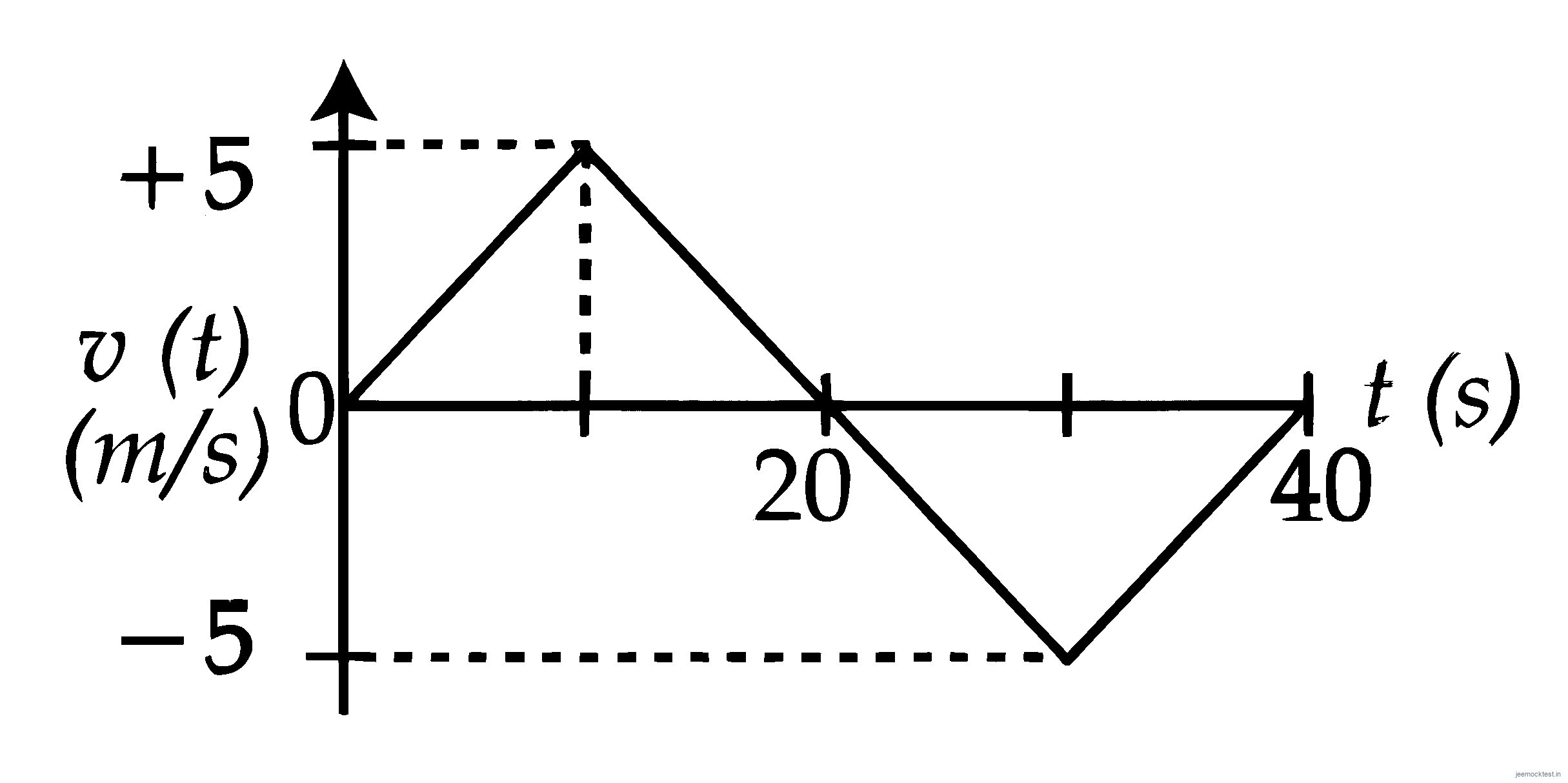
The velocity versus time plot of a particle is shown in the figure, for a time interval of 40 s . The total distance travelled by the particle and the average velocity during this period are, respectively
.
Two cars and are moving in the same direction along a straight line with speeds and , respectively such that car is moving ahead of car . A person in car throws a stone with a speed so that it hits the car with a speed of . The value of is .
A particle starts moving from time and its coordinate is given as
A. The particle returns to its original position (origin) 0.866 units later
B. The particle is 1 unit away from origin at its turning point
C. Acceleration of the particle is non-negative
D. The particle is 0.5 units away from origin at its turning point
E. Particle never turns back as acceleration is non-negative
Choose the correct answer from the options given below :