JEE PYQ: Motion in a Straight Line - Question ID bc5449bc3fc2 (JEE Main 2022)
A ball is thrown vertically upwards with a velocity of from the top of a tower. The ball strikes the ground after . The height from the ground up to which the ball can rise will be . The value of is __________. (use )
Your Answer
Step-by-step Explanation
When a ball is thrown vertically upward or downward, its motion is governed by the equations of uniformly accelerated motion under gravity. The key formulas we use are:
- Displacement as a function of time: where is the initial velocity, is the acceleration (here, since we take upward as positive), and is the time.
- Velocity as a function of time:
- Maximum height reached above the point of projection: (This comes from setting at the highest point.)
In this problem, the ball is thrown upward from the top of a tower, and we are given the total time until it hits the ground. We must find the height of the tower and then determine the maximum height the ball reaches above the ground.
Step-by-Step Derivation:Step 1: Define variables and coordinate system
- Let the height of the tower be (unknown).
- Initial velocity upward: .
- Acceleration due to gravity: (downward).
- Total time until the ball hits the ground: .
Step 2: Write the displacement equation
The displacement of the ball from the top of the tower after time is: Since the ball ends up on the ground, which is meters below the starting point, we have: Substitute the known values:
Step 3: Calculate the right-hand side
First term:
Second term:
Sum:
Thus:
Step 4: Find the maximum height above the ground
The ball rises to a maximum height above the point of projection (top of the tower) given by: Therefore, the maximum height above the ground is:
Step 5: Express in the required form and find
The problem states that the maximum height above the ground is . So:
Common Traps & Exam Tip:Students often make the following mistakes:
- Sign confusion: Forgetting to take downward as negative when setting up the displacement equation. Always define a clear coordinate system (upward positive or downward positive) and stick to it.
- Misinterpreting the displacement: The displacement at time is the position relative to the starting point. Since the ball ends up on the ground, which is below the starting point, must be negative if upward is positive.
- Incorrectly calculating the maximum height: Some students add the initial velocity time instead of using to find the maximum height. Always use the correct kinematic formula for the situation.
- Unit errors: Ensure all units are consistent (meters, seconds, and ).
Exam Tip: Always draw a diagram showing the initial and final positions, label the known quantities, and write down the kinematic equations before plugging in numbers. This helps avoid sign errors and conceptual misunderstandings.
Related Questions from Motion in a Straight Line
A gas balloon is going up with a constant velocity of . When this balloon reached a height of 75 m , a stone is dropped from it and balloon keeps moving up with the same velocity. The height of the balloon when the stone hits the ground is m. (Take )
The velocity versus time plot of a particle is shown in the figure, for a time interval of 40 s . The total distance travelled by the particle and the average velocity during this period are, respectively
.
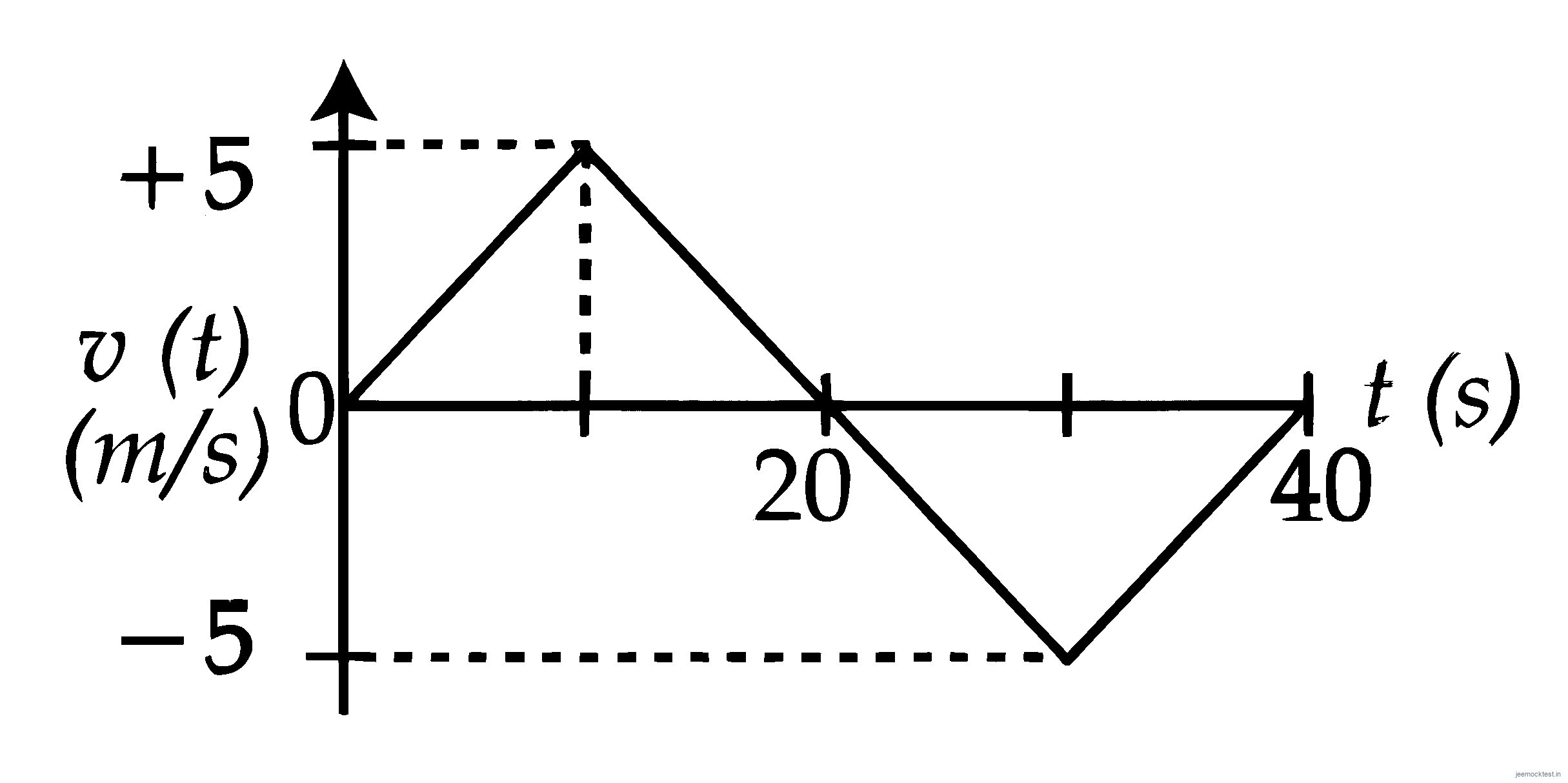
Two cars and are moving in the same direction along a straight line with speeds and , respectively such that car is moving ahead of car . A person in car throws a stone with a speed so that it hits the car with a speed of . The value of is .
A particle starts moving from time and its coordinate is given as
A. The particle returns to its original position (origin) 0.866 units later
B. The particle is 1 unit away from origin at its turning point
C. Acceleration of the particle is non-negative
D. The particle is 0.5 units away from origin at its turning point
E. Particle never turns back as acceleration is non-negative
Choose the correct answer from the options given below :