JEE PYQ: Motion in a Straight Line - Question ID b71f42f7164b (JEE Main 2022)
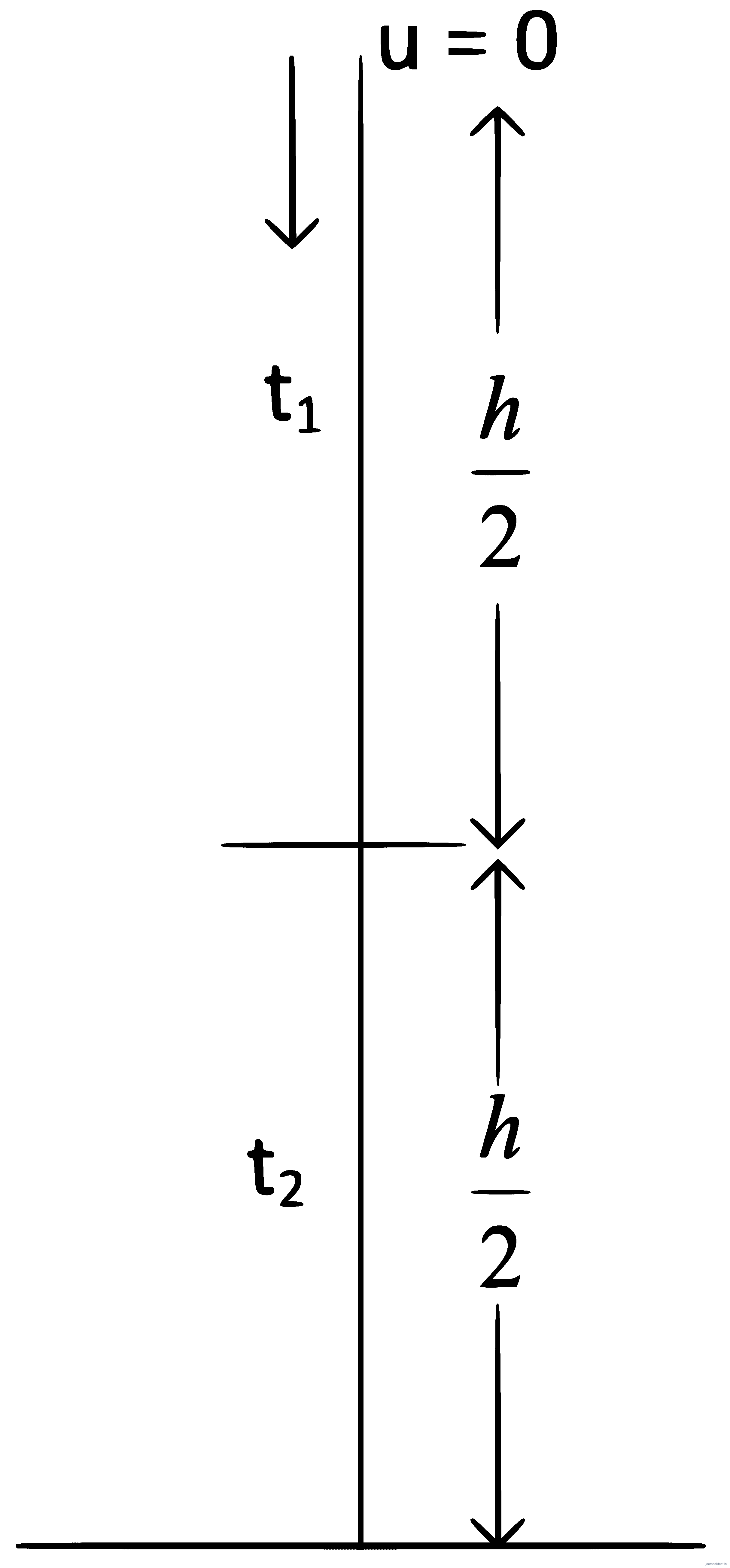
A ball is released from a height h. If and be the time required to complete first half and second half of the distance respectively. Then, choose the correct relation between and .
Select Option
Step-by-step Explanation
When a ball is released from rest under gravity, it undergoes uniformly accelerated motion with acceleration (downward). The key formulas for displacement , initial velocity , time , and acceleration are:
- Displacement as a function of time: Since the ball is released from rest, , so
- Velocity as a function of time:
The problem divides the total fall into two equal distances: the first half () and the second half (). We must find the times and taken to cover these respective halves.
Step-by-Step Derivation:Step 1: Express total fall time
Let be the total time to fall distance . Using :
Step 2: Express time for first half ()
For the first half, distance . Using the same formula:
Step 3: Express time for second half
The second half starts after time and ends at time . Hence: Factor out : But from Step 2, , so: Rearranging gives the relation:
Step 4: Match with given options
The derived relation matches option D exactly.
Common Traps & Exam Tip:Students often mistakenly assume constant velocity or confuse the order of and . Remember:
- The ball accelerates, so the second half (lower portion) is covered faster than the first half.
- Always use the displacement formula for free fall from rest.
- Double-check the algebraic manipulation when factoring square roots to avoid sign errors.
By carefully applying the kinematic equations and verifying each step, you can confidently select option D as the correct answer.
Related Questions from Motion in a Straight Line
A gas balloon is going up with a constant velocity of . When this balloon reached a height of 75 m , a stone is dropped from it and balloon keeps moving up with the same velocity. The height of the balloon when the stone hits the ground is m. (Take )
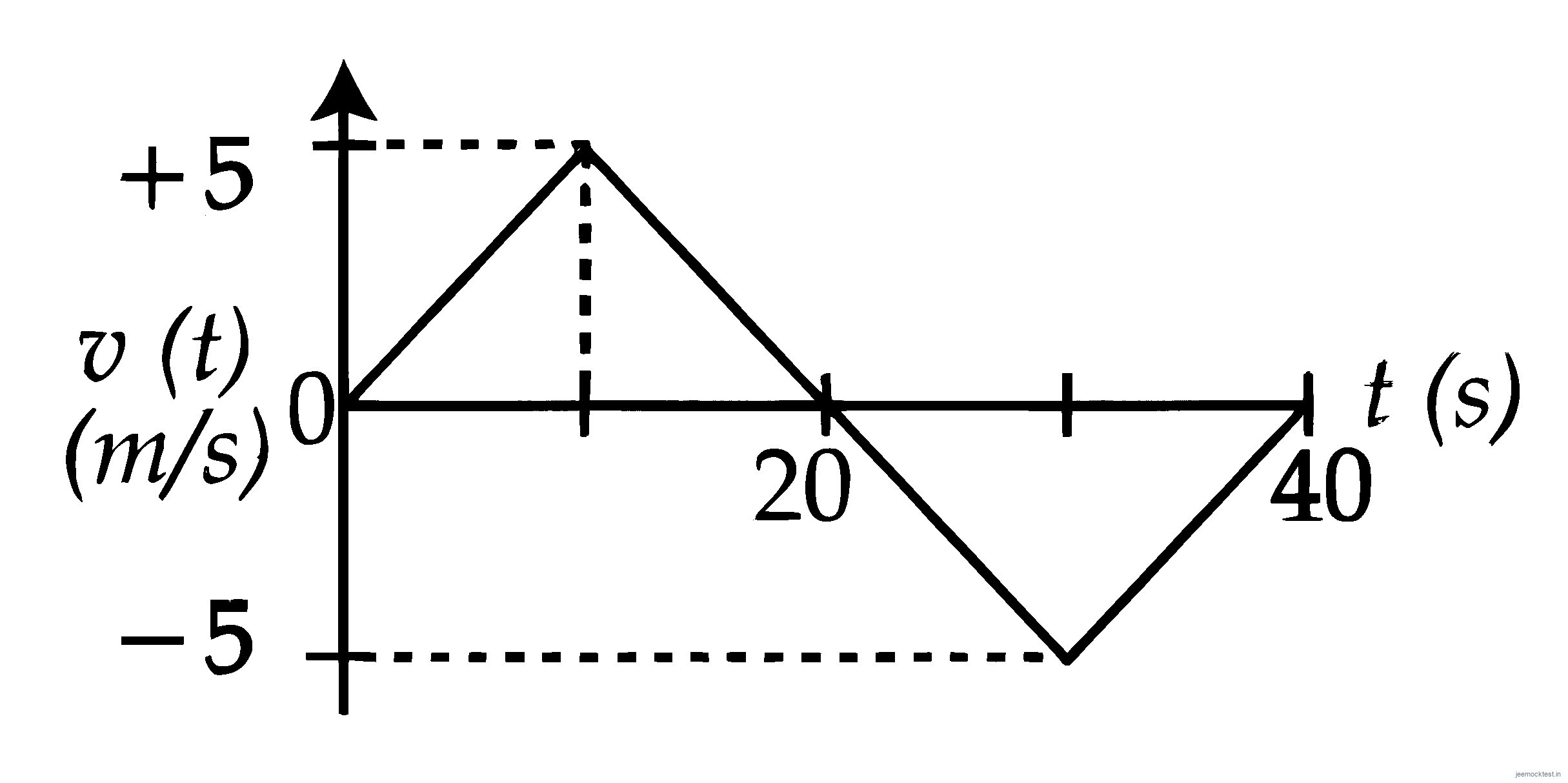
The velocity versus time plot of a particle is shown in the figure, for a time interval of 40 s . The total distance travelled by the particle and the average velocity during this period are, respectively
.
Two cars and are moving in the same direction along a straight line with speeds and , respectively such that car is moving ahead of car . A person in car throws a stone with a speed so that it hits the car with a speed of . The value of is .
A particle starts moving from time and its coordinate is given as
A. The particle returns to its original position (origin) 0.866 units later
B. The particle is 1 unit away from origin at its turning point
C. Acceleration of the particle is non-negative
D. The particle is 0.5 units away from origin at its turning point
E. Particle never turns back as acceleration is non-negative
Choose the correct answer from the options given below :