JEE PYQ: Motion in a Straight Line - Question ID ab77f17a1ea6 (JEE Main 2009)
Then the velocity as a function of time and the height as a function of time will be :
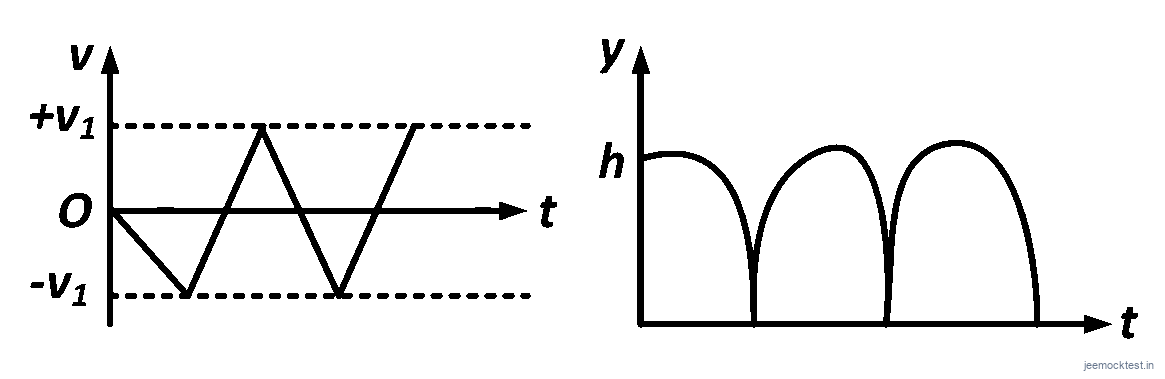
Select Option
Step-by-step Explanation
This problem involves motion under constant acceleration (gravity) and elastic collisions. The key concepts and formulas are:
- Free-fall motion: For an object dropped from rest at height , the velocity and height as functions of time are: The time to fall from height to the ground is: The velocity just before impact is:
- Elastic collision with a stationary plate: In a perfectly elastic collision with a stationary horizontal surface, the velocity reverses direction but retains its magnitude. So, if the ball hits the plate with velocity downward, it rebounds with velocity upward.
- Periodic motion: After rebounding, the ball moves upward, decelerates under gravity, momentarily stops, then falls again. This creates a periodic motion with symmetric velocity and height profiles over time.
Given and , we can compute the time of fall: So the ball hits the plate at , rebounds, and repeats the motion every (up and down).
Step-by-Step Derivation:Step 1: Define coordinate system and initial conditions
- Let be the position of the plate (ground level).
- Positive -direction is upward.
- Ball is released from at , with initial velocity .
Step 2: Motion before first impact ()
- Acceleration:
- Velocity:
- Height:
- At : ,
Step 3: Elastic collision at
- Velocity reverses: (upward)
- Duration of collision is negligible, so position remains .
Step 4: Motion after first rebound ()
- Ball moves upward with initial velocity , decelerates at .
- Velocity:
- Height:
- At : , (ball reaches max height again)
- At : , (ball hits plate again)
Step 5: Generalize for all
The motion is periodic with period . We can express and using the sawtooth and parabolic patterns:
-
Velocity :
- Decreases linearly from 0 to in
- Jumps to at
- Decreases linearly to 0 at
- Repeats every
This creates a sawtooth wave with slope , jumping from to at each impact. -
Height :
- Parabolic descent from to 0 in
- Parabolic ascent from 0 to in
- Repeats every
This creates a symmetric parabolic arch every , peaking at , hitting zero at .
Step 6: Match with given options
- Option A: Shows velocity as a smooth sine-like wave — incorrect. - Option B: Shows velocity as a sawtooth wave with correct slope and jumps; height as symmetric parabolic arches — correct. - Option C: Velocity has incorrect slope and jumps; height is asymmetric — incorrect. - Option D: Velocity is piecewise constant — incorrect.
Common Traps & Exam Tip:Students often make these mistakes:
- Ignoring velocity reversal in elastic collision: Some assume the ball stops or loses speed, leading to incorrect velocity profiles.
- Miscounting time intervals: The time to fall is , not or . Always compute .
- Confusing velocity and height graphs: Velocity is linear (sawtooth), height is parabolic (smooth arches). Mixing them up leads to wrong option selection.
- Forgetting periodicity: The motion repeats every . The graphs should reflect this symmetry.
Exam Tip: Always sketch the motion: downward parabola, elastic rebound, upward parabola. Then match the shape of and to the options. The sawtooth velocity and symmetric parabolic height are hallmarks of elastic bouncing under gravity.
Related Questions from Motion in a Straight Line
A gas balloon is going up with a constant velocity of . When this balloon reached a height of 75 m , a stone is dropped from it and balloon keeps moving up with the same velocity. The height of the balloon when the stone hits the ground is m. (Take )
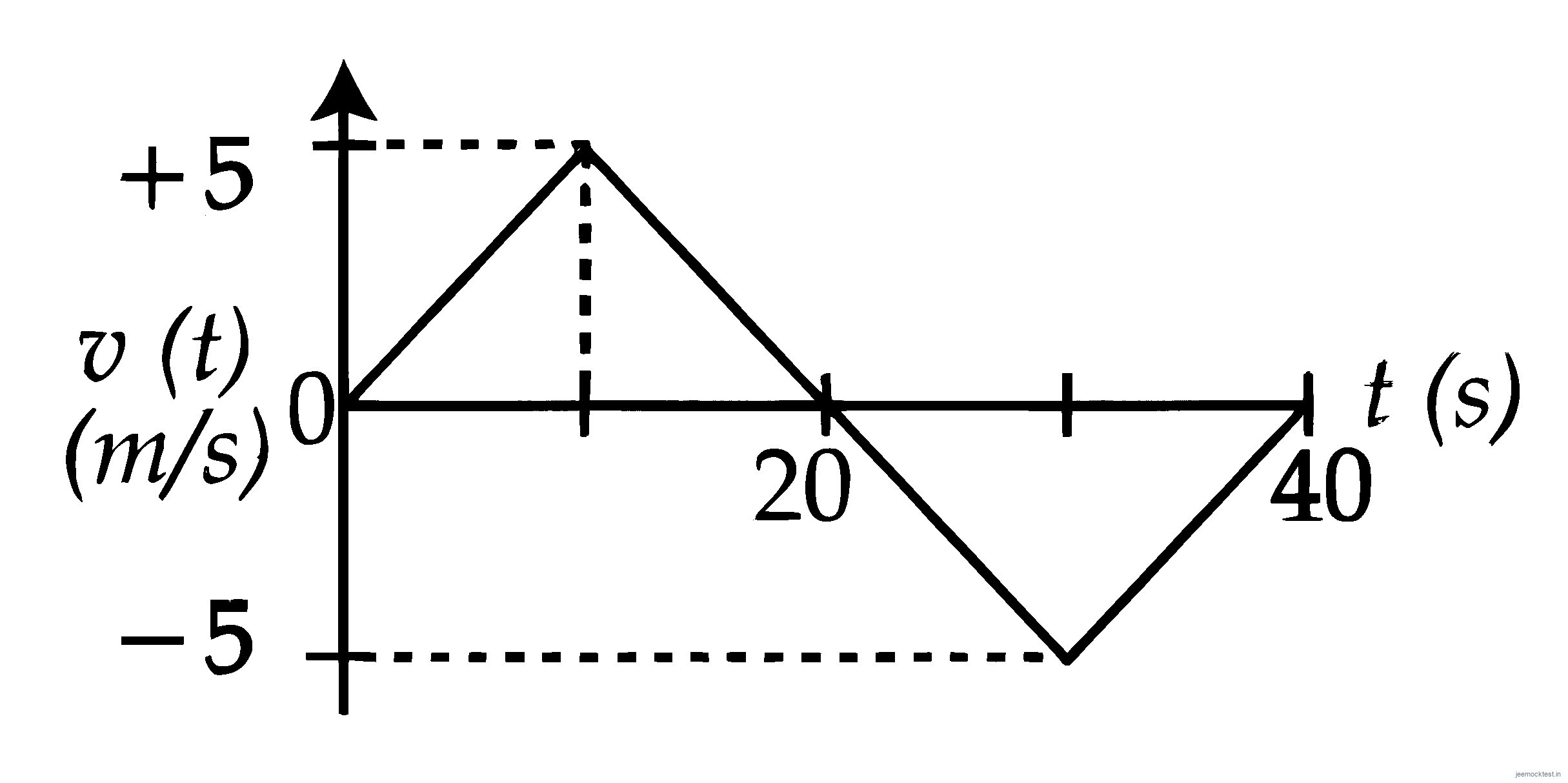
The velocity versus time plot of a particle is shown in the figure, for a time interval of 40 s . The total distance travelled by the particle and the average velocity during this period are, respectively
.
Two cars and are moving in the same direction along a straight line with speeds and , respectively such that car is moving ahead of car . A person in car throws a stone with a speed so that it hits the car with a speed of . The value of is .
A particle starts moving from time and its coordinate is given as
A. The particle returns to its original position (origin) 0.866 units later
B. The particle is 1 unit away from origin at its turning point
C. Acceleration of the particle is non-negative
D. The particle is 0.5 units away from origin at its turning point
E. Particle never turns back as acceleration is non-negative
Choose the correct answer from the options given below :