JEE PYQ: Motion in a Straight Line - Question ID aa08c2dca467 (JEE Main 2022)
A ball is thrown up vertically with a certain velocity so that, it reaches a maximum height h. Find the ratio of the times in which it is at height while going up and coming down respectively.
Select Option
Step-by-step Explanation
To solve this problem, we rely on the kinematic equations of motion under constant acceleration (gravity, , acting downward). The key concepts and formulas are:
- Equation of motion for displacement: Here, is displacement, is initial velocity, is acceleration, and is time.
- Velocity at maximum height: At the highest point, the velocity becomes zero. Using , with , , and , we get: This gives the initial velocity in terms of maximum height .
- Time to reach height : We want the time taken to reach height during ascent and descent. Using the displacement equation: This is a quadratic in , yielding two roots — one for the upward journey (smaller ) and one for the downward journey (larger ).
Our goal is to find the ratio: where is the time to reach on the way up, and is the time to reach the same height on the way down.
--- Step-by-Step Derivation:Let’s denote:
- : initial upward velocity
- : maximum height reached
- : acceleration due to gravity (acting downward)
Step 1: Express in terms of
At maximum height, velocity . Using :
Step 2: Write the displacement equation for height
We use:
Substitute and :
Divide both sides by :
Let’s define a dimensionless time variable . Then:
and
So the equation becomes:
Rearranged:
Step 3: Solve the quadratic equation for
Multiply through by 3 to eliminate fraction:
Use quadratic formula:
Simplify , so:
Step 4: Identify and
The two roots correspond to the two times when the ball is at :
- (smaller time, on the way up)
- (larger time, on the way down)
Step 5: Compute the ratio
Recall , so:
Now rationalize the denominator:
Multiply numerator and denominator by :
Wait — this seems messy. Let’s re-express the ratio in a cleaner form.
Instead, let’s write: But , so: This matches option B.
Conclusion: The ratio of the times is:
--- Common Traps & Exam Tip:
Trap 1: Misidentifying the roots.
Students often confuse which root corresponds to upward and downward motion. The smaller root is always the time during ascent, and the larger one during descent.
Trap 2: Forgetting to rationalize or simplify.
The answer appears in a form that must be simplified or rationalized to match the given options. Directly comparing with options is difficult — it must be rewritten in terms of and .
Trap 3: Using wrong sign for acceleration.
It’s crucial to take as negative when upward is positive. A sign error here leads to incorrect quadratic solutions.
Exam Tip:
Always express time in terms of a dimensionless variable (like ) to simplify algebra. Also, verify units and consistency — the ratio must be dimensionless and less than 1, which all options satisfy.
Final Answer: Option B is correct.
Related Questions from Motion in a Straight Line
A gas balloon is going up with a constant velocity of . When this balloon reached a height of 75 m , a stone is dropped from it and balloon keeps moving up with the same velocity. The height of the balloon when the stone hits the ground is m. (Take )
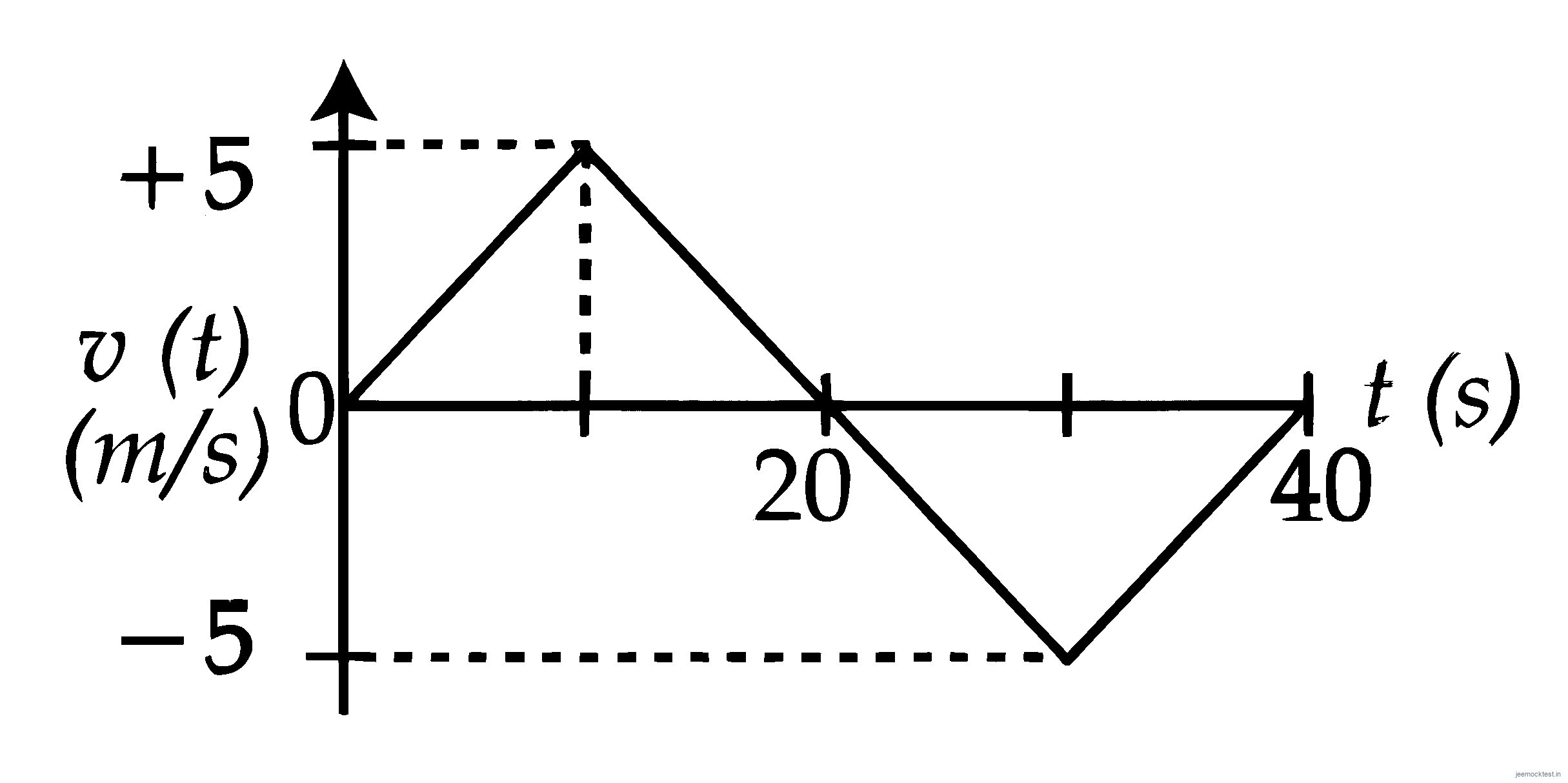
The velocity versus time plot of a particle is shown in the figure, for a time interval of 40 s . The total distance travelled by the particle and the average velocity during this period are, respectively
.
Two cars and are moving in the same direction along a straight line with speeds and , respectively such that car is moving ahead of car . A person in car throws a stone with a speed so that it hits the car with a speed of . The value of is .
A particle starts moving from time and its coordinate is given as
A. The particle returns to its original position (origin) 0.866 units later
B. The particle is 1 unit away from origin at its turning point
C. Acceleration of the particle is non-negative
D. The particle is 0.5 units away from origin at its turning point
E. Particle never turns back as acceleration is non-negative
Choose the correct answer from the options given below :